Free and legal MP3 from Stina Stjern (wonderful, scuffed-up Scandinavian rock’n’roll)

Straightforward rock’n’roll with a scuffed-up edge, assured vocals, and a subtly powerful melody.

“The Horizon” – Stina Stjern

Straightforward rock’n’roll with a scuffed-up edge, assured vocals, and a subtly powerful melody. The guitar work here is especially wonderful, all rough and crunchy and bendy, with a dissonant flair and offhanded discipline. There’s a rumbly guitar at the bottom of the mix that gives the song a beat-up gravitas, and there’s a rhythm guitar pretty much playing lead (I tend to like that, now that I think about it), and there’s probably a regular rhythm guitar in there too but by and large everything coheres so agreeably that my mind resists further efforts to pick it apart. I’m just enjoying the vibe, a lot. Stjern herself says she’s “a sucker for good melodies and edgy white trash rock music (whatever that is),” so there’s as good a description as any. And be sure to pay attention to that great coda (3:06): a full minute of churning, squeaking guitars, held together briefly by a circular lead guitar line before disintegrating into a squonky puddle.

Born in Norway and now based in Copenhagen, Stina Stjern has one of those natural voices that gives the illusion that she’s speaking more than singing; there’s something in her full-bodied tone that brings to mind another wonderful Scandinavian singer/songwriter, Ebba Forsberg, but yikes that’s an analogy that’s going to mean nothing to almost everyone. Well, look her up someday. And then here’s something that reminds me of nobody at all: Stjern has hand-knit (as in yarn and needles) covers for the 7-inch vinyl version of the single; she’s made a video of many of the covers, accompanied by the song. MP3 via Stjern’s web site.

Free and legal MP3: The Antlers

Twinkly and hypnotic, with gathering force

“Two” – the Antlers

For a tune that pretty much loops over and over, “Two” has an uncanny–and almost unbearable–amount of grit, substance, and heartache. The song is part of a tightly-themed album called Hospice, which is clearly based on a tragedy in front man Peter Silberman’s life, a tragedy which is only amplified by his free-flowing but unpitying lyrics, his dry, falsetto-like tenor, and the music’s tinkly, buzzing, hypnotic momentum. For all its gathering, contraption-like force, “Two” retains a hand-hewn quality that adds to the pathos; and just listen to those pensive piano chords that appear intermittently (first at 1:53), commanding attention despite–or maybe because of–their quiet matter-of-factness. They’re kind of heartbreaking in their own way.

And I’m not normally a lyrics-focused kind of guy but this song demands a reading, so check it out when you have a chance. “Two,” by the way, is subtitled “Or, I Would Have Saved Her If I Could.”

The Antlers’ first release, in 2007, was a solo project for the Brooklyn-based Silberman; the band has since evolved into a trio, with more players joining in for the album. “Two” has been circulating around the blogosphere since last fall; Hospice is set for self-release next month. MP3 via the band’s site.

February’s Q&A now online, featuring Dave Derby from Gramercy Arms

The Fingertips Q&A was launched in August with the express intent of allowing actual, working musicians the chance to talk about the state of the music industry in the digital age. This is not intended as a comprehensive discussion; each time I ask five (relatively) simple questions, all having something to do with making sense of what popular music in the 21st century is about. Easy!

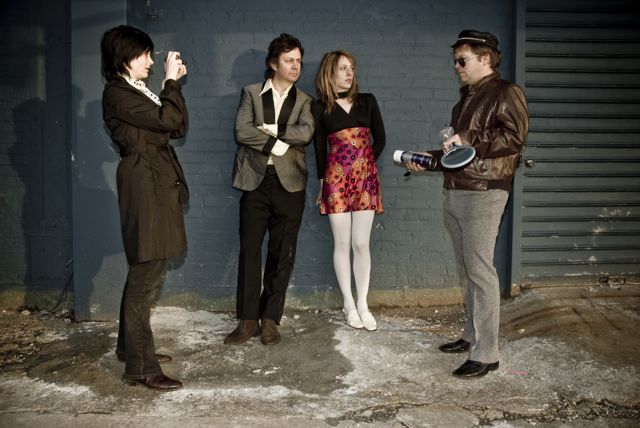
This month we welcome aboard Dave Derby, of the band Gramercy Arms, whose song “Automatic” was featured on “This Week’s Finds” in December. The band released its self-titled debut album in November, which featured a number of indie rock semi-celebrities, including Matthew Caws from Nada Surf Joan Wasser of Joan As Police Woman. You may know Derby better as the front man of the Dambuilders, a Boston-based band that gained a footing on alternative rock radio in the ’90s. (In the photo, Derby is second from the left.)

Free and legal MP3: Marissa Nadler (beautiful, mysterious, atmospheric toe-tapper)

“River of Dirt” – Marissa Nadler

A master of atmosphere, Marissa Nadler can maintain her delicate, otherworldly vibe even when she adds percussion and electric guitar to her spidery sound, and even when the music chugs along at a toe-tapping pace. A lot of the aura has to do with that spooky voice of hers, encased in reverb, and the words that voice is singing–weird words, full of romance, escape, and sorrow (the titular metaphor appears to be referring to death itself). The echoey, keening lap steel that hovers in the background heightens the familiar strangeness of it all.

Nadler may be adding band-like instrumentation to her sound, but it’s hardly a standard sort of rock band she’s got going here. Listen, first, to the drumming, which moves forward with an idiosyncratic blending of rims and toms, and a most judicious use of cymbals–what you hear in the intro from about :06 onward is what propels the entire song; it’s a subtly peculiar sound, seeming at once mechanical and homespun. Then check out the aforementioned lap steel guitar, which howls and sings with uncanny luminosity, mixing in and around an electric guitar and also Nadler’s own backing vocal tracks, often stressing notes that set it apart from the melody and harmony and yet join everything mysteriously together. Beautiful, compelling music we have here.

Fingertips regulars may recall Nadler from the oddly gorgeous 2007 song “Diamond Heart,” which ended that year among the top 10 favorite free and legal MP3s here that year. “River of Dirt” is from her forthcoming (and fourth) CD, Little Hells, which is slated for release next month on Kemado Records. MP3 originally via Kemado, but no longer available there. You can still grab a free and legal download of it via Stereogum, but it’s no longer a direct link, so you can’t sample it in the player here.

Free and legal MP3: Blue Horns (thorny guitars, yelpy vocals)

“Shotgun Wedding” – Blue Horns

With its thorny guitars and yelpy vocals, “Shotgun Wedding” brings the early work of the late great New Zealand band Split Enz rather immediately to mind, but that’s only because I’m old and remember them. It’s probably an accident. (They didn’t really do the thorny guitar thing, anyway. Thorny keyboards, thorny strings, maybe. Yelpy vocals, definitely.) Perhaps less of an accident is the way the band’s clearly voiced dual guitar sound recalls another ’70s band, Television, although this is jumpier and poppier than what Tom Verlaine and Richard Lloyd were doing. These guys are like Television’s kid brother, just wanting to have a bit of actual fun. (Television was cool and great but not much fun.)

“Shotgun Wedding”‘s charm, to me, has to do with its commanding spirit of loose tightness (or is it tight looseness?)–an aural sense and sensibility that characterizes a lot of great rock’n’roll through the years. You want it to sound spontaneous and alive, but you also want everything just so. There’s nothing muddy or muddled here; the two guitars play cleverly together, and you can always hear what each one is doing if you stop to listen. The song rollicks to a spiky, shuffly beat, singer Brian Park (he also plays one of the guitars) unleashes his warbly falsetto with exquisite precision (check out the note he hits at 0:52, which pretty much sold me on the song), the guitars take a break from their prickly, tick-tock dueting to give us a little “Heat Wave”-y swing (1:19), and the whole thing wraps in 2:40.

Blue Horns is a quartet from Portland, Oregon. “Shotgun Wedding” is the lead track on the band’s self-titled debut album, which was self-released at the end of last year.

Free and legal MP3: Neko Case (spellbinding voice, upbeat but subtle song)

“People Got a Lotta Nerve” – Neko Case

The mighty Neko Case is back with a soon-to-be-released album and an initial song that took a while to sneak up on me, as it were. To be sure, her voice is as spellbinding as ever, with that rich lower register, that clarion upper register. And this one does have an immediate, breezy-jangly appeal. I just wasn’t sure about the song itself. I kept hearing the chorus, with its simple-sounding, repetitive core, and was too distracted to listen to what was actually going on.

The words were the first to penetrate. Over what may sound like a throwaway melodic line, she sings “I’m a man-man-man, man-man-maneater/But still you’re suprised-prised-prised when I eat you.” It turns out this is a bouncy, casual, humorous-seeming way of nailing a painful and complicated interpersonal tendency among us humans that would take me a full paragraph to explicate (I don’t have the room; I’ll leave it to you to ponder.) And then, the music: the way the second series of repetitions, on “surprised,” lag at half-rate, and behind the beat, helps deliver the complex, wistful payoff far better than the words alone would. Eventually, too, I noticed she has two different melodies for the two verses, which feels curious and elusive. You keep needing to go back and listen again. Don’t miss, also, that rueful seven-note run on the guitar before the second verse starts (beginning at 0:56), a C-sharp scale that comes up one note short, leaving us on the most unresolved C note possible (in this difficult scale it’s considered a B-sharp, to be precise). She uses this same pattern for the song’s cryptic coda, as she sings: “It will end again in bullets fired,” which strikes me as an allusion to Chekhov’s famous theatrical principle.

So there’s a little more here than meets the eye. And, “People Got a Lotta Nerve” comes with a nifty promotional gimmick to boot. For every blog that posts this song, Case and her record label, Anti, will donate $5 to the Best Friends Animal Society. Today is in fact the last day the promotion is in effect, so I’m in under the wire. Phew. The new CD, Middle Cyclone, is due out in early March. (There’s a nice video on the making of the album, worth watching, here.) MP3 via Spinner.

A Free and Legal MP3 Manifesto (part two)

Yesterday I posted the first half of this essay, which is the latest Fingertips Commentary on the main site (where it comes complete with a few footnotes). We pick up here where we left off, literally: I’m repeating the last paragraph, for context.

* * *

So: let every album have one free and legal MP3. Other songs must be purchased; the album, if desired, must be purchased as well. If this were the industry standard, if every album had one free and legal MP3, the industry would be in better shape, and the path for future growth clearer.

Here are five reasons why:

1) Free and legal MP3s do not equal lost revenue.

Let’s begin by shredding once and for all the fantasy that every free and legal MP3 downloaded equals money the record companies aren’t receiving. That’s a patently false, self-serving assumption.

To begin with, when you offer a free and legal MP3, you invite many many experimenters, people who grab it because it’s free but would never have bought it if it weren’t free–who often would have no idea it even existed if it weren’t free. There’s no lost revenue in that at all. This would be like saying it was lost revenue every time someone heard a song on the radio but didn’t go out and buy it.

Okay, and then what? Well, they listen and decide if they like it. If they don’t, then these people would not have bought the song anyway. Again: this is not lost revenue.

If the downloader likes the song, then we get to the all-important fork in the road: he or she can then buy another song from the album (or maybe even the whole thing), or still not buy anything further. In the first case, you’ve created revenue, so, okay, phew. But then there’s that troubling second case to deal with, and this is probably one that has the labels fretting: “You mean they downloaded the song for free, they liked it, and they still aren’t giving us any money?”

Well, yeah, maybe. But it is shortsighted to see this as simply lost revenue. What you generate here instead are two important things: customer goodwill (hey! they keep giving me a free song! and they’re sometimes really good!) and technologically effective promotion. Look: this “free song” will pop up in the listener’s iPod, will make it onto playlists, will generate awareness of the artist in question. Over time, there’s still significant sales potential, especially in this day of fostering community between artists and listeners. Record companies must begin to understand the promotional value of this exposure, which leads us to point number two:

2) Free and legal MP3s are the single most valuable way to promote artists to music fans in a post-radio age.

Let’s return to the plight of our magnanimous Nonesuch friend (see yesterday’s post). So, yay, he protected every single song on a worthwhile but off-the-beaten-path album. I have to wonder: are copies of the Sam Phillips album therefore flying off the shelf? Do people think, “Well, crap, since I can’t have any free songs I better buy the whole album?” Not in 2009 they don’t think this.

The easiest and most effective way to promote an album, especially an album that is not in any case destined for million-seller (or even 100,000-seller) status, is by making a free and legal MP3 readily available. Give people a song to have, to listen to in the context of their preferred music-listening environment. Let it spread around the internet, friend to friend, blog to blog.

I find it ironic that record labels that are squeamish about letting loose free and legal MP3s had no problem for decades handing out free physical copies of their records to radio stations. Oh, well, one might say, that’s an entirely different thing. There were huge audiences at stake. Giving a free record to a big-city radio station could result in millions of dollars of sales.

True enough, at the very top end of the music market, commercially speaking. But these same record labels also had no trouble shipping copies of many albums destined for obscurity (where’s the return on that?), and no trouble shipping albums to some pretty tiny radio stations, including all those college stations with audiences that number in the dozens at any given time.

Truth be told, radio has pretty much disintegrated for the majority of recording artists. Hardly anyone gets on the radio. (Sam Phillips certainly doesn’t get on the radio, outside of a coterie of “adult alternative” stations.) And it doesn’t matter because nowadays, people’s computers and people’s iPods are, effectively, their radios. That’s where they listen to music, both old and new. And the only way record companies can get on these “stations” is–how?

You got it: by giving people a free and legal MP3 to download and play–to, essentially, “program” on their own personal station. Because, yes, in order to listen on computers or MP3 players most easily and comfortably you have to give people the song, not expect them to sit there trapped in their browser listening to a stream, or trapped on a particular web site where music is free if you watch the ads, and not sitting in front of a screen watching a video. (Am I the only one left who realizes that a video is not a song? Just curious.)

And guess what? Delivering a free and legal MP3 to all of them costs a lot less than printing CDs and shipping them out for free to hundreds of radio stations around the country. Never mind lost revenue, what about all the expense involved with that entrenched promotional technique for all those years? To the extent that it “paid off” when a handful of records hit the big-time, fine–that was then. For the music industry to move forward in the 21st century, it has to relinquish that pray-for-a-blockbuster mentality, and the marketing techniques that went along with it.

Give people one song, make it easy to download and use anywhere they want. That’s how you get your records played on these individual “radio stations.” They usually have just one listener each, but there are millions of them across the country.

3) One free and legal MP3 per album makes for easier and less confrontational policing.

For starters, if there is automatically going to be one free and legal MP3 from every album, right away you’ll have fewer bloggers posting illegally distributed tracks. I’m guessing many will be happy to stick with the legal one, particularly if approached reasonably; right now, for far too many albums, and for pretty much every major-label album, they don’t even have this choice.

Second, when labels set about policing things online, they can use an approach which is kinder and gentler and thus much more likely to move future music-sharing behavior in a more legally-oriented direction. “The track you have been sharing is not legally available for free online distribution,” the email can state. “However, were you aware that the song ‘Free and Legal,’ from the same album, is in fact available for free online distribution? Here’s the link.”

Or whatever. The point is, with one sanctioned free and legal song from every album, the record industry will finally be closer to being on the same page as 21st-century music fans. Record labels will effectively be entering their world rather than creating phony and pointless and old-fashioned barricades.

This strikes me as a more important issue than anyone seems to bother to realize. Thanks in large part to its well-known campaign to sue people who were illegally downloading their songs, the major record companies spent the better part of the current decade in open conflict with their own customers and potential customers. As a believer from the outset in free and legal MP3s, I obviously have no sympathy for those who have chosen to download a lot of music illegally, but I also have no patience for record companies who choose only to see that behavior as reprehensible rather than try to understand the context and work to find a middle ground.

After all, the record companies, from the outset, could have combatted illegal downloading with this idea: “Hey! Do legal free downloading instead!” But they chose instead to see this as a war and to see their customers and potential customers as enemies. Not real smart in the long run.

I would also, by the way, have no sympathy with bloggers who, in a world in which there is a free and legal MP3 available from each album, would continue to post songs that are not freely and legally distributed. Bloggers are perfectly entitled to tell the world what songs they like; they are not entitled to decide on their own what songs to make available for public consumption. This is a freedom that many presumed to take from the outset, but this freedom continues to have no basis in fairness or legality.

4) If you have to give away one good song this means you must, in theory, put out albums with more than one good song on them.

Needless to say, this would be another excellent outreach strategy for a bedraggled industry.

Although I can offer no direct evidence of this theory, I am pretty sure that there exists in the music industry an additional resistance to free and legal MP3s that has to do with the suspicion that if a music listener gets one good song for free, they won’t buy the rest of the album. (After all, why else would Mr. Nonesuch be so resistant to releasing one Sam Phillips song?) To the extent that this is true, I’d say that music listeners have been well-trained over the years by their experience with albums that have only one good song on them in the first place.

As long as giving away one good free and legal MP3 from an album is the equivalent of giving away the store, as it were–because it is in fact the only good song–then, yes, this is a legitimate concern. There is one pretty straightforward solution to this, however: make sure the albums you’re releasing are actually good. The days of fooling people into buying a whole album based on hearing one good song really have to be over if the Free and Legal MP3 Manifesto is to be effective. Surely we don’t need so many albums anyway, as fewer people appear to be interested in buying them in the first place.

Note that this does not mean there will be no more albums. Can we finally agree to put an end to this black-and-white, all-or-nothing, sound-bite-oriented world view? If albums are going through a less-popular phase this hardly warrants the idea that no one wants to record them or listen to them henceforth and forevermore.

5) The music industry herein has a newborn opportunity to affirm the value of what it is selling.

Okay, so stick with me here, because I know that lots of people still think that handing out free digital music undermines the idea that music has value. To begin with, songs have become mere files, and files are eminently and endlessly copyable and distributable; add to that free distribution and where’s the value? Where’s the possibility that people will pay for it?

And the record companies themselves have gotten so spun around and bamboozled by the fledgling century’s digital realities that here they are, after years of complaining that giving away free music compromises the idea that music has value, lining up to experiment with the idea of giving unlimited access to music on streaming sites via a minor or bundled fee–something, ideally, that the end user won’t even notice or realize he or she is paying.

Talk about devaluing music! Treating music as a utility, like electricity or water, inherently devalues the artistry and effort of any individual artist, the subjective worth of any given song. But the industry seriously considers this idea now because, well, it’s desperate, like an addict whose supply has pretty much run out. It’ll try anything to get its mojo back.

Returning to the spirit of the Inaugural Address, I’d like to suggest that the industry seek not the pipedream fix but seek instead the true opportunity in this long-standing crisis brought on by digital distribution. What that opportunity may be is nothing less than the full embrace of what it has to offer us.

I mean, think of it: here are companies selling one of humankind’s most profound creations: song! Often grouped into album! And for decades upon decades now, these same companies have largely sought to treat their products as just that–mere products. (Or, in true industry parlance, the singular: “product.”) But these aren’t screwdrivers and frozen pizzas that are being sold. This is music. The word itself has magic in it. When something is music to your ears, it’s wonderful, delightful, perfect. When you have to face the music, you’re dealing with something significant, serious, not to be ignored.

I know that many many musicians have been waiting, without hope or encouragement, for record companies to understand the inherently special nature of their offerings, waiting for the suits and the bean counters to take into account the personal, aesthetic, subjective, and artistic aspects of their so-called products, not just in terms of projecting sales but in terms of how they do business from the ground up.

And now: here’s their chance. Not by forcing value upon us (e.g. suing from an aggrieved position) but by proactively asserting that their products do indeed have value. Invaluable value.

And they can do this, paradoxically, by first offering us a gift. Never mind the promotional merit (which, as discussed, is real and significant)–how about simply seeing the mandatory free and legal MP3 each album must offer, according to the Free and Legal MP3 Manifesto, as just that?: a gift. The record companies and artists will give this gift to music fans, now, because the technology has long since arrived to make it possible, because it’s a valiant way to break into our fragmented, overconnected lives, because they so value what they produce that they want, first, to share it with us.

Because: when they hand out a yummy free sample of something earthy and organic at Whole Foods, do you think, “Well, gee, this must be worthless if they’re willing to give it away?” Or, “Hey, this must be pretty good or they wouldn’t be giving out tastes?”

The music industry has completely blown it so far, but here at the outset of what clearly is a brand new day I’m thinking maybe it’s not too late. And we, the music fans, can assume our responsibility in the matter as well. We can receive this gift with newfound appreciation. And with our appreciation we can likewise offer our hard-earned dollars when we hear something that moves us, that lifts our spirits, that assures us that it was created out of hope and inspiration and artistry.

And yeah I know not every piece of music is created in this manner. And I know this whole issue is complicated by convoluted circumstances and thorny issues. But I have a dream. And now I have a Manifesto. Change, as we have seen, may begin with just such things.

A Free and Legal MP3 Manifesto (part one)

A new Fingertips Commentary piece has been posted on the main site. It’s called “Got to Do What You Should,” is subtitled “A Free and Legal MP3 Manifesto,” and comes with the tagline: “Why the mainstream music industry must learn to stop worrying and love the free and legal MP3.”

I’ll post the essay here in two parts, one today, one tomorrow. The essay is the same here as on the main site, except there are a handful of footnotes accompanying the piece on the Fingertips site, which flesh out the subject at hand.

* * *

Careful followers of Fingertips may have noticed a blip in the normally smooth weekly presentation of free and legal MP3s in December, when a song I featured, Sam Phillips’ charming and deep “Sister Rosetta Goes Before Us,” was pulled down by the record label before the end of the first week of being spotlighted here.

The record company, Nonesuch, a part of Warner Brothers, delivered an email apology to affected bloggers via Toolshed, the music promotion company with which it was working. Toolshed, you should know, is a digital-savvy company widely known for promoting musicians via the use of, typically, one free and legal MP3. In an effort to sound both contrite and magnanimous, Nonesuch took the blame upon itself, exonerating bloggers of any legal wrongdoing. The problem, said the Nonesuch executive, was that he never realized Toolshed was going to put MP3s online versus streams.

Okay, so he didn’t know that a company that pretty much always uses free and legal MP3s to promote its clients was going to use a free and legal MP3 to promote Sam Phillips. Fair enough. But his supposedly generous gesture, absolving bloggers of criminal activity, was irritating for those of us (myself, and at least one other) who only seek to post free and legal MP3s in the first place. It’s our stated policy. We do not want to post MP3s that are not free and legal.

Meaning that if a free and not-legal MP3 somehow slips through the cracks, guess what? It’s a mistake. The only way it happens–as with the Phillips song–is when the MP3 is presented as free and legal. There was no way for anyone to know it wasn’t until, oops!, the very record company who released it decides it didn’t really mean to.

I am so happy to know that Nonesuch will see to it that the law will spare me punishment for something that was an unavoidable mistake.

Beyond merely irritating me, this incident illustrates yet again how baffled the major record companies remain when it comes to downloads. The Nonesuch executive could not bring himself to utter the name “MP3” in his explanatory letter; what he said was, “I did not realize these tracks were not streaming.” It’s like okay, if I don’t mention MP3s, they don’t exist. To the big boys, there is no difference between free and legal and free and not-legal. The big problem to them is “free.” Free does not compute.

This is a common attitude at the upper echelons of the music industry. We all know that they hate illegally posted MP3s, but the truth is they hate legally posted MP3s also, when they’re free. Which is why, by and large, the bigger record companies never post them. (Or, when they do–hello, Nonesuch!–it’s probably a mistake.)

I’m not surprised about this, of course. When all is said and done, the big labels continue to do what big labels have always done best: burrow their heads deep in the sand when faced with changes to the status quo. Having been dragged against their will into a world in which music exists digitally, without a physical product that needs to be manufactured, they continue to try to make this new world function like the old one.

But everything changes when music is available digitally. Major record company desire notwithstanding, there has not been and there never will be a slick and handy transition from everyone buying physical copies of songs and albums to everyone buying digital copies of songs and albums. The appearance of free digital music has gotten in the middle of all this and has rendered the industry’s simplistic ideal an impossibility. The public will never buy everything it used to buy. The question for the music industry is whether it wants to work with this reality or continue to fight it.

I contend that if the industry keeps fighting it, more and more potential revenue (and customers) will be lost. If, on the other hand, the industry finally starts to accept digital reality, which includes the reality of a certain amount of freely distributed music, the record companies might learn how to stop worrying and love the free and legal MP3.

For it is in fact the free and legal MP3 that might yet save the music industry.

So far, of course, the major record companies are nowhere near understanding this. They–along with a surprising number of smaller record companies–cling against all reason and evidence to the belief that “protecting” every single song on an album is somehow the road to increased sales, and they rally around any scheme that seeks to circumvent the reality of downloading altogether. Look no further than the current hyping of unlimited streaming services to see the lengths to which the music industry continues to want to fool itself.

And yet the actual answer to a workable future for record labels and musicians alike is staring everyone in the face. What needs to be done is not complicated. Lord knows I never thought I’d be quoting Ronald Reagan, but what we have here is pretty much a “Mr. Gorbachev, tear down this wall,” moment. Only in this case it’s more like “Mr. Gorbachev, put a gate in the wall.” Because I’m not saying everything has to be free. That’s silly and unrealistic. I’m just saying one song has to be free. One song from every album and EP.

So that’s it–that’s my Free and Legal MP3 Manifesto. It’s got one immutable principle: Every album or EP released by anyone, anywhere, should have one easy-to-access free and legal MP3 available. Moving forward, this should be the industry standard.

Note that it doesn’t have to be two or three or four free and legal MP3s. Just one free and legally distributed song per album, across the board. And note that I mean one easily accessible free and legal MP3, not a file you can access only after surrendering your email address, or a file so buried beneath Flash-based web tricks that you can’t figure out where the download has gone. One accessible link to a free and legal MP3, for every album released.

If this sounds like what is already going on–well, believe me, it’s not. Yes, in the particular corner of the independent music world in which Fingertips largely hangs out, many albums automatically come with a free and legal MP3 or two. But you may be surprised how often this is not the case; Nonesuch Records is hardly the only culprit. Plus, there’s often a built-in dead end, as bands who get popular often disappear from free-and-legal-MP3-land. The Decemberists, for example, were Fingertips heroes in the site’s early years. But then they signed to Capitol Records and that was pretty much the end of the free and legal MP3s. Foolish strategy but it happens all the time.

Equally foolish, alas, is the strategy of over-compensating, of putting everything out there as free and legal MP3s. I appreciate the goodwill involved, but it actually doesn’t help anyone. It’s kind of a child-like response to the mean and crazy world, an immature coping mechanism: “Okay, if people want to take my stuff anyway, I’ll just let them have it, and hope that money will just magically appear because I’m being so nice and giving.”

Enough of that. Like President Obama (wow, huh?) just said, it’s time to put away childish things. The situation here demands level-headedness; it requires everyone to release the greedy pipedream of blockbuster sales so that we might all see a middle ground in which musicians can earn a living, record companies can thrive (but modestly, not extravagantly), and the music finds its rightful homes in people’s hearts (and iPods, or bookshelves, or wherever people most like to keep it).

So: let every album have one free and legal MP3. Other songs must be purchased; the album, if desired, must be purchased as well. If this were the industry standard, if every album had one free and legal MP3, the industry would be in better shape, and the path for future growth clearer.

For five reasons why this is true, come back tomorrow, or continue at the main Fingertips site.

Free and legal MP3: Little Joy (islandy world pop with a wondrous melody)

“No One’s Better Sake” – Little Joy

A delight from beginning to end, “No One’s Better Sake” rolls along with a shuffling, organ-infused island beat and a casual sensibility that belies how beautifully this little song is put together. What we have here is that rare pop composition that is constructed around a full 16-measure melody–listen and you’ll see how the entire verse is an unfolding melody (from 0:18 all the way to 0:54), even as the song’s gentle, world-pop sway implies a simpler melodic framework. The chorus does its magic in eight measures, as the organ comes back to the fore and the song’s lone, exquisitely placed minor chord just melts the heart there at around 1:04. (At least, it feels like the only minor chord; I could be wrong about that.)

Singer/guitarist Rodrigo Amarante has an endearing, laid-back vocal style that gives the lyrics the quality of a developing conversation; he often sings as if he’s just then deciding what to say. At the same time, Amarante’s processed vocals call to mind the Strokes distinctive vocal sound, which may be no accident: the trio Little Joy is a side project for the Strokes’ drummer, Fabrizio Moretti (the third member is singer and multi-instrumentalist Binki Shapiro). Amarante, it should be noted, is far more well-known in his home country, Brazil, than Moretti is in the U.S.; he gained fame as a member and eventual leader of the Brazilian band Los Hermanos, which is currently on hiatus.

“No One’s Better Sake” is a song from Little Joy’s self-titled debut album, which was released in November on Rough Trade Records, to not a whole lot of fanfare. The band took its name from their favorite bar in Echo Park, the section of LA where they lived while recording the album. MP3 once again via the Beggars Group web site, which has had a great run of offerings lately.

Free and legal MP3 from Jessie Kilguss (singer/songwriter combines spacious sound with clarity of expression)

“Americana” – Jessie Kilguss

What I like right away here is the clarity in Kilguss’s voice. The overall mood—upbeat, spacious, minor-key, with a piano pulse–has a familiar, Sarah McLachlan-like sheen to it (and nothing, it should be noted, remotely Americana, the genre, about it). But Kilguss does not milk the drama with any extra vocal ache or wooshiness. This makes an immediate difference, to me. Music of this general sort does not usually come with a restrained singer. (Maybe her previous career as an actress keeps her from having to get all melodramatic vocally.) Kilguss has a pretty tone–prettiness is the first thing to go when histrionics set in—and she doesn’t even lose it in her upper register, which is where many pop sopranos get all airy and blowy. At the same time, she doesn’t have one of those “hey listen to my pretty voice” kind of voices either. Restraint, again, is the key.

The other principal thing I like about “Americana” is the left turn the song takes at the chorus. First we get a brief hit of string-like synthesizers, as the piano either disappears or is overwhelmed, and the word “Americana” sung anthemically, but then, hey–check out that unexpected chord shift (1:08) as she sings the word a second time over accompaniment that lags engagingly behind the beat. One more unforeseen chord awaits us at 1:20, and by now it’s apparent that this elusive-sounding chorus is driven by neither melody nor lyrics but by a surging, almost orchestral musical flow. The lyrics alone on paper do not begin to suggest the music, which is not a disconnect but a testament to the songwriter’s musical imagination.

You’ll find “Americana” on Nocturnal Drifter, Kilguss’s second album, which she self-released earlier this month.