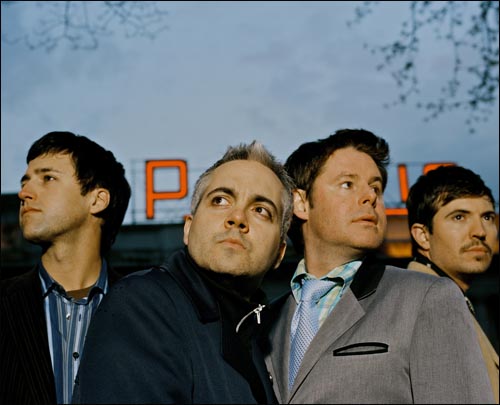
Free and legal MP3: Evening Magazine (a big ensemble w/ capacity to stay quiet)

“Apple Eye” – Evening Magazine

Marrying an old-fashioned “sound of Philadelphia” sweep to 21st-century electronics and indie-rock flavorings, Evening Magazine makes music that shouldn’t probably work but in this case does, however idiosyncratically. A nine-piece collective from (yes) Philadelphia, the band is led by guitarist/vocalist David Disbrow (formerly of the band BC Camplight) and engineer Kevin Francis (who plays synths too), and features a trumpeter, trombonist, flutist, and harpist, among others. For all the colorful instrumentation, the band doesn’t feel the need to fill in all the aural blanks. As a singer, Disbrow has a somewhat fragile presence, and the music gives him space to establish this presence; in fact, he usually isn’t singing on top of much more here than an acoustic guitar and a drumbeat. The arrangement is reminiscent of classical music, which is more willing than rock to explore dynamics via having instruments just stop playing for a while. Rock musicians, if they’re holding an instrument, they want to play it pretty much constantly.

What makes it all work for me is nothing more complicated than a pleasing melodic interval. Actually, a relationship of intervals. After the relaxed, horn-driven intro, the melody in the verse, itchier, finds Disbrow singing a rapid-fire series of tones. Staying on the first note for six or seven iterations, he slips down just a half-step for four syllables and then up five steps of the scale for the last three. Disbrow sounds particularly fragile at the top of the leap—so much so that the note, while actually the tonic of the scale, the home base, sounds unresolved, just a bit off, adding to the muted urgency of the ambiance fostered by that half-step-down, big-leap-up combination.
     “Apple Eye” is the lead track off the band’s debut EP, The Ride Across Lake Constance, released this month on Ohso Records, which appears to be the band’s own imprint. Thanks to the band for the MP3.

New Commentary online

At long last, the Fingertips Commentary has reemerged. The topic is nothing less than the free and legal MP3 itself, something so obvious to write about that I haven’t, previously, written about it. I will post the whole essay here on the blog in two parts, beginning Wednesday. For the eager, curious, or bored, you can see the whole thing now on the main Fingertips site.

Free and legal MP3 from Elvis Perkins in Dearland (cryptic, powerful, uniquely instrumented dirge)

“Shampoo” – Elvis Perkins in Dearland
     What may seem like a throwaway, the twiddly gathering of odd-ish creaks and whistles we hear in this song’s opening 25 seconds or so, is in retrospect an intriguing hint of the powerful agglomeration of sound that Perkins and his idiosyncratically-named band pump out as this one ramps up. Among the instruments the group plays are upright bass, saxophone, pump organ, harmonica, harmonium, trombone, banjo, and clarinet. (This is not your father’s rock band.) I advise turning up the volume so as best to hear the deep and mighty sonic breaths that propel this cryptic dirge forward. Perkins sings with an offhanded, cumulatively heart-rending ache; a startling phrase or two comes to the surface (“Black is the color of a strangled rainbow,” for one); but the song’s meaning lies more in the convincing churn of the the musical and lyrical momentum than in precise denotation. (In other words: I don’t know what he’s actually saying.)
     Perkins was featured on Fingertips around the time of his 2007 solo debut CD; check out that review for the executive summary of his sad backstory. He’s been playing, with long-time friends, as Elvis Perkins in Dearland at least since then. The band’s self-titled debut CD is due out on XL Recordings in March. MP3 via the Beggars Group web site.

Free and legal MP3: Hollowblue (brisk, noir-ish, and dadaesque)

“First Avenue” – Hollowblue

First come the blurred piano chords and crazed cello bleats. Next we hear the speaking voice of hard-bitten, semi-anarchic American novelist Dan Fante delivering the hard-bitten, semi-anarchic lyrics that he wrote for this song by the Italian band Hollowblue (however that collaboration came about). The words make sense yet the sentences don’t (“Drag your laundry down First Avenue”? “Spend some time in your drugstore mind”?), but with his voiceover-announcer-from-hell intonation, he sells it to you anyway. “I’ve got a pair of socks I like better than you”—well, okay, sure, if you say so, Dan. (And he does, twice.)

Turns out the jittery, slippery, loopy opening section is over before you can quite absorb it; at 0:27, the band fully takes over, the lyrics now reintroduced over a brisk, noir-ish Continental beat, sung in heavily accented English by the engaging front man Gianluca Maria Sorace. While Sorace’s breezy earnestness and reedy tenor brings Fante’s nutty non-narrative to a more grounded and inclusive place, in my mind it’s cellist Ellie Young who provides the heart of this likable dadaesque melodrama. First we heard those wild, horn-like blurts accompanying Fante. She returns at 0:48 with strong, gypsy-ish bowing and then uses a muscular 25-second solo in the center of the song (1:40) to make a strong argument for the cello as a rock instrument, and it’s less maybe about the solo itself than how great the song sounds when Sorace returns in full force afterward.

“First Avenue” is the lead track from Hollowblue’s CD Stars Are Crashing (In My Backyard), which was released in Europe last year on Midfinger Records, an Italian label. MP3 via the band’s site.

Free and legal MP3 from Mazes (lovely lo-fi-ish Americana with a hint of gospel about it)

“I Have Laid in the Darkness of Doubt” – Mazes
     For better or worse, we live in expansive musical times. Back in the 20th century, which some of you may remember, a band would work hard (or, maybe, not so hard) at being successful, and usually not succeed. That much hasn’t changed. Sometimes, when a band was very successful, one of the members might form an offshoot, a so-called “side project,” for a variety of reasons, but the starting point was that the original band had gained some traction, was relatively well-known. A side project would often arise, in fact, as a way of giving less involved members of an established band a chance to be leader. Today, side projects sprout like dandelions in the indie music meadow. Bands with little or no widespread recognition routinely spawn side projects, sometimes more than one.
     I am not judging this, just pointing out the change. People seem genuinely to have more music coming out of them than hours in the day, and obviously more ways than ever to record and distribute it. And if there had been some small-minded, last-century-oriented part of my brain that did want to judge this phenomenon, it has been silenced once and for all by Mazes, a side project of the worthy but not very well-known Chicago band the 1900s (previously featured on Fingertips in 2007, by the way). Edward Anderson and Caroline Donovan from that band have joined up with Charles D’Autremont to form the trio Mazes, and the result here is a gorgeous bit of sturdy, sort-of-lo-fi Americana tinged unexpectedly with gospelly overtones. “I Have Laid in the Darkness of Doubt” floats along with a backwoods sort of poise, picked and strummed and percussed on top of what surely sounds like a chorus of crickets, in no hurry to go anywhere, without even a chorus to distract us. Every time I listen I’m surprised how quickly it’s over.
     This is one of 11 songs on Mazes’ self-titled debut CD, scheduled for a March release on Parasol Records. MP3 via the Parasol site.

January Q&A now online, featuring Shane Nelken of The Awkward Stage

The latest installment of the Fingertips Q&A is now online, this one featuring Shane Nelken, front man for The Awkward Stage. While previous Q&As have prompted some thoughtful ramblings on the state of the music industry, Nelken will have none of that. He doesn’t ramble; he goes straight for the punchline. Once I convinced myself he wasn’t making fun of my questions, I realized how funny his answers were. Although he probably was making fun of my questions. Check it out for yourself on the main site. And that’s the MegaSaurAss himself, second from the left in the picture.

Free and legal MP3 from Smothered In Hugs (modern power pop with throwback elements)

“Blank Test” – Smothered In Hugs
     So listen to that opening melody (beginning at 0:15), remove the primal drumbeat, and think about what this sounds like: it’s not merely based on the standard I-IV-V chord progression, but it’s rooted in an early-rock setting of that progression–three successive ascending notes, each a whole interval apart, each accompanied, in order, by one of those I-IV-V chords. The verse of the hugely popular and evocative song “All I Have To Do Is Dream” uses this exact pattern, in a swaying, Everly Brothers soundscape, but this was hardly the only example. Enough other doo-wop era songs grounded themselves in this simple structure for it to carry forever an ineffable air of bygone times about it.
     Which is what, to me, helps make “Blank Test” so satisfying, somehow: it manages to conjure the past while presenting the melody in not one but two contemporary frames–the opening, percussive section and then the sped-up version (first heard at 1:23), after the song’s prominent tempo change. Interestingly, it was this second, faster version that first sounded most nostalgic, maybe because there was kind of a double-nostalgia at work, this speedier section likewise echoing the late ’70s via the Ramones and Blondie, bands which also mined ’50s and early ’60s melodies and chord progressions for use in their faster and harder-rocking compositions.
     Smothered In Hugs (named after a Guided By Voices song) is a quintet from the picturesque and music-laced island of Prince Edward, way out there in the Atlantic Time Zone. “Blank Test” is the lead track on the album The Healing Power of Injury, set for release next month on Collagen Rock Records, a local collective that Smothered in Hugs has established with three other bands from the Maritimes.

Free and legal MP3: Alela Diane (sharply-written, sung with poise, presence, and melisma, plus plaintive fiddle)

“White as Diamonds” – Alela Diane

Alela Diane (born Alela Diane Menig) is associated with the so-called “psych folk” and/or “New Weird America” movements, but as with the previously featured Marissa Nadler, similarly associated, there is nothing freakish or discomfitingly idiosyncratic about this young California-raised, Oregon-based singer/songwriter. On the contrary, “White as Diamonds” strikes me as solid as a genuine folk song, with the added benefit of a great—if offbeat—hook. This hook isn’t part of the chorus (there is in fact no chorus), it’s not even a particular turn of phrase or melody; instead, it’s her ongoing use of what is officially called melisma, which is when a singer uses several notes to sing one syllable of a lyric.

Rooted in ancient, sacred music, utilized in classical music, and rendered histrionic by most American Idol contestants, melisma can be not only aurally engaging but emotionally powerful in the hands of the right singer. Diane nails it so well that, as noted, the melismatic recurrence is, really, the song’s great hook. Listening to her singing “white as diamonds” (0:16) or “I was sifting through the piles” (0:51) (melismas on “sifting” and “piles”) or “a tangled thread” (1:01) (check out that upward flutter as she stretched the second syllable of “tangled” out, briefly but indelibly), something inside me opens to her, completely. The song has both a homespun feel, accentuated by the plaintive fiddle accompaniment, and a solemn rhythmic throughline, almost like an old Civil War song, but—in part because of the repeated melisma—is buoyed by a curious sense of the unexpected, which comes to the fore during the bridge (2:04), when the song’s beat is overtly disrupted by a shift in the drumming.

“White as Diamonds” will be found on Diane’s To Be Still CD, coming out on Rough Trade in February. MP3 courtesy of the Beggars Group web site.

Free and legal MP3 from the Traditionist (guitar, harmonica, drone, and more; deceptively complex and affecting)

“I Know My Ocean” – the Traditionist
     Guitar, bass, small drum kit, a harmonica flourish or two, an amiably insistent melody, a one-line chorus–turns out you don’t need that much to make an effective and affecting song. Well, okay, there’s also a banjo. Slide guitar too. And that droning sound beneath the mix pretty much the entire time. And those great lyrics, blending a stream-of-consciousness feeling with some startlingly focused observations.
      What Joey Barro, in fact, has put together, hiding behind a name that looks like a word but isn’t, is a deceptively complex song hiding out as an easy-going one. Building upon sonic territory pioneered of course by Bob Dylan (guitar, harmonica, wordy lyrics crammed into tight musical spaces) and more recently explored by fellow Southern Californian Peter Case (whom he resembles vocally, somewhat, in a good way), Barro, working with friend and producer Tim Bluhm, has constructed a wide-open delight of a song, all forward-moving flow and evocative texture–it’s one of those songs that goes by in something of a blur, and yet every time your ear specifically tunes in, there’s something interesting going on.
     Barro is based in Huntington Beach, California, and is better known around those parts as front man for the band the Antiques. His new album actually started life as an Antiques CD, but became something different over the course of an extended recording schedule. Season to Season will be out on Better Looking Records in March; “I Know My Ocean” is the last track, and a really nice last track it is. MP3 via the Better Looking site.

Free and legal MP3: Casador (shuffly, echoey, minor-key lament)

“The Puritans” – Casador

From Argentina by way of Italy comes a young man named Alessandro Raina, doing musical business as Casador. And moody-but-beautiful musical business it is–a shuffly, echoey, minor-key lament, with a crispness and sense of purpose not often found in independently produced debut EPs. And yes, “The Puritans” manages to be both echoey and crisp at the same time, which is not an ordinary accomplishment; indie rockers in the ’00s have tended to slop reverb on songs like whitewash on an old barn wall, boosting appearance without needing to clean anything up underneath. Raina instead uses an octave-lower harmony line to enhance his vocals in the verse, and maybe those lower vocals are touched up with a slight reverb, or maybe it’s that chiming, reverberant bass at the bottom, but the end result is a rich, spacious vocal sound without tramping mud all over the rest of the mix.

One sign of the sonic clarity is how naturally the song can drift back and forth between louder/faster and softer/slower without creating any aural jolt. The introduction offers a sonorous interplay between acoustic guitar and the aforementioned bass; they are joined first by the vocals, and then, kicking the volume and tempo up a notch, the drums. Keyboards arrive at the chorus (0:54), adding another notch to the song’s insistence, but right after that, at 1:34, we are taken back down to the quiet music of the introduction, which, with the addition of a few remarkably well-placed notes on a piano, feels almost thrillingly introspective at this exact moment.

“The Puritans” is the title track of Casador’s two-song debut EP, which is apparently based on the ancient tale of the sword of Damocles. Both songs are available on