Free and legal MP3: Pete Droge (feat. Elaine Summers) (Strong, gentle, lovely)

“Skeleton Crew” – Pete Droge (featuring Elaine Summers)

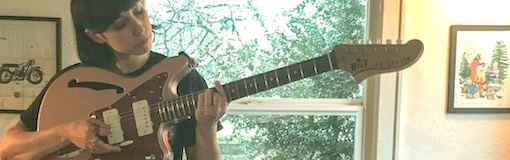
While singer/songwriters are relatively common here on Fingertips, I don’t end up featuring a lot of “man with a guitar” or “woman with a guitar” tunes. Not because I don’t like that kind of thing, but, truth be told, because I just don’t hear a lot that crosses the line from “nice” to “vital.” Because look: most acoustic-guitar-and-voice songs are by definition “nice.” But me, I want and need more from a song than niceness, especially now, and I think we get a lot more than that with this one, from Pete Droge, performing here with his wife and collaborator, the artist and musician Elaine Summers.

“Skeleton Crew” is a sad, sturdy song about resilience. Even as it sounds acutely relevant to our current moment —

We’ll get through this thing together
You lean on me and I’ll lean on you
Know that nothing lasts forever and ever

— in truth the song was started in November 2017 and had nothing to do with the pandemic (or, of course, our even more recent crisis). Launched off a concise, ear-catching guitar riff, the song is gracefully crafted, with its crisp, intimate guitar sound and well-placed vocal harmonies. The balance achieved between gentleness and strength, both musically and lyrically, is at the heart of the song’s loveliness and power.

Pete Droge had a moment or two back in the ’90s, with a major label record deal and some mainstream radio play; Allmusic calls him “one of the most overlooked of the modern-day Americana/rock/folk music movement.” But for whatever reason, probably having nothing to do with his talents and efforts, he faded off the scene as the new century turned. He was part of a short-lived “supergroup” called the Thorns, with Matthew Sweet and Shawn Mullins, which released an album in 2003.  Since then he has released four albums under his own name, on his own label. He has also done a lot of composing for a variety of media projects, from his home studio on Vashon Island, in the Puget Sound a short ferry ride from Seattle.

Speaking of which, Droge released “Skeleton Crew” in March as a fundraiser for a local charity, Vashon Youth and Family Services. He was kind enough to let me post the song here, but if you’re up for it, I’d suggest heading to Bandcamp and offering 50 cents or a dollar for the cause. And a big thanks goes out to visitor Scott for the head’s up about the song in the first place.

Free and legal MP3: Steve Earle & the Dukes (Fierce country stomper)

“Devil Put The Coal In The Ground” – Steve Earle & the Dukes

And here’s about the opposite of “nice” singer/songwriter music (see previous review): a rough-edged country stomper that functions simultaneously as a celebration of coal miner grit and an indictment of an industry racked by tragedy and exploitation.

Built upon a plaintive, insistent banjo riff, “The Devil Put the Coal in the Ground” finds the prolific and genre-bending Earle in backwoods mode, putting the instruments of bluegrass in the service of fierce country blues. Earle sings with his harshest growl while the fiddle and banjo articulate a rather terrifying jig. I warned you, it’s not very nice. But it’s arresting.

The lyrical motif is as deft as the situation described is insidious: the idea that coal was placed in such a difficult and unsafe location by none other than the devil himself. The devil of course exists in the human imagination as a being intent on making human life (and afterlife) as miserable as possible, often through the tragic force of temptation. For the sake of coal’s value as a resource, not to mention its role in generating diamonds, mankind has paid a price, at both the individual and the collective levels—there are the various calamities that befall coal miners on the one hand, and the environmental devastation wreaked by the mining industry on the other. And yet there have been benefits too, from a miner’s pride in his challenging line of work, to the way coal powered what has often been framed as “progress.” All this is covered, by implication, in the course of this less-than-three-minute song.

“The Devil Put the Coal in the Ground” is the third of 10 songs on the album Ghosts of West Virginia, released last month on New West Records. The music was inspired by the 2010 explosion at the Upper Big Branch Mine in Raleigh County, West Virginia, and was initially created for a theatrical production at the Public Theater in New York City. Entitled Coal Country, the play opened in early March but shut down prematurely due to the pandemic. Earle was the music director and performed his songs on stage during the play.

Steve Earle I trust you know already but if not, please do give his catalog some attention. He has been one of America’s most talented and uncompromising singer/songwriters of the last 30 years, and one who seems always interested in growing as an artist and a human being. I’m partial to his early- to mid-’00s work, most of all Transcendental Blues, but you’ll find rewarding music on pretty much every release.

MP3 via KEXP.

Free and legal MP3: Washed Out (very appealing synth pop)

“Too Late” – Washed Out

I’m trying to figure out what Ernest Greene’s secret is. The man who does musical business as Washed Out—and let’s remember that he is credited with more or less inventing chillwave—offers up what appears on the surface to be standard-issue 21st-century electronic pop: beat-heavy, bass-forward, easy-on-the-ears, all sounds seemingly emerging from digital sources. Why is this song so good and so many similar efforts so forgettable?

I have a few ideas. First of all, never underestimate the power of a good voice. I am continually surprised by how many submissions I get that discourage me as soon as the singing starts. Not everyone who tries to sing is a good singer; not all voices are created equal. Greene’s voice has a tone at once rich and hazy, and whatever manipulative effects are employed, a listener never loses track of the appealing human voice producing the  sounds. (Boy do I wish that anyone still tempted by Auto-Tune would discover the potential of other ways to deal with voice in the digital realm. Greene should teach a master class.)

Digging deeper, there is something too in the actual notes he sings. I don’t have perfect pitch and my knowledge of music theory is incomplete at best but I do think that Greene has the happy inclination to sing what may be suspended notes, or in any case are notes appealingly off the underlying chord. You hear this as soon as he opens his mouth (0:40), singing “I saw you there”: there, that’s the note I’m talking about. It’s not in the chord backing the melody here. He doesn’t in fact meet up with the chord until the end of the next phrase (“waiting outside“); how warm and cozy that feels is a side effect of how much he has otherwise been hanging the melody in suspension. He draws some extra attention to this inclination when he gets to the word “shy” at 1:03. The subtle tension created by these notes is seductive.

Another thing going on here to the song’s benefit is the dynamic range of the percussion. I don’t know if any of this comes from a three-dimensional drum kit or not but the effect is three-dimensional because Greene offers up shifts in volume in the elements of the beat.  A lot of electronic beats, however seemingly intricate, are flatter in this regard. You can hear a purposefully dramatic incidence of this in the intro, at 0:15. But all through the verse section, what you actually have, underneath the blurry trappings, is an old-fashioned backbeat (emphasis on the second and fourth beats of the measure), effected via the dynamic range. It’s not that this is impossible or even difficult to do electronically; it may just be that music makers right now don’t really care to do it.

Lastly, Greene is comfortable getting a little odd. And a bit of oddness can be extremely welcome, especially in a musical era marked by click-oriented efforts to be “catchy.” Here we get a distinctly odd chorus (1:20): the beat disappears; the vocals layer into a vibey mist; the lyrics are punctuated by what sound like distorted, synthesized cellos; and for good measure we get some digitized hand claps before it’s done.

“Too Late” is a single released in April on Sub Pop. Washed Out was featured previously on Fingertips back in August 2011. MP3 once again via KEXP.

Free and legal MP3 Yumi Zouma (happy music, wistful words)

“Cool For a Second” – Yumi Zouma

Remember this feeling? Breeziness? Lack of any immediate concern? “Cool For a Second”—all warm, boopy synths and cheery electronic percussion—glides in with a carefree, encouraging spirit, a lovely breath of good-natured air. Augmented by front woman Christie Simpson’s conversational personability, the song snuggles itself easily into my happy place.

Maybe a bit too easily, if one doubles back and considers the words that accompany the breezy-bouncy music. Take the chorus:

Omissions never flare, they go out if you let them
Changing every year, I was cool for a second
Find me in the fall, swept underneath
Forgetting every charm, took a bullet together
You could pull apart, so I’d never remember
The image that would call you back to me

While I’m not sure what the heck she’s singing about, I’m quite sure that it’s not all unicorns and rainbows here. But maybe, on second thought, this does snuggle into my happy place, because I have long looked kindly upon songs that manage the unique-to-pop feat of juxtaposing happy music with sad or wistful lyrics. In the case of “Cool For a Second,” both the happy music and the wistful lyrics eventually, over the course of this concise 3:10 tune, seem to converge into one feeling—something resembling perseverance. I think this has a lot to do with the powerful circular melody of the chorus, with its persistent up-and-over refrain. You hear it first starting at 0:53, and it incorporates at one point the title phrase, and that’s another of the song’s subtle virtues: finding a title in a phrase that recurs but is not repeated too often. Most songs are named for phrases that are clearly the most regularly sung, and sometimes it’s the opposite, where the song has a title entirely separate from the lyrics. Most unusual is the song where the title is in there but doesn’t go out of its way to stick in your ear. I’m not sure why but in this case it seems especially effective.

Yumi Zouma is a quartet from Christchurch, founded in 2014. “Cool For a Second” is a track off Truth Or Consequences, the band’s third full-length album, released last month on Polyvinyl Records. MP3 via KEXP.

Free and legal MP3: Pinewood (ear-pleasing mystery)

“Riverbank” – Pinewood

Fleet, spacious, and impressive, “Riverbank” gathers a solemn momentum through the determined repetition of its underlying finger-picked riff. The riff materializes from the quiet haze at 0:09 in the introduction and it literally doesn’t stop, accompanying the song straight through to the end, with one brief, well-placed shift (heard first at 1:07, repeated just once more at 2:34). The riff, warm and resolute, is augmented by a carefully curated soundscape, including a homey variety of percussion, what sounds briefly like a string section (1:12), a distant murmur of voices (2:08), an intermittent mandolin, and a great bottom-register buzz that sounds familiar but I can’t identify it—it’s often there deep in the background but can be heard a bit more clearly at around 1:50. (Maybe some kind of flanged bass guitar? Amplified mouth harp??)

The end result is an ear-pleasing mystery, at once calm and urgent, simple and complex, organic and manipulated, 1970s and 2020s, blended into a here-and-gone 3:05 composition. Such a spell is cast that the lyrics themselves seem to dissolve into the music, leaving wisps of impressions with little concrete information. Note how the song comes to an all but complete stop around 2:10, itself a somewhat mysterious turn of events. And then, later: bam, the thing ends with an abrupt shutdown.

Pinewood is the performing name of  Sam Kempe, a songwriter, producer, and multi-instrumentalist based in Atlanta. “Riverbank” is one of four tracks on the debut Pinewood EP All Things With Symmetry, which comes out May 1.

Photo: Megan Varner

Free and legal MP3: Sass (terrific grunged-out pop)

“11:11” – Sass

Maybe what we all really need right now is some guitars. In which case, the Minneapolis band Sass is at your service. And we’re not talking mindless, mathematical thrashing. What Sass delivers, guitar-wise, runs the gamut from amiably ringing riffs and sparkly plucking to full-on crunches and delightfully distorted squonks. For the guitar-starved who also likes a good pop song, this is a veritable buffet of aural delight.

And this is indeed a terrific if thoroughly grunged-out pop song, full of melodic spunk, lyrical thrusts, and self-possessed forward movement. And did I mention guitars? Given the fitful ruckus, “11:11” requires a special someone to pull it all together, vocally, and Sass has you covered here too, in the person of front woman Stephanie Jo Murck. Often we speak of a singer’s vocal range in terms of dynamic register, as in how low to how high a voice can go. Murck’s range, alternatively, is tonal, encompassing everything from blasé yearning to full-throated howling, a range that aptly complements the variegated guitar work. There’s nothing show-off-y going on here, which is one of the song’s special powers—the dynamic performances here all hit the ear as matter-of-fact. Murck’s narrator seems to have made a misstep in a fledgling relationship after previously assuring herself she didn’t need anyone to be okay. Now she’s not so sure. It’s a complex circumstance to cover in less than three and a half minutes, and a good part of the complexity is portrayed as much by sound as by words; there’s an “I can’t go on; I’ll go on” vibe in the air. Sporadic moments of chaos convey it; sustained histrionics would ruin it.

You will hear without effort the obvious moments of ramshackle guitar splendor the song has in store for you; let me here draw your attention to a few subtler things this deft band makes happen along the way. There’s the smeary line drawn by one of the guitars from 0:28 to 0:32;  the odd group of slightly off notes woven in from 1:17 to 1:20; and the squeal at 1:35, which leads into this lyrical highlight:

I am unreasonable
Let me push and
Never be pulled
But that’s impossible

Murck lets loose on this last line, the guitars screech a while, and then we’re back to a more restrained tone, revisiting the line “I thought I’d be fine alone,” and it somehow hits the ear as especially poignant, perhaps because this time it’s followed by the lines “I’d watch a new TV show/Learn to dance and paint and sew.”

Sass was founded in 2016. After a couple of early singles, they released an EP in 2017 and their first full-length, Chew Toy, last year. You can listen to and buy all their music via Bandcamp. “11:11” was released this month, and is a track from their upcoming album, Heart to Heart. Thanks to the band for the MP3.

Free and legal MP3: Thrillhouse (subtle hooks, accumulated majesty)

“Lesser” – Thrillhouse

As we collectively ponder just how to put one foot in front of the other without falling into a pit of grief, recalling a disregarded sense of normal wrenched away from us, let’s take a deep breath. Music remains accessible. It helps. As the hackneyed but undeniable truism reminds us: Don’t look back. You’re not going that way.

So. We’ll take it one song at a time, and “Lesser” is a worthy place to start—a smart 21st-century rocker paved with subtle hooks and accumulated majesty.  The throbbing beat set against an unresolved chord in the introduction grabbed me quickly, while the song’s unfolding changes and idiosyncratic twists—most notably the spoken-word pre-chorus (first heard at 0:52; listen to how the melody is implied without being sung)—keep the ear and heart engaged through to the end.

Other impressive moments and touches: the anthemic guitar line appearing at 1:08, and again only at 2:51 (what great restraint to use this only after one particular lyric); the telegraph-signal synth that emerges from the background around 1:38, and gets something of its own solo around 2:27; the unexpected percussive effect at 2:39; the wonderful squiggle of a synth solo in the coda (beginning at 3:26).

Thrillhouse is a trio based in Brighton. “Lesser” is their second single, released earlier this month. Thanks to the band for the MP3.

Free and legal MP3: Wye Oak (gliding, gratifying rocker)

“Fear of Heights” – Wye Oak

A long-standing Fingertips favorite, the duo Wye Oak continues to produce music that feels effortless and compelling. Despite my general familiarity with their history, each new recording of theirs manages to hit my ears in unexpected ways. “Oh,” I end up saying to myself, “that’s what they sound like this time.”

The ongoing constant is Jenn Wasner’s voice—smoky, yearning, articulate, unyielding. We begin in a sparse setting, devoid of time signature, just Wasner and a few piano chords. This is striking as an opening salvo—not a standard introduction, it is in fact the song’s first verse, waded rather than plunged into. We end up in the middle of the first verse without quite realizing how we got there—perhaps an apt mirror of how someone afraid of heights has to trick herself into making the upward journey.

As the song develops lyrically, the ostensible subject transforms into a metaphor about the difficulties and rewards of a long-term relationship. The idea of being afraid of heights is, I think, easier to grasp and/or acknowledge as a physical concept than as an emotional one; as such, linking the two informs both sides of the challenge.

A potentially weighty concept? Maybe. And yet handily presented at a pop-perfection length of 3:34, gliding forth with a gratifying momentum that feels at once circular and syncopated. Building off its piano-based opening, the song juxtaposes verses with musical space between lyrics against a declarative chorus, offering one thought: “You say it’s worth it for the view.”  Wasner’s self-harmonies add gorgeous texture. A bridge section intervenes with a cascade of phrases pivoting around the recurring sentence “I am a woman.” It is mysterious and powerful. To top it off we get a Bowie-like saxophone (or sax sound, in any case) playing the song out from 3:00 onward.

Wye Oak has lately been releasing singles in lieu of albums. “Fear of Heights” came out in January, more recently available, via KEXP, as a free and legal MP3. Their latest single is “Walk Soft,” available via Bandcamp. This is the band’s fifth feature on Fingertips, dating back to 2008.

Free and legal MP3: Hamilton Leithauser (Irresistible melancholy)

“Here They Come” – Hamilton Leithauser

If you happen to know that Hamilton Leithauser is the lead singer for the perpetually underrated New York City band The Walkmen, you may also happen to know that he doesn’t usually sound like what you hear when “Here They Come” starts. Typically Leithauser presses against the upper range of his vocal register, with a scuffed-up sort of zeal that does battle with the band’s bashy atmospherics.

This starts as another thing entirely: we hear a growly baritone, accompanying a finger-picked guitar. This goes on for 35-some-odd seconds, at which point, if you listen carefully, something in the background lightens up—you can kind of hear a higher vocal harmony in the distance, and the elusive sound of maybe a melodica? Then, just after his voice turns growliest, on the lines “all my candy’s gone” (1:02), bang: Leithauser converts to his familiar upper register, the music acquires a ramshackle beat, and off we go into the epitome of a sing-along chorus. This is, I feel, impossible not to like, but maybe that’s just me.

The verse returns at 1:26, now swinging along in the song’s revised setting. Leithauser’s transformed voice, just this side of hoarse, is for me the source of the song’s deepest charms—despite the tale of woe recorded here, something about a friend who can’t cope with the messy realities of life, the music’s effervescence coaxes a smile. Maybe that’s the point.

From the album The Loves of Your Life, released last month. MP3 again via KEXP. Note that the Walkmen have been on hiatus since 2014 but have not officially broken up. Old-timers may remember that that the band have been featured twice on Fingertips, in 2004 and 2008.

Free and legal MP3: Sløtface (wistful midtempo rocker)

So yes I guess every now and then I am engaged by a song’s lyrics, however much that is not normally the case for me here.

“New Year, New Me” – Sløtface

“New Year, New Me,” already pithily arranged, strips down even further, shortly after the halfway point, allowing front woman Haley Shea to draw attention to the following lyrics:

I keep playing my own therapist
And I’m convinced I’m good at it

Packed into these lines is the layered theme of this appealing midtempo rocker. With a blasé crispness suited to the matter at hand, Shea initially sings of the inevitable disappointments of unfulfilled new year’s resolutions. But this isn’t a cynical pity party. If, yes, we annually set ourselves up for failure by making new year’s resolutions in the first place, then maybe this inevitability is itself worth pondering. Most of us want to be better people but at some point have to confront the reality that you don’t get there via new year’s resolutions. Being convinced that one can be one’s own therapist is a poignant part of the wistful predicament, but recognizing that this is what one keeps trying to do is, maybe, a first step towards actual change. And maybe approaching the self with compassion rather than reproof offers a new hope, having nothing to do with making fated-to-fail “resolutions” (a word Shea does not in fact employ here).

So yes I guess every now and then I am engaged by a song’s lyrics, however much that is not normally the case for me here. As for the music, the first thing I like a lot is the laid-back lead guitar line, which comprises the introduction: it’s concise, melodic, and self-assured. The verse unfolds so casually as to seem spontaneous, with a couple of nicely-placed chord changes (e.g., 0:25), then launches into the chorus on a riff itself so understated as to be nearly nonexistent (0:37)—a musical reinforcement, perhaps, of the self’s predicament here: does stasis make change impossible, or is there some oh-so-gentle way to accept the self that can lead to transformation?

Sløtface is a band based in Stavanger, Norway. Although consistently identified as a punk pop (or a pop punk; is there a difference?) band, Sløtface (original name Slutface, and that’s still how you pronounce it), presents more accurately as a band that knows how to write and perform crafty, accessible rock songs, their guitar-laced volume consistently tempered by musical know-how and Shea’s approachable vocal style. Note that Shea has American parents, but grew up in Norway; the band’s other three members are Norwegian. “New Year, New Me” can be found on Sløtface’s new album, Sorry For The Late Reply, released late last month via Nettwerk/Propeller Recordings.

MP3 via KEXP.