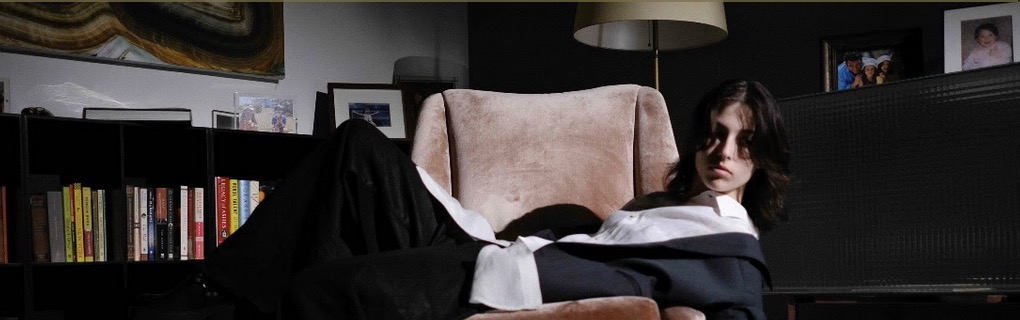
“The Day Is Long Enough” – Claire Barbour

Lovely, vulnerable

“The Day Is Long Enough” – Claire Barbour

“The Day is Long Enough” begins with a lovely sense of spacious vulnerability, and doesn’t take long to show off its fetching chorus. The 21-year-old Claire Barbour sings with both authority and reserve as the song combines lo-fi immediacy with a sneaky sense of production know-how. The simple, engaging melodies provide a throughline for a song that slowly transforms itself from bedroom ambiance to, by 1:47, the feel of a full (if gentle) band playing, a transition preceded by Barbour providing us with an unexpected taste of airy, jazz-inflected singing starting at 1:26.

And remember that gorgeous chorus that gets introduced near the beginning? This smartly crafted song withholds the chorus’s lyrical and musical resolution until its third and final iteration, as Barbour at last completes her thought that begins with “I can’t say it all enough,” singing, at 2:22, with wonderful offhand phrasing, “how the light makes me high.” The song, it turns out, is at least partially about those famously long Scandinavian summer days.

There is not much yet to learn online about Claire Barbour. Her submission letter here identifies her as “Stockholm/New York based” and notes that she was born in New England; her internet trail at this point is all but nonexistent. “The Day is Long Enough” was released last month on Hvilan Grammofon, an independent label based in Stockholm.

“Stereo” – Kendall Jane Meade

Exquisite singing, memorable melody

“Stereo” – Kendall Jane Meade

What starts as a precise bit of acoustic singer/songwriter fare transforms itself in the chorus into a memorable mid-tempo rocker. What pulls the listener in and through is Kendall Jane Meade’s beguiling singing voice. Soft and silvery, it’s the kind of voice that makes you wonder why some other people even bother to sing. Equally important here is the strength of the melody in the chorus. With the verse, the ear gets it, sure, she has a pretty voice; when the chorus arrives, by some deep alchemy the thing leapfrogs to a new level. The instrumental bridge with the ringing, distorted electric guitar (1:37) is an unexpected bonus. “Stereo” is not very long; the chorus only comes around twice. I put the song on repeat and left it there for quite a while.

The song had its origins in news in 2023 about Madonna canceling tour dates due to a health scare. Like Madonna, Meade is from Detroit and had always felt a kinship with the so-called “queen of pop.” The thought of potentially losing this hometown icon put Meade in a reflective mood, and “Stereo” was the result.

Meade was previously featured on Fingertips back when she was recording as Mascott, in 2013. I was as smitten with her voice back then as I am here in 2025. “Stereo” is a song from Space, Meade’s first solo album released under her own name, coming out at the end of February on Mother West Records.

“Two Feet Tall” – Ciao Malz

Bright and slightly woozy

“Two Feet Tall” – Ciao Malz

“Two Feet Tall” is brisk and bright and slightly woozy; between the pleasant warble of the guitars and the off-center time signature shifts, the music here effectively mirrors the uncertain state of mind the song appears to be concerned with. Malz has a feathery voice that sounds natural and matter-of-fact, one of those singing voices that, while definitely singing, sounds like talking. (This is a compliment.) The music hustles along in the verse then gets a little whiplashy with that half-time chorus. The lyrics address a certain sort of failure to communicate, epitomized by the recurring line “But I can never tell, quite tell you stuff.” As this line, repeating later, shortens to “I can never tell,” the connotation is smartly complicated. The overall vibe is friendly and cozy and slightly befuddled. This is also a compliment.

Keep an ear on the dizzy guitars all the way through, but note in particular the short warped solo that happens between 1:08 and 1:19. That’s my kind of detail. Another: the abrupt ending, after a final “I can never tell, quite tell you stuff,” which is one last way that form and content echo one another here.

Ciao Malz is the stage name adopted by the Brooklyn-based singer/songwriter Malia DelaCruz. “Two Feet Tall” is a track from her cleverly named EP Safe Then Sorry, released earlier this month on the Audio Antihero label. She had previously self-released an EP called To Go in 2020. Check the new one out over on Bandcamp.

photo credit: Alex SK Brown

“Broken Ceilings” – Morgan Swihart

Simmering with intention

“Broken Ceilings” – Morgan Swihart

Smoky and deliberate, “Broken Ceilings” simmers with intention, unfolding on top of a wide-ranging if elusive instrumental palette. The drums are front and center, the electric guitar occasionally steps forward, a piano vamps a bit and disappears; strings, too–or synthesized strings?–provide texture and drama; an athletic bass line lends subtle movement. Are there horns, actual or digital, in here too? No matter. It turns out to be far less about individual lines and more about how the amalgam produces a swelling, wall-of-sound feeling, of a sort you might get from putting a rock band into a blender with a small orchestra. (Don’t try that at home either.)

The song launches, minus introduction, straight into the verse’s melody, with its languorous ascent, Swihart’s resonant voice extending her notes out there on the borderline between shy and coy. You can sense from the start that the song is aiming in the direction of Big, and cumulatively, we get there, even as Swihart seems surely to be holding something back, in a good way. I’m an ongoing fan of restraint, and, counterintuitively, that’s what is ultimately on display here, despite the buildup, the eventual volume, the unbridled bashing of drums. You can hear it in the way the melody ongoingly steps down to resolve, in the spaces Swihart leaves from line to line, and, a closing touch, at the very end, in the way she modestly slides away.

Morgan Swihart is a singer/songwriter based in Brooklyn. “Broken Ceilings” is a song from her short, appealing album of the same name, released in June. You can check it out on Spotify. A previous album, The Grave, was released last year.

“Jacket” – Sam Evian

Affable, McCartney-like tunefulness

“Jacket” – Sam Evian

“Jacket” has an affable tunefulness about it, with a loose-limbed, Ram-like vibe bespeaking on the one hand singer/songwriter/producer Sam Evian’s long-standing adoration of the Beatles, and on the other the fact that he recorded this latest album in his idyllic-sounding studio in the Catskills, in a renovated barn, live on vintage tape–“No headphones, no playback, minimal overdubs or bleed,” in his words. The guitar sounds are straight out of the 1970s, as is the perky, midtempo, Nilsson-esque melody, with its easy-going wanderings up and down the scale.

Structure-wise, the song has a sneaky convolution to it, with a verse and chorus that sound somewhat but not precisely alike; it’s especially easy to get disoriented when a song starts with the chorus, as this one appears to. Bonus bewilderment points here for removing the first line of the chorus after one iteration, thereafter replacing it with a cheerful set of female-voiced “La-la-la”s. Lyrically this is one of those songs where the words are at once legible and incomprehensible: you can read along with the song and still have little sense of what’s transpiring. And then, in the middle, a verse pops as meaningful, even though it has no apparent relation to anything previously sung:

I trace it back and find a twisted memory
A loose end coming back to haunt me, it’s getting older and older
You know our trouble has a way of finding more
Like we were soldiers in a war so long ago

First off, he traces what back, exactly? We don’t know, pushed as we abruptly are into the middle of a thought without any context. Listen next to how perfectly “A loose end coming back to haunt me” scans with the music; it’s the parade of iambs in the lyrics that does it–except for the “it’s getting older and older” addendum, all the lines here offer perfect one-TWO stresses. The words glide effortlessly, all but forcing our attention to the stanza’s gloomy conclusion, contradictorily presented with the song’s ongoing peppiness. I’m not sure what it all adds up to–by the way, there’s not a single mention of a jacket–but it keeps me listening, and re-listening. Perhaps the song is being sung to an old jacket? Or by one?

Plunge, Evian’s fourth album, came out in March, and is the first he’s released on his own label, Flying Cloud Recordings. Collaborators on the album include El Kempner (Palehound, Bachelor), Adrianne Lenker (Big Thief), Sean Mullins, and Liam Kazar, among others. Meanwhile, Evian has for some years been an in-demand producer, having recorded albums with a wide variety of indie rock acts, including Widowspeak, Cass McCombs, Blonde Redhead, Cassandra Jenkins, Big Thief, and Hannah Cohen, who happens also to be Evian’s partner.


“Buddy” – Eileen Allway

Subtle power

“Buddy” – Eileen Allway

Deliberate and engaging, “Buddy” has an air of casual accomplishment about it. Everything seems just so, from the short, no-time-signature introduction to the easy, well-built melody of the verse, and then, best of all, the way the song opens up and out in the subtly brilliant chorus. Note too the different vocal ranges and aspects: in the verse, Allway employs a low tone, her voice nearly speaking as much as singing; while in the chorus her voice soars to a powerful upper range. And even here we get two iterations–the airy voice that takes us through the affecting chord change in the first line (starting at 0:51), and the stronger, yearning tone we get in the second line (starting at 0:57). There’s something almost Kate-Bushian in the air here.

The accompaniment feels at once minimal and well-rounded, a deft mix of acoustic and electric guitars. The slide guitar accents heard throughout communicate knowingly, in particular the upward-reaching note that leads into the chorus (first heard at 0:37): simple, striking, perfect. Meanwhile, also in the chorus, the prickly high notes that offer moody fill between the lines of lyrics deliver entirely different but equally canny enhancement. The second time the chorus comes around, lower-register guitar lines add to the carefully crafted atmosphere. Speaking of which, while the lyrics are somewhat hard to decipher, there’s one clear, telling moment, which is at the end of the chorus, when Allway sings, with a pang, “I want to make you fall in love.” Notice how the words pull up short of music here; how much an added “…with me” is implied but unstated. That’s devious in a good way.

Not outlasting its welcome, the song disintegrates at 2:10 with some initial noise, then fading slowly in a mush of distant, repeating vocals, quivering instrumentation, and, near the end, an ominous line of descending, Beatlesque strings, which happen to echo the opening notes of the introduction–another sign of the attentive craft involved in putting “Buddy” together.

Eileen Allway is a singer/songwriter based in the Los Angeles area. “Buddy” is her latest single, released last month. You can (and should!) check out her music on Bandcamp. Thanks to Eileen for the MP3.

“Gray Apples” – Sarah Morrison

Meditative, idiosyncratic, approachable

“Gray Apples” – Sarah Morrison

“Gray Apples” is the kind of artful, meditative, idiosyncratic yet approachable song one rarely hears here in the algorithm-choked 2020s. A direct spiritual descendant of the ’80s and ’90s work of the great Canadian singer/songwriter Jane Siberry, “Gray Apples” offers metaphysical musings within the container of a three-and-a-half minute pop song, held together by Sarah Morrison’s airy and elastic voice.

Similar to Siberry at her finest, Morrison deals in unorthodox musical and lyrical interruptions, such as what first happens between 1:00 and 1:16, when the heartbeat pulse of the verse stops, the time signature disappears, and Morrison’s lyrics take on a spontaneous, spoken-poetry feel. And not to drive the Siberry comparison too far into the ground, but I’m even noting specific words here that directly call back Siberry songs (apples and Bessie, to name two), and likewise see Morrison’s evocation of what she calls “The Holy Comforter–indifference” as an echo of Siberry’s discussion of “The Great Leveler” in her epic “Mimi on the Beach.”

That all said, you don’t have to be familiar with any of this to appreciate “Gray Apples,” but if you happen to know Jane’s work you’ll get an extra kick out of what’s in store for you here. In drawing consciously or not (I’m betting consciously) on the work of an underappreciated luminary in the history of singer/songwriter music, Morrison has composed and recorded something with a subtle sparkle all its own.

“Gray Apples” is a song from Morrison’s debut album, Attachment Figure, which is coming out next month on Ramp Local Records. Morrison is based in Tallahassee, and has previously been the live keyboardist for Locate S,1, playing there alongside Clayton Rychlik and Ross Brand, who are also in the band Of Montreal. Rychlik and Brand play with Morrison on Attachment Figure, and co-produced the album with her. You can check out one other song and pre-order the album over on Bandcamp.

photo credit: Chris Cameron

“Francine” – Brandon De La Cruz

Hushed and minimal

“Francine” – Brandon De La Cruz

Fingertips veteran Brandon De La Cruz returns with another of his intimate and tremulous gems. Possessing a whispery, minimalist style that can veer in an ill-fated direction in less capable hands, De La Cruz quietly mesmerizes, transcending the seemingly straightforward setting.

“Francine” launches off a classic folk-guitar riff, swinging gently into a subdued tale of (I think) long-distance love. De La Cruz’s minimalism extends to his storytelling: he’s short on concrete details, long on suggestive phrases. And, as I can’t help but continue to mention, the man is a master of using simple words to skip at the surface of deep meaning; here, the entire song, besides the name “Francine” and two exceptions (“between” and “apart”), is composed of one-syllable words. This is not as easy as it may look, and works with the gentle music to create a trance-like vibe. (De La Cruz’s Bandcamp bio notes an interest in Japanese haiku, which makes sense.) One telling, self-referential line comes near the beginning: “Words don’t say what I mean.” And yet they’re all we have to go on, to quote Tom Stoppard.

In and around the hushed and humble setting you may notice some stray sounds in the background. Towards the beginning, underneath the finger-picked guitar, an echoey string effect (0:12) hints at the tweaks to the audioscape that De La Cruz uses to ever so subtly distort the vibe. Throughout most of the song, if you listen for it you’ll hear a low ambient rumble that gives the impression of his playing in an empty warehouse or maybe an amphitheater. There’s a sound resembling a backward guitar loop beginning around 0:54 and continuing softly from there. Later, a couple of unexpected voices, with a “found sound” character, float in and out of the mix. De La Cruz reports that his inspiration in this case is rooted in his time working part-time at Mississippi Records in Portland, which puts out a lot of folk and country reissues; he sees the sampling as a creative way to collaborate with artists who are long gone from the world. The end result to my ears has the collage-like feel of something you might encounter in an art gallery.

“Francine” is a track from De La Cruz’s new album, Two Kilos of Blue, which was recorded in New Zealand in 2020, and released last month. De La Cruz was in New Zealand visiting friends when the pandemic broke out; he ended up stuck in there for a year. However inconvenient that might have been personally, it seems to have been amenable artistically–Two Kilos of Blue is the second album he recorded while marooned, and is a collection of songs he’d written over the previous ten years. De La Cruz is based in Portland; this is his third full-length album, coming after four previous EPs, the first recording dating back to 2010. He has been featured on Fingertips in 2011, 2013, and 2020.

“Let Go” – Brooke Bentham

Bittersweet allure

“Let Go” – Brooke Bentham

Launched off a world-weary acoustic strum, “Let Go” turns almost magically beautiful, all resolute melody and intimate, affecting vocals. The song has the bittersweet allure of something that has come down through the decades, not just the months. And it has the feeling of a take recorded with what happened to be handy: “strum this guitar,” “sing in that mic,” “the lyric sheet’s over here if you need it.”

Even when things open up sonically near the one-minute mark, the song retains its tenacity, never filling the space up with more than is necessary, leaning in the chorus on twangy, unresolved chords for drama. And then–speaking of drama–there’s the unusual way the song comes nearly to a halt at around three minutes, finishing with a slow, reflective minute of voice and a guitar strummed even more sparingly than we heard in the intro. The uniting force from start to finish is Bentham’s appealing and penetrating soprano, which holds its silver tone at both ends of the volume spectrum.

Deemed “enigmatic” by her own press material, the Newcastle-based singer/songwriter Brooke Bentham started making and performing music as a teenager, and did her first recordings while still in college. After a flurry of singles and EPs in 2017, beginning with the moody, potent single “Oliver,” she hit a songwriting wall. Her much-anticipated full-length debut, Everyday Nothing, did not emerge until 2020. Three years later we have new music by way of the EP Caring, which is where you’ll find “Let Go,” and three other songs. The EP was released in March; check it out on Bandcamp.

“To Supreme” – Will Ranier

The fine line between mysterious and ominous

“To Supreme” – Will Ranier

Any song that opens with the words “There were dark clouds” is unlikely to be super cheery. But however moody a scene “To Supreme” sets, the song retains an underlying spirit of curiosity and resolve, treading the fine line between mysterious and ominous in an agreeable way. Much is established simply via Will Ranier’s plainspoken voice; he sounds like a guy pondering his circumstances with a friend more than a guy undone by dark forces.

While not exactly peppy, the song does stride along with a midtempo pace, anchored by a steady acoustic rhythm guitar and some bass notes on the piano. Intermittent visits from a muted trumpet (played by Ranier) add to the reverberant atmosphere. But clearly the key to the song’s aura is the pedal steel providing fills between lyrical lines, each new echoey flourish different than the previous one. I especially like the discordant notes pedal steel guitarist Raymond Richards sprinkles in midway through (1:26-1:32)–another touch that lightens things away from the sinister.

In the end, perhaps the biggest mystery here is what the title is about. The lyrics do little to enlighten. “Supreme” is where “they” tell the narrator he “should go.” And he “followed their advice,” which led him “into the neon light show.” What the what? Then again, it doesn’t take much search-engine-ing to discover that Supreme is a pizzeria and bar in Seattle, which is where Ranier lives. I can see a songwriter building a mystery around a word laden with as much baggage as “supreme” (there’s the being, the Court, the leader, to start in the obvious places).

Ranier is a musician with a varied discography. “To Supreme” is a track from his forthcoming album, Wobble in the Moon, to be released June 30. While this is only his second solo album, he has one previous album with his band, Will Ranier and the Pines, and nine albums credited to Stuporhero, a duo comprised of Ranier and his wife, Jen Garrett.