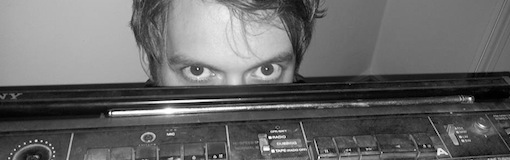
Free and legal MP3: Work Drugs (irresistible chillwave, w/ guitar solo)

Just about as irresistible as chillwave comes.

Work Drugs

“Chase the Night” – Work Drugs

Recycling the slick grooves of the late ’70s and early ’80s through 21st-century digital noodling has given birth to an entire (sort of) genre which has in recent years been as cutting-edge hip in pop music circles as the original music had been deemed hopelessly passé for a good 20 years or more. Funny that.

But there’s no denying the allure of this stuff, and “Chase the Night” strikes me just about as irresistible as chillwave comes. Equal parts sultry beat and soaring melody, the song transcends the genre’s robotic drift via some canny songwriting chops: both the verse and the chorus have two distinct sections, the second in each case building on the first in subtle but ear-grabbing ways. In the case of the verse, the melody changes from ascending to descending at the midway point and now comes at us in double time (0:30); the chorus, meanwhile, likewise goes double-time about halfway through, adding a lower-register counter-melody (1:03) after opening more anthemically.

And the boys of Work Drugs aren’t done there. We get a short, foggy bridge that floats near a kind of vocal manipulation that tips its hat towards commercial pop, but fades as quickly and curiously as it arose, and then leads into the song’s last two, disarming sections: first (2:35), the chorus, now presented in a new, minimal setting that accentuates the appeal of both the melody and of the human voices singing it; second (2:55), an out-of-the-blue, honest-to-goodness guitar solo, which sounds beautifully in context even as it was the last thing I might have expected. (Repeat listens to the song have since revealed a guitar hiding in plain sight in the back of the mix in the chorus, but without the closing solo, I’d never have picked it out.)

Work Drugs is the bizarrely prolific Philadelphia-based duo of Thomas Crystal and Ben Louisiana. They have been recording since 2011, and their forthcoming album, Louisa, will be their seventh full-length. I’m not even sure how that happens. The band performs live as a five-piece. “Chase the Night” is from Louisa, and can be downloaded as an MP3 in the usual method, above, or you can visit the band’s SoundCloud page and grab it there as a higher-definition .wav file. Lots of other songs available there as well. Thanks to the band for the MP3.

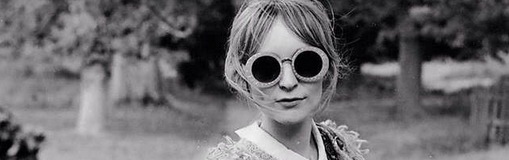
Free and legal MP3: Static In Verona (one man band, big bashy power pop)

More gratifying evidence of power pop’s unanticipated third life in the 21st century.

Static In Verona

“Blindfold” – Static In Verona

Blessed with heroic chord progressions, wall-of-sound fuzz, background chimes, and a sweet-voiced singer, “Blindfold” offers up more evidence of power pop’s unanticipated third life in the 21st century. A genre all but genetically resistant to overt electronic manipulations, power pop does however seem to seduce any number of good-hearted bedroom rockers with guitars, laptops, and a decent microphone. As in this case: its big bashy extraversion notwithstanding, “Blindfold” is the product of Chicago-based Rob Merz, doing musical business as Static In Verona, and playing every last instrument his own self.

And I may be a sucker for this kind of thing, but the result here pretty much takes my breath away—some elusive combination of melodic invention, sturdy structure, and masterly conciseness (the song clocks in at a wonderful 3:33) that leaves me with little choice but to hit the repeat button, repeatedly. My music theory abandons me pretty quickly, so I can’t identify the type of chord that recurs here with great success (you can hear it at 1:13, 1:28, 2:30, et al.), but I can report that it is a Beatlesque/Brian-Wilson-y gesture that is well-known too for its memorable appearance in the extended piano coda to “Layla.” One of the greatest but most ineffable things about effective power pop is how the great exemplars, for all their straight-ahead catchiness, often weave some slight oddness or deviation into the fabric of the song. And so here: in addition to the chord in question, “Blindfold” also works with a shifty pre-chorus/chorus arrangement (the pre-chorus itself, first heard at 0:47, provides us with arguably the song’s strongest hook) and, further, sets off the chorus with an unusual, rhythmically separated mini-introduction—the “Be with you” part, which sounds maybe more normal than it actually is.

Rob Merz has been on the Chicago music scene for 18 years, most recently as a member of the band Ash Avenue. He has been recording by himself as Static In Verona since 2009. “Blindfold” is a track from the second Static In Verona full-length, Everything You Knew Before You Knew Everything, which has actually been out for almost a year. I just found out about it via a 2015 post on the Insomnia Radio blog. You can listen to the whole album via Bandcamp, where you can also buy it for any price you choose. Thanks to Merz himself for the MP3.

Free and legal MP3: Shannon Wardrop (ambling, vaguely psychedelic, & impressive)

The young London-area singer/songwriter has a rich and elastic tone, and employs it with ravishing restraint.

Shannon Wardrop

“I Wanna Be Your Lady” – Shannon Wardrop

With its distorted guitars and spongy bass line, “I Wanna Be Your Lady” has an ambling, vaguely psychedelic feel that seems suddenly like the very thing we need to be listening to, collectively, right now. The song suggests weathered trees and cracked sidewalks, roasty cups of afternoon coffee, heart-breaking daylight, and things made of rugged glass; it reminds us that there may be evil in the world, and stupidity, but that right now you’re probably okay, and that’s worth something too.

A young singer/songwriter from the London area, Wardrop has a rich and elastic tone, and employs it with ravishing restraint, letting her big voice rip only in the final moments. But me I prefer the shimmering implications in her phrasing of “Wanna to be the one you call,” starting at 0:23, particularly the understated oomph she gives to the word “one.” Lots of small moments like that here add up to major delight—another one: the way the droning guitar riff gets a clipped punctuation at 0:44 that kind of sounds like a vocal and kind of doesn’t—and help to turn a song of head-bobbing simplicity into something deep and lasting.

And how great is it that there are young singer/songwriters in the world in 2015 who sound like this? The rejection of digital hubris begins here, with a generation for whom classic rock has warm parental associations, and who seek to move forward musically via simple humanity, sly good humor, and well-informed musicianship. “I Wanna Be Your Lady” is one of three songs on Wardrop’s Cloud 9 EP, her second, released last month. You can listen via Bandcamp. Her previous EP, Medicine, was released in 2013.

Free and legal MP3: Annalibera (slow-ish and soaring)

The song develops not by clearly going from A to B and back again but by gliding into separate but related segments.

Annalibera

“Black Cat White Cat” – Annalibera

Slow songs are tricky things. Songs that move “too slowly” (whatever that ends up meaning, or feeling like) can violate our sense of needing to get things done, or at least needing to feel like something is happening. And yet a slow song can also be delicious in its deliberation and restraint. But: what makes a slow song slow, anyway? A song can have a slow-moving beat but fast-moving melodies; a song can have a normally-paced beat but still feel slow.

“Black Cat White Cat” works both sides of this fence with aplomb, first establishing the prominence of an unhurried 1-2 beat and then contradicting that impression with first-verse lyrics that move largely in double-time. Soon, in what appears to be a kind of chorus (although seemingly wordless), the bass continues its deliberate, spread-out line but the guitar now rings out with a lead constructed of strung-together triplets (first heard at 0:52). Later the guitar fills space between languid lyrics with urgent oscillations of a different timbre (1:48 and following). That there is no obvious overall structure further contributes to the sense of slowness, I think. The song develops not by clearly going from A to B and back again but by gliding into separate but related segments. The faster-moving melody of the first verse never repeats; the thing I thought of as the wordless chorus disappears until the song’s final quarter (3:20), and there evolves into an indecipherable but dramatic interaction between skyscraping vocals and a truly foundational guitar riff.

Holding everything together are two related things: the interval-oriented melody, which floats us up and down the octave via archetypal arpeggios; and singer Anna Gebhardt’s soaring, searing voice, in which I hear rich echoes of the perennially underrated Tanya Donelly. (And if that comparison means anything to you, seriously, don’t miss this song.)

A native of rural Nebraska, Gebhardt studied voice at Drake University and stayed in Des Moines to start the trio Annalibera. “Black Cat White Cat” is a single from their forthcoming album, Nevermind I Love You, which is due in March via the Des Moines-based label Sump Pump Records. The band has one previous release, a three-song self-titled EP that came out in 2013. You can pre-order the new album (with a vinyl option) via Bandcamp.

photo credit: Bruce Bales

Free and legal MP3: Record/Start (crunchy, melodic, smartly-crafted)

“Rock From Afar” manages to funnel nostalgia through a contemporary filter, conjuring the past without wallowing in it.

Record/Start

“Rock From Afar” – Start/Record

Crunchy, melodic, smartly-crafted rock’n’roll, “Rock From Afar” is one of those rare one-man-band home recordings that sounds spacious and outgoing. (In that way it brings to mind the work of Devin Davis, for those with long Fingertips memories.) And while full of elusive homages to great moments in rock history, this song is likewise a rare bird for managing to funnel nostalgia through a contemporary filter: conjuring the past without wallowing in it, without losing the recognition that we live in the here and now and that that’s okay too.

So—stay with me on this one—I’m thinking now that what sounds like a catchy, well-paced song is actually much more than that. With “Rock From Afar,” Simon Cowan, doing business as Record/Start, offers us a much-needed (not to mention delightful) way out of the dead-end technophilia of the early 21st century. Enough with having to pretend there is nothing of value to be had from the past, enough with entrepreneurs and venture capitalists so smug and myopic that they can’t credit or recognize anything they didn’t invent or fund. Life existed before us and life (if we don’t go all Interstellar on ourselves) will go on after us and the smartest and most valuable (not to mention most fun) people are those who partake of the whole buffet. Use the past to inform the present and aim towards the future.

That’s what “Rock From Afar” does and it’s a breath of fresh air in a musical age suffocating from the addictive beats and compressed mightiness required to keep the kids dancing and the fingers clicking. Cowan finds a brisk pace and rich texture far removed from the stifling dictates of today’s pop, with guitars that bleed into a kind of 2015 Wall of Sound, and melodies that sweep you pretty close to power pop heaven. One of my favorite moments is the abrupt break for a “woo-oo-oo” vocal that happens at 2:41, because of how precisely this moment embodies the seamless melding of past and present: this kind of “woo-oo-oo” is pure Beach Boys, but Cowan augments it with an ear-popping 21st-century affect that Brian Wilson probably wishes he could have invented 50 years ago but most certainly did not.

Cowan fronted the Manchester band Carlis Star during the latter ’00s. Record/Start, a solo project, came into being in 2014. “Rock From Afar” has been bumping around the internet for a few weeks, in advance of its official double-sided single (on cassette) release next month, via Post/Pop Records. Thanks to Insomnia Radio for the MP3.

Free and legal MP3: Chelan (martial clarity meets windswept moodiness)

Often the acoustic and electronic are mixed in a song in blatant juxtaposition; here the analog and digital mingle with unnerving ease.

Chelan

“Pretend We Live Forever” – Chelan

We’ve got the snap-to-attention drumming on the one hand, and echoey industrial background washes on the other: martial clarity meets windswept moodiness. What’s not to like? And check out the sneaky way that swells of actual stringed instruments press their way into a sonic landscape that feels at once intimate and expansive. Often the acoustic and electronic are mixed in a song in blatant juxtaposition; here the analog and digital mingle with unnerving ease.

And then there’s the matter of how this thing, well…swings. Underneath the rat-a-tat snare is a deeper, swaying, gut-level beat, and this, I think, is what really nails “Pretend We Live Forever” together. (If you’ve got any desk-dancing inclinations, this song all but requires some kind of awkward-looking but satisfying upper-body gesticulations.) Another somewhat hidden strength here is singer Jennifer Grady’s voice, which has a lovely, limpid tone and is allowed to hit our ears with gratifying directness, even as a variety of layered effects swirl around her. But she’s also oddly easy to miss since so many songs that aim for the kind of ambiance we’ve got going here seem not too often interested in presenting a clear and unadulterated voice. Which kind of trains our ears not to hear. Which is another matter for another day.

Chelan is the duo of Jen Grady and Justin Hosford. She teaches music; he is a TV and film composer with a studio in the Mojave Desert, where they converge to write and record whenever they can. “Pretend We Live Forever” is a track from their forthcoming album Equal Under Pressure, to be released later this month. MP3 via Magnet Magazine.

Free and legal MP3: Rebekka Karijord

Rich, rhythmic, and passionate

Rebekka Karijord

“Use My Body While It’s Still Young” – Rebekka Karijord

“Use My Body While It’s Still Young” has a haunting richness to it that belies the edgy electronics that may first grab your ear. Some of this is a simple function of Karijord’s vivid mezzo, with its half-creamy, half-vehement tone; just about anything she might sing is likely to be rich and haunting.

But there’s something deep in the song that moves me as well, something timeless running through its urgent, 21st-century setting. To begin with, “Use My Body…” skillfully blends electronic rhythms with what sounds like organic percussion. That always helps. Note too how the steadfast, familiar sound of an old-school organ works its way to the center of a song characterized otherwise by jittery rhythms. But, perhaps most effective of all, there is way that the musical landscape, while pulsating with inventiveness, nevertheless roots itself in, of all things, the blues. Not that I am any kind of blues fan (at all), and not that this is in any actual sense a blues song (it isn’t), but if you listen attentively you may hear what I hear in both the chord progression (unfolding in a 12-bar verse) and in the primal passion on display.

Beyond the cumulatively entrancing music, the lyrics too bear consideration. It’s not your everyday pop song that addresses the fleeting vigor of youth. Then again, Rebekka Karijord is hardly your everyday pop singer—she is, instead, a Norway-born, Sweden-based composer/performer/writer who has written music for a variety of media, including film, theater, and dance; she has worked regularly as an actor as well. Meanwhile, as a singer/songwriter, she has recorded three albums. “Use My Body While It’s Still Young” is from her second album, We Become Ourselves, which was originally released overseas in 2012. Karijord is releasing a deluxe edition of the album for the United States next month, via her own label, Control Freak Kitten Records.

Free and legal MP3: Auditorium (dramatic vocal layers, acoustic setting)

As off-kilter as you might imagine a song entitled “My Grandfather Could Make the World Dance” would be. Also, bold and captivating.

Auditorium

“My Grandfather Could Make the World Dance” – Auditorium

The 2015 indie music scene is full of creative types who come from all sorts of idiosyncratic backgrounds. Even among his heterogeneous cohorts, however, Spencer Berger stands out for his unusual back story: from the ages of nine through 12, he was an opera singer, performing at the Metropolitan Opera with the likes of Luciano Pavarotti. And while you might not immediately guess “child opera singer” when “My Grandfather Could Make the World Dance” starts up, I’m pretty sure you can see that something muscular and expansive is going on here vocally, both in terms of Berger’s singular tone and his penchant for dramatic layering.

And so it turns out that this is as off-kilter as you might imagine a song entitled “My Grandfather Could Make the World Dance” would be; likewise is it bold and captivating. Berger’s penchant for stagy vocalizing is all the more convincing for its being matched, against expectation, with the simplest of accompaniments—acoustic guitars, a touch of piano, and a small helping of percussion is all that’s going on here, instrumentally. Musically, the song is dominated by descending melody lines, punctuated by intermittent yelping leaps; the overall effect is a kind of optimistic melancholy that helps give the whole thing the feel of a lonely suburban afternoon in 1972. I can’t pinpoint why but to me this seems quite clear.

Based in Los Angeles, Spencer Berger has been recording music as Auditorium since 2011, when his debut album, Be Brave, was released. (You can check that one out via Bandcamp.) “My Grandfather Could Make the World Dance” is a single released earlier this month. Thanks to Insomnia Radio for the link.

Free and legal MP3: Emma Swift

Brilliant, achy cover of a new wave nugget

Emma Swift

“Total Control” – Emma Swift

Australian singer/songwriter Emma Swift has transformed this new wave classic via the most delicate and deft mutation. The Motels tune still burns slowly, achingly. In place of the original’s rubbery, late-’70s itch Swift employs a torchy, old-style country setting, with exquisite pedal steel work and a slight but effective vocal twang.

We know we are in excellent hands from the opening notes: Swift creates an entirely new introduction for the song, composed of lovely, unresolved arpeggios, played on a silver-toned guitar. It couldn’t be more different than the dated, repetitive staccato of the original intro, which had its new-wave-y charms but always struck me as clunky. (It can be a fine line between a slow burn and lack of imagination.) And while there is likewise nothing wrong with Martha Davis’s vocals—okay they were a bit affected but that was her thing—Swift here really sings this baby, accessing all sorts of actual emotion in places where Davis was content to go for eccentricity.

That’s the thing about this cover that feels almost shockingly appealing: how deep and lived-in Swift makes a song that never previously seemed much more than a quirky curiosity. Some of this has to do with the subtle but superb arrangement; there does not appear to be one note in the background or foreground that isn’t being played for a purpose. Even something as seemingly minor as the decision to deliver the oddly climactic line “Stay in bed/Stay in sheets” with harmony vocals (Swift otherwise sings single-tracked the whole way through) becomes a moment rich with ineffable delight via some combination of know-how and hunch. In any case, I have only rarely heard such a satisfying reinterpretation.

Swift is a singer/songwriter from Sydney who spends half her year in Nashville. She also hosts an Americana-oriented radio show on the Australian station Double J. “Total Control” can be found on Swift’s debut release, a self-titled six-song EP, which you can listen to and/or purchase via Bandcamp. Thanks muchly to Cover Lay Down for the link. Joshua’s been running a genial covers-only music blog there for years and years; check it out at http://coverlaydown.com.

Free and legal MP3: The Sharp Things

Lovely, urgent, and deep

Sharp Things

“Everything Breaks” – The Sharp Things

“Everything Breaks” manages the uncommon trick of being both lovely and urgent. Each of these aspects, as it turns out, seems to hinge primarily on the song’s consistent—and subtly edgy—alteration between minor and major keys. We hear it right away in the crisp, ringing piano intro, and the minor/major shifting is only deepened and underlined by the addition of vocals. There’s a breathlessness to the proceedings, a sense that the song just has to burst out as is and be done.

And then too there’s the way the song unfolds lyrically as an elegiac litany of facts, descriptions, and/or circumstances, creating a kind of beauty-meets-tragedy atmosphere, even if it is difficult to apprehend exactly what is being sung about and why. With its graceful confluence of lyrical and melodic portent, “Everything Breaks” grabs the ear so quickly and securely that we feel grounded without even a chorus to provide its steadying influence.

The Sharp Things, previously featured on Fingertips in November 2013, are an expanding and contracting NYC ensemble, active since the ’90s, and currently in a nine-piece phase. “Everything Breaks” is the lead track on Adventurer’s Inn, released earlier this month. This album, the band’s sixth, turned out to be a personally notable and heartbreaking effort for front man Perry Serpa, as it is the last album the Sharp Things were able to record with drummer and band co-founder Steven Gonzalez, Serpa’s best friend since childhood. Gonzalez died in September from complications related to a lifelong struggle with cystic fibrosis.

Thanks to the band for the MP3.