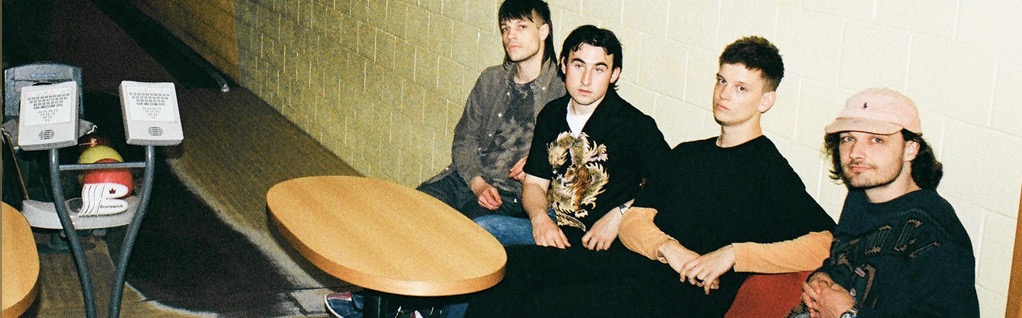
“Once It Starts to Kick In” – Hand Gestures

Deft ambling

“Once It Starts to Kick In” – Hand Gestures

With its friendly vibe and strummy groove, “Once It Starts to Kick In” develops over an agreeable mix of crunchy, bell-like guitars and a perky synth line. The song so deftly ambles along that I was surprised when I noted the length (4:44); it feels shorter than that, never hurrying yet never wearing out its welcome.

Front man and songwriter Brian Russ has an appealing, everyman voice that manages to convey innocence and experience simultaneously–which is kind of what the music itself does here, with the juxtaposition of the substantive guitar work and that playful synth line. Speaking of, I like in particular how the synthesizer, after dutifully playing its instrumental hook a couple of times, breaks out at 3:42 for an extended, off-script solo.

By the time Russ was writing the songs for this album, in 2022, he had had 20 years of experience on the Brooklyn music scene, which you may or may not recall was quite the engaged and engaging environment back there in the ’00s. He was in his early 20s then, putting him now in his 40s and eager to write songs reflective of his current life stage. Although Russ originally wrote these songs for Unisex, a previous band of his, by 2024 that band had more or less dissolved; he ended up recording the songs by himself with the help of the Unisex drummer. Then, this year, he assembled a new group of musicians and as such decided to change the group’s name. The album had been titled Hand Gestures; this became the band’s name too. Russ by the way is also the founder of the indie label Campers’ Rule Records, which released Hand Gestures on Halloween. You can listen to the album, and buy it, via Bandcamp.

“Solar Babes” – Storm Recorder

Brisk, poignant guitar rock

“Solar Babes” – Storm Recorder

Driven by brisk, clangy guitar chords, “Solar Babes” has an unmistakable poignancy about it, even as I can’t quite put my finger on what’s driving that impression. Some of this seems built into Jesse LeGallais’ voice, with its fetching, slightly nasal timbre. Some of it may be generated by the verse’s insistent, two-chord melody, the sing-song-y quality of which creates an underlying innocence to the proceedings.

The chorus, comprising little more than the word “fight,” creates a passing sense of movement even as it’s still built on the same two-chord foundation. The breakthrough happens around 1:15, after one more round of verses: we find ourselves in an extended bridge or bridge-like section that offers the ear the sorts of chord progressions the song has previously withheld from us, and which sound all but heroic in context. Equally heroic is how the opening chords are re-cast at the end in a brief, quasi-Springsteen-esque conclusion (2:07). Wrapping up in under three minutes, the song invites and rewards multiple listens.

Storm Recorder is the Nova Scotia-based duo of LeGallais and Palmer Jamieson. LeGallais was based in Montreal for 15 years, playing in an assortment of bands, before moving to Halifax; Jamieson is a Halifax-based producer who runs his own studio. LeGallais initially intended to record a solo project with Jamieson. Their level of affinity ended up turning the record into a new, joint project called Storm Recorder. “Solar Babes” is the opening track on the album Always Coming Home, which they position as an homage to the Ursula LeGuin novel of the same name. A particular inspiration for the duo comes from a LeGuin quotation the band has posted on its Bandcamp page: “We live in capitalism, its power seems inescapable–but then, so did the divine right of kings. Any human power can be resisted and changed by human beings.” These are words that feel especially welcome right about now. Thanks to LeGallais for the MP3.

“Two Feet Tall” – Ciao Malz

Bright and slightly woozy

“Two Feet Tall” – Ciao Malz

“Two Feet Tall” is brisk and bright and slightly woozy; between the pleasant warble of the guitars and the off-center time signature shifts, the music here effectively mirrors the uncertain state of mind the song appears to be concerned with. Malz has a feathery voice that sounds natural and matter-of-fact, one of those singing voices that, while definitely singing, sounds like talking. (This is a compliment.) The music hustles along in the verse then gets a little whiplashy with that half-time chorus. The lyrics address a certain sort of failure to communicate, epitomized by the recurring line “But I can never tell, quite tell you stuff.” As this line, repeating later, shortens to “I can never tell,” the connotation is smartly complicated. The overall vibe is friendly and cozy and slightly befuddled. This is also a compliment.

Keep an ear on the dizzy guitars all the way through, but note in particular the short warped solo that happens between 1:08 and 1:19. That’s my kind of detail. Another: the abrupt ending, after a final “I can never tell, quite tell you stuff,” which is one last way that form and content echo one another here.

Ciao Malz is the stage name adopted by the Brooklyn-based singer/songwriter Malia DelaCruz. “Two Feet Tall” is a track from her cleverly named EP Safe Then Sorry, released earlier this month on the Audio Antihero label. She had previously self-released an EP called To Go in 2020. Check the new one out over on Bandcamp.

photo credit: Alex SK Brown

“Blue Tuesday” – Francis of Delirium

Propulsive and vulnerable

“Blue Tuesday” – Francis of Delirium

How is it that some singer/songwriters sing about their personal angsts and it comes across as kind of small and whiny while other singer/songwriters sing, as well, about their personal angsts and it soars into something weighty and inspiring? It’s a mystery. And obviously my personal perspective on any given musician is just my own, and often at odds with cultural consensus. But Jana Bahrich, who fronts the project Francis of Delirium, strikes me as the real deal. Nothing small and whiny about what she does.

From the ringing guitar and pulsing backbeat of the intro, “Blue Tuesday” propels us forward with itchy resolve. We are pushed directly into the middle of a story via the opening line’s unusual kickoff: “And it starts in the back of a cab.” This demonstrates the kind of stout assurance that supports the song beginning to end–an assurance perhaps best epitomized by the audacious slant rhyme upon which the chorus pivots:

It’s a blue Tuesday
I could use babe some of us

In another setting, in someone else’s hands, this (sort of) near rhyme might seem an awkward blunder; here it feels sly and subversive. She’s kind of daring you to call her on it and not caring if you do. Throughout, the 22-year-old Bahrich sings with a tone alternating between airy and grounded, between vulnerable and assertive. You buy what she’s selling; the underlying bash and drive leaves you almost no choice. This a concise song both musically and lyrically, with a seemingly straightforward meaning: the narrator is feeling down and desires her partner’s presence as a balm. But being down often leads to passive indecision, while in this case, the singer knows what she wants and asks for it, not something everyone has the presence of mind to do. She offers a second slant rhyme in the process, in the second half of the chorus: “It’s a blue Tuesday/I could use babe some of your touch.” It’s an even slantier slant, matching two syllables (“your touch”) against one in the previous line (“us”), so the lyrics scan differently too, with Bahrich hesitating on the second word, landing it on the backbeat of the next measure, sweeping us back into the song’s adamant flow.

Based in Luxembourg, Francis of Delirium was previously featured on Fingertips in April 2022. “Blue Tuesday” is a track from the outfit’s excellent debut album Lighthouse, which was released in March. I like by the way that the song is the fifth track on the album–another move, in a world of side-one, cut-one singles, that speaks to Bahrich’s underlying confidence. MP3 via KEXP.

(A sad side note: KEXP’s “Song of the Day” feature, which has fed Fingertips a significant number of free and legal MP3s over the years, has been discontinued. The MP3s they’ve uploaded still seem to be online at this point, but it’s unclear how long that will last.)

“How High” – The Usual Boys

Distinctive character, with guitars

“How High” – The Usual Boys

“How High” is a nifty, left-of-center rocker, pairing a sophisticated riff motif with a disco-derived bass line and hoping for the best. Which turns out to be pretty darn good. While the song doesn’t sound all that much like the Smiths, I sense a bit of a Smiths-like vibe here in terms of the idiosyncratic structure and distinctive character–and, more concretely, the central, lead-like role of the rhythm guitar. Who does this anymore? Probably a good number of people, you just don’t get a lot of them from the algoritihm.

The song takes its time establishing itself, but rather than this involving some sort of slow and/or repetitive vamping (a pet peeve of mine!), this is an introduction that introduces us, properly, to the variety of rhythm guitar refrains upon which the song is constructed. Front man Aleksi Oksanen enters at around 32 seconds, his resonant, slightly distorted baritone delivering a patter of nearly spoken lyrics with charismatic dexterity. The funked up bass line and itchy percussive touches add unanticipated texture, then step away as the chorus (1:03) reprises two of the riffs we heard at the outset: the first slowing down to half time (the “You say, ‘Jump!'” part), the second reasserting the pace (after the “I say, ‘How high?'” part) with a tumble of unresolved chords.

“How High” is a concise song, wrapping up in under three minutes, but still offers a sense of development, partially due to the unfolding guitar work, and partially due to production details that add appeal along the way, including a siren-like guitar heard first around 1:36, and an extra instrumental sound–a synthesizer, or some sort of processed guitar?–that chimes in at 2:20. These are small flourishes but I always appreciate it when someone is continuing to think about and play with a song’s sound from beginning to end, rather than recycling the early parts as is.

The Usual Boys are an international foursome (Finland, Scotland, England, Sweden) based in Germany and playing together since 2017. Released in October, “How High” is the third single to date released by the band from the as-yet forthcoming debut album. Thanks to the band for the MP3.

“Let Me Know When It’s Yes” – Smug Brothers

Jangly, catchy, concise

“Let Me Know When It’s Yes” – Smug Brothers

Against the odds, power pop survives into the 2020s, often perpetuated by the kind of good-natured, low-drama outfits such as Ohio’s Smug Brothers, who have been plying their quirky wares since 2004. “Let Me Know When It’s Yes” falls unmistakably into the classic power-pop soundscape, with its jangly guitars, catchy but bittersweet melodies, and concise song structure. Interestingly, what is concise for many bands is an extended track for Smug Brothers, since the majority of songs in their ample discography clock in not merely under three minutes but often under two minutes, or even one. Singer/songwriter Kyle Melton says the short songs are largely a side effect of the small notebooks he carries around to write down his ideas. “Let Me Know When It’s Yes,” by contrast, was written on a computer, with more room to spread out lyrically. Be that as it may, there are good songwriting instincts at work here, as super-short songs have a different structural logic to them than songs of a more standard length. “Let Me Know When It’s Yes” grounds itself in two succinct, interrelated melodies, a situation which counterintuitively requires more time to absorb as a listener than a more complex melody that you only get a passing chance to get your arms around.

Which is to say, with a super-short song, you don’t as a listener, consciously or not, expect something to seem familiar as it unfolds. The songwriter, consciously or not, might as well make it intricate because it’s not really going to sink in on first listen in any case. But it’s nice and short so you are theoretically being invited to listen a few times. A three-minute song, on the other hand, with a simpler, recurring melody scheme, allows the listener to get more readily comfortable, a comfort level enhanced, ideally, by potent motifs and a strong sense of resolution, both of which Smug Brothers smartly deliver. I’m half thinking that what might seem to be the chorus here may simply be the final, resolving line of the verse (“Give me a call and let me know when it’s yes”). This is a structure that pays homage to folk ballads and is, relatedly, a ploy Bob Dylan has often used (think “Come in, she said, I’ll give you shelter from the storm”). Tangentially, I wouldn’t call Kyle Melton’s voice Dylanesque per se, but he’s got something of Dylan acolytes Roger McGuinn and/or Tom Petty in his tone.

Smug Brothers have been through a variety of lineup changes over the years; founding members Melton (who also plays guitar) and Don Thrasher (drummer) remain at the core. Kyle Sowash (bass) and incoming lead guitarist Ryan Shaffer round out the quartet; two of the four are in Columbus, the other two in Dayton. Former lead guitarist Scott Tribble was with the band through the recording sessions for the latest album, which is called In the Book of Bad Ideas and is coming out in September. That’s where you’ll find “Let Me Know If It’s Yes.” You can check out the semi-voluminous Smug Brothers discography via Bandcamp. MP3 courtesy of the band. Note that Smug Brothers were previously featured on Fingertips in 2019.

“True Religion” – Couch Prints

Fuzzy and buzzy

“True Religion” – Couch Prints

“True Religion” is a coherent tornado of fuzz and buzz, its swirling noise counterbalanced by unexpectedly sweet lead vocals and a concise structure. So, a question: are we starting to experience ’00s nostalgia? Between the terror attack and the economy bottoming out it wasn’t that much fun to live through but hell compared to watching democracy teetering on the edge of fascism, an ideology-crazed Supreme Court eager to treat more than half the population like second-class citizens, and social media continuing to fray our political and social fabric, the ’00s have an oddly innocent glow about them in retrospect. “True Religion” in any case gives me a 2000s feel, with its fizzing amalgam of droning electronics, bagpipe-y guitars, and disembodied vocal samples, guided from above by the feathery soprano of Jayanna Roberts.

I find it interesting to follow the percussion on this one. For the first half or so you might not think so–I’m no expert but the drumming sounds pretty programmed up to that point. All percussion clears out at 1:35 for the first iteration of the chorus, featuring just voice (Roberts in her lower register), guitar, and bass. At 1:49 we get the chorus repeated, an octave higher, with the drums kicking back in. And–again, I’m no expert–but I’ll be darned if the drumming doesn’t sound live now versus programmed. A big hint happens at 2:03, when the drum skitters through a few beats in an agreeably unexpected and (what sounds like a) three-dimensional sort of way. The drumming from this point onward hits the ear as somehow more grounded (listen in particular to the cymbal sounds), so either it’s a human drummer or the program was altered. In any case, all percussion exits abruptly at 2:36 in favor of a brief coda of noise and more of those disembodied speaking voices. Everything wraps up in just under three minutes, which is frequently a sign of a job well done.

Couch Prints is the NYC duo of Roberts and Brandon Tong. “True Religion” is the first single available from their forthcoming debut album Waterfall: Rebirth, which is due out this fall.

“Showgirls” – Man on Man

Noisy and welcoming

“Showgirls” – Man on Man

For all its fuzzy noise and punk-ish simplicity, “Showgirls” moves with a light touch and a welcoming vibe. The vocals, although filtered, feel personable, while the parade of two-part, closely contained melodies gives the ear an easy hand-hold into the squawky soundscape’s controlled hubbub. A sense of things simultaneously coming together and falling apart is underscored by a set of lyrics that are concise but pretty much unintelligible, a series of sometimes suggestive phrases (“You gotta use spit/If you wanna get used to it”) without any sense of narrative or setting. Whatever is specifically going on, it appears to be a good time, and we seem to be invited along.

Guitars make their presence known quickly and noisily, providing a wash of background buzz from the start, but it’s the instrumental break starting at 1:51 where they really break out, with a squalling six-second opening moment that deserves an extra pat on the back.

Man on Man is the duo of Roddy Bottum, best known as keyboardist for the band Faith No More, and his partner Joey Holman. What started as a pandemic-based lark has solidified into an ongoing endeavor. “Showgirls” is a track from their second album, Provincetown, which comes out next month on Polyvinyl Records. It’s one of a number of songs from the album that were written in and/or inspired by its namesake locale, at the tip of Cape Cod, with its longstanding history of LGBTQ+ respect. As the band’s name implies, Man on Man is not only open about their sexual orientation but they appear ongoingly delighted to celebrate it. We would do well to be delighted on their behalf, as it takes an insecure and/or bigoted pinhead to believe that diversity of all kinds is anything but a planetary blessing.

MP3 via KEXP.

photo credit: A.F. Cortés

“Forever Far Out” – Dot Dash

Succinct power pop

“Forever Far Out” – Dot Dash

One of the reassuring things about power pop, besides its indelible if elusive charm, is that it never quite goes away–largely because it never fully arrived in the first place: a relentlessly niche-y genre, power pop has yielded relatively few big hits over the decades. And although you may see a recurring set of words and phrases used in efforts to describe the sound–upbeat, melodic hooks, often of the sing-along variety; jangly and/or crunchy and/or chunky guitars; sweet-sounding vocals; concise songwriting–we always land eventually in “I know it when I hear it” territory.

So, even here in the year 2023, a good 50 years on from power pop’s formative era, the song “Forever Far Out,” from the veteran DC band Dot Dash, reads as power pop all the way: there’s the chunky guitar line, the upbeat ambiance, a lot of melodic resolution, sweet-toned vocals, and succinct craftsmanship, with the song clocking in under three minutes. Favoring melodies that repeatedly resolve is an underrated commonality among most power pop songs, and Dot Dash does that here before you know what’s hit you: the first verse unfolds in three lines, taking you from tension to resolution in 10 seconds flat. The chorus is a bit cagier on the resolution front but resolution still arrives, and is followed up with some wordless “oo-oos”–a feature, it should be noted, that is rarely out of place in power pop.

Bonus: there’s a bridge (1:39), apparently an endangered concept in 21st-century songwriting, and (extra bonus points) it’s an instrumental bridge, as in no singing. As with everything here it doesn’t waste time. That squalling guitar note that leads us back to the chorus is worth the price of admission, simply as something you pretty much never hear these days.

Dot Dash is a D.C.-based trio, formerly a quartet, with six previous albums to their name. “Forever Far Out” is the lead track from their seventh, entitled Madman in the Rain, released in November. You can check the whole thing out, and buy it, via Bandcamp. The band was previously featured on Fingertips in 2015; read the review and you’ll find out where the name came from and other fun facts. MP3 via the band.

“The Funhouse” – Francis of Delirium

Edgy ’90s guitar rock via a 2022 filter

“The Funhouse” – Francis of Delirium

What kind of name is this–Francis of Delirium? Distinctive, while bordering on the absurd? Offering a religious undertone with a feverish overtone? In any case the name seems somehow to hint at the aural palette on display, which meshes tightly articulated guitar work with a sense of structural abandon, as if you’re never sure what is about to happen next.

And what kind of band is this anyway? The front woman and guitarist is Jana Bahrich, who is 20. The drummer is Chris Hewett, who is 50. They met because Hewett’s daughters were in school with Bahrich. This was in Luxembourg (Luxembourg!?), although neither are from there. (Bahrich was born in Vancouver and later moved to Belgium and Switzerland; Hewitt is from the Seattle area.) They intially bonded over their love of Pearl Jam. Jana started the band when she was 17.

It’s a story that didn’t have to go this way but somehow they’ve turned into an internationally touring band with a compelling sound, which includes some of the best guitar playing I’ve heard in a long while–not for its intricacy or wizardry but for the confident, rhythmic melodicism anchoring its movement. The song, as Bahrich has explained, is about being unfazed by the mayhem around you, and if you can’t make it out too specifically from the lyrics, you can feel it from the music. And yet, these lyrics!: check them out because to my ears they achieve something akin to poetry for their evocative blending of the concrete and the allusive. This is worthy stuff from beginning to end.

“The Funhouse” is Francis of Delirium’s sixth offering, which includes two EPs and four singles, the latter of which sometimes have extra songs attached as well. You can check everything out on Bandcamp. MP3, one more time, via KEXP.

(Oh, and the name? It derives from a woman who lived in Jana’s grandparents’ elder care facility, who used to shout swear words at them when she visited as a child. The memory lingered.)