Free and legal MP3: Allo Darlin’

Bright smart pop w/ movement and charm

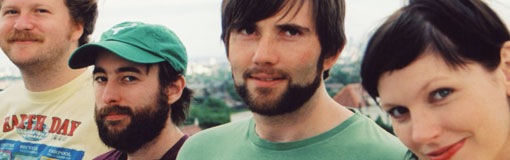
Allo Darlin'

“My Heart is a Drummer” – Allo Darlin’

So we should be clear by now, class, that there is no formula here, no checklist that leads, guaranteed, to a great song. But if I were forced to identify one characteristic that gives a song a leg up, that sends a song soaring skyward rather than plummeting earthward, it might be this: movement. (For those who thought I might say a ukulele, no, but I like how you’re thinking.) A song becomes too easily dreary or dull without a sense of movement; while a song that moves is a song you are more likely to want to hear again, a song that warms and nourishes and reminds you of that all-important, often-overlooked detail: you are alive.

Movement does not have to mean speed. But movement means we do not, as a listener, feel we are stuck, and we do not feel we are waiting very long for something to happen (this is pop music, after all, not a Brahms Symphony). Something, rather, is almost always happening—the melody goes from here to there to there, chords shift and shift and shift again, the band finds its groove without veering into a rut, the singer sounds ever so slightly breathless or edgy or even as if he or she is in some way making the words up on the fly.

Needless to say, “My Heart is a Drummer”—a song that is itself about a certain sort of movement—moves. (That there is no introduction gets us off on the right foot.) The melody leaps and prances and yet also resolves with fluid ease, while the fetching Elizabeth Morris delivers her lines in natural yet idiosyncratic rhythms. The band plays along with such locked-in elasticity you almost don’t notice they’re there; this is one of those songs that sounds less arranged than discovered. But if you get around to it, notice how the guitar plays with great judicious ease—I especially like the high, ringing countermelody it offers beginning with the second verse (around 0:44).

Allo Darlin’ is a half-Australian, half-British quartet based in London (leader Morris one of the Australians). “My Heart is a Drummer” is a song from the band’s self-titled debut album, released in June in the UK, and this week in the US, on the Fortuna Pop label.

Free and legal MP3: Jupe Jupe

Irresistible neo-New Romantic camp

“Add As Friend” – Jupe Jupe

Treading that oh-so-fine line between camp and earnestness, “Add As Friend” is a melodramatic, irresistible slice of neo-New Romantic synth pop, complete with a crooning baritone, goofy synthesizer sounds, and an anthemic dance-floor melody. We know we’re in good hands when the intro builds rapidly from a bell-like synthesizer line through a pulsating (and smile-inducing) middle section into full-fledged melodic glory by 0:28—a simple, beautifully crafted instrumental theme that serves as the ongoing heart of the song. I find a song with a wordless hook difficult to get out of my head.

But make no mistake about the camp here. One giveaway is the overtly humorous synthesizer lines which pop up throughout the song—most noticeably at 0:22, 1:26. 2:44, and 3:12, if you’re keeping score at home. At its heart, camp is a joke—even if, often, a serious joke—so humor is always near the surface. Another is the song’s Erasure-esque vibe, and Erasure was nothing if not the camp champion of the New Romantic movement. But as Erasure themselves proved, a camp act can still create really good music. Jupe Jupe has hereby joined the club.

A foursome from Seattle, Jupe Jupe self-released their debut album, Invaders, this week. That’s where you’ll find “Add As Friend.”

Free and legal MP3: Margot and the Nuclear So and Sos (poignant, world-weary ballad)

Poignant, world-weary ballad from a shape-shifting band that has previously inspired both a cult following and an impressive amount of critical invective. But there’s little not to like here, or, truly, on the rest of their fine new album, Buzzard.

Margot and the Nuclear So and Sos'

“Lunatic, Lunatic, Lunatic” – Margot and the Nuclear So and Sos

Poignant, world-weary ballad from a shape-shifting band that has previously inspired both a cult following and an impressive amount of critical invective. But there’s little not to like here, or, truly, on the rest of their fine new album, Buzzard. From the clarity of the acoustic guitar to the subtle, well-chosen embellishments to front man Richard Edwards’ elusive and compelling voice, “Lunatic Lunatic Lunatic” commands and rewards attention. And don’t miss the song’s revelatory transformation from a sleepy, singer-songwriter-y narrative to a compelling band piece, which begins with the backward-sounding guitar break at 2:23. Compare how Edwards sings the song’s first lyrics, beginning at 0:29, to how he conveys them with the band at 2:56—compare in particular the two different voices he uses for the phrase “all the time.” Same words, same notes, and yet he almost sound like two different singers.

Turns out that “Lunatic, Lunatic, Lunatic” is one of those admirable songs for which the strength of the music and performance deeply invigorates the lyrics. I might not otherwise be engaged by the second-hand exploits of some supposedly crazy, unappealing young woman, but the melody and vibe grab me and cause me to reevaluate what I’m hearing. I stop to consider why the narrator is spending so much time on this grubby tale. Why, in fact, does he insist on calling this girl a lunatic not just once but three times each time? Weaker music would kill the story; here I intuit grand subtext. By the end of the song, listened to a certain way, one might legitimately wonder who the actual crazy person is.

Originally from Indianapolis, now Chicago-based, Margot features not even one person named Margot. Once something of a chamber-pop ensemble, the So and Sos have reoriented their sound—it’s a bit roughed up and guitar-based at this point—while re-populating themselves: there are eight of them listed as current members on their Facebook page, but only three remain from their initial incarnation. (Among the new folks is singer/songwriter Cameron McGill, who himself was featured on Fingertips just around this time last year.)

Buzzard was released on Mariel Recordings last month. MP3 via Filter Magazine.

October Q&A: Eux Autres

The October Q&A chats with Heather Latimer, who with her brother Nick comprises the San Francisco-based duo Eux Autres. Full of authenticity and energy and musical know-how, Eux Autres—pronounce it “ooz oh-tra,” with the “oo” as in “good,” if you would—to me is something of the quintessential 21st-century indie rock band: talented, musically astute, unsung, humble, hard-working. That they are also thoughtful and considerate folks is a bonus, and something you’re likely to pick up by reading Heather’s answers to our continually unanswerable monthly questions.

Eux Autres was featured in September for a wonderful Bruce Springsteen cover they did a couple of years ago, which continues to find fans online, but Heather and Nick’s ties with Fingertips go back to 2005, when they were featured for the charming dead-pan French-language garage rocker “Ecoutez Bien,” from the duo’s 2004 debut Hell Is Eux Autres. May as well note too that “Ecoutez Bien” furthermore ended up on the late great Fingertips compilation CD, Fingertips: Unwebbed, which was available for a limited time in 2007 as a gift for contributors.

The band’s latest album, Broken Bow, comes out next month. They’re offering a new free and legal download from that album, the song “Go Dancing,” over at Bandcamp.


Eux Autres


Q: Let’s cut to the chase: how do you as a musician cope with the apparent fact that not everybody seems to want to pay for digital music? Do you think recorded music is destined to be free, as some of the pundits insist?

A: It’s very difficult. Right now, the music industry is in some sort of limbo. Because if recorded music is destined to be free, then eventually someone’s going to have to figure out how to subsidize its creation. Recording music is incredibly expensive, both in effort and actual money. There’s been some democratization of recording with more accessible home equipment, but most of the bands you care about aren’t making records for free in their basements. So when no one wants to pay for songs, it dramatically inhibits artists’ ability to continue making music. And even with the bigger bands—if no one’s buying, then the advances and recording budgets are obviously going to go away. Eventually, there’s got be some sort of major adjustment in the equation, one one side or the other.

Our band tries to cope with the current music economy by taking the long view, taking a deep breath and trying to focus on what we want to bring into the world—regardless of whether it’s valued in the monetary sense. We trust that it has a cultural value beyond what is reflected in our iTunes checks. And we spend a lot of time thinking about the whole package, not just the MP3 as heard in a vacuum. It pushes us to pay more attention to the cohesion of everything—the artwork, the themes—and to try to make beautiful and interesting actual physical objects. But then again, we’re sort of extreme. We think that making crest-shaped lapel pins is an awesome use of our merch budget.


Q: Related question: there’s a lot of talk these days that says that music in the near future will exist in the so-called “cloud”—that is, on large computer networks—and that music fans, even if paying, will not need to “own” the music they like any longer, since they will be able to simply listen to everything on demand when they want to. How do you feel about this lack of ownership? Do you see anything really good or really bad in the idea?

A: It’s an interesting idea. On one hand, it seems sort of like having a musical harem. You’re certain you’ll get laid one way or another—you don’t have to commit to or support anyone in particular, there’s always that pack waiting for you. I think it’s unfortunate, because historically listeners have gotten so much out of being committed to bands, following them through triumphs and missteps and weird phases, and deciding when to break up with them—really having to figure out if you can stomach Black Flag’s My War or if they’d just gone too far.

But then again, the cloud model also seems progressive, a kind of artistic socialism. Maybe tons of artists under the same umbrella or system can share the “wealth” and help each other stay afloat.


Q: How has your life as a musician been affected—or not—by the existence of music blogs?

A: I think our musical lives have been affected a lot by blogs. So many more people know about Eux Autres than would have in the analog model. And luckily, so far, the blogosphere has been very, very supportive. Since we’re not some juggernaut, no one has gone out of his or her way to take us down. It seems if people don’t like us, then they don’t write about us. Of course, there’s a downside of blogs. I miss just walking down to the record store in Omaha and grabbing a mysterious 7″ and having no preconceptions about what I was about to listen to. It was just the cryptic artwork and the music. And I was totally free to develop my own reaction in the privacy of my own home.


Q: What are your thoughts about the album as a musical entity— does it still strike you as a legitimate means of expression? If listeners are cherry-picking and shuffling rather than listening all the way through, how does that affect you as a musician?

A: I absolutely believe in the album. A good album is like a well thought-out meal. It has stages, and each stage deepens the experience, rather than just moving along the surface. That said, the album didn’t really exist before the late ’60s, and I don’t think it’s the only way to do it. There are a lot of bad albums in the pop world because people are building around one or two singles. I really wouldn’t mind if it went back to a singles-dominated game, and people only felt the need to make albums when they were really inspired to do so.


Q: What is your personal preferred way of listening to music at this point? Describe the circumstances (are you in an otherwise quiet room? in a car?), the technology (laptop? iPod?), how you choose what to listen to (random shuffle? full albums?), and anything else of relevance to your listening habits.

A:: It’s funny, I’ve gotten so much less flexible about listening to music. It’s really hard for me to do anything else if music I care about is playing. My friends get annoyed because I can’t even converse; I’ll be in a coffee shop and Elliott Smith’s “Speed Trials” comes on and I totally forget where I am. My ideal situation is a quiet room, for sure. And I still very much like to listen to albums. I like surrendering to the duration of it. I really try not to skip past songs—it seems like cheating.

Free and legal MP3: Amy Bezunartea (strong, swaying, poignant)

With a swaying, mournful melody, “Doubles” hits home hard for its offhand lyricism. The narrator sings of the harsh, unexceptional struggles of daily urban life in America in the 21st century with the deft touch of a short story writer (“Taking orders in her sleep/All those hours that she keeps”).

Amy Bezunartea

“Doubles” – Amy Bezunartea

Even now, in 2010, there are untold gazillions of singer/songwriters out there singing acoustic-guitar-based songs. The robots haven’t won yet. Then again, most of these songs are earnest and forgettable, so maybe those robots are wilier than we already think. But the glimmer of hope, every year, is that there are four or five or six that turn out to be almost mysteriously wondrous—not just songs that are pleasant enough to hear once or twice (there are plenty of those), but songs that strike deep within the soul, songs that become part of your life. Here is one of 2010’s best.

With a swaying, mournful melody, “Doubles” hits home hard for its offhand lyricism. The narrator sings of the harsh, unexceptional struggles of daily urban life in America in the 21st century with the deft touch of a short story writer (“Taking orders in her sleep/All those hours on her feet”). And I have to say, I more than ever appreciate the singer/songwriter—someone who takes her troubles and finds poignancy and humanity in them (“Some girls they like to win/But instead they’ll serve you lunch”) rather than fear and suspicion, someone whose intelligence naturally seeks connection rather than someone whose ignorance flails them towards divisiveness. Maybe you see what I’m getting at.

Anyway. Bezunartea’s voice is the marvel here that seals this song’s fate. She sings with the unadorned, reverbed loneliness of a standard-issue DIYer with one big difference: she can really sing. I mean really. It’s almost a revelation to hear someone with a plain-spoken voice like this with this level of tone and control. I can appreciate a good off-key indie moment as much as the next guy but it’s a subtle relief to the brain not to be continually if unconsciously waiting for that next moment when the note the singer hits doesn’t quite match the melody.

“Doubles” is from Bezunartea’s debut CD Restaurants and Bars, coming out in November on Kiam Records (a label run by singer/songwriter Jennifer O’Connor). The album was produced by John Agnello, who is known for his work with Dinosaur, Jr. and Sonic Youth, among many others. MP3 via Kiam; thanks to Largehearted Boy for the head’s up.

Free and legal MP3: The Fresh and Onlys (R.E.M. meets the National, out West)

An inscrutable blend of the retro and the up to date, “Waterfall” combines a galloping, lonesome-Western feel with a bit of garage-rock psychedelia, a touch of present-day indie-rock eartnestness, and the tumbly muddiness of an early R.E.M. song (aided by “Waterfall”‘s “Driver 8”-like bassline; and we’re in the same key here too).

The Fresh and Onlys

“Waterfall” – The Fresh and Onlys

An inscrutable blend of the retro and the up to date, “Waterfall” combines a galloping, lonesome-Western feel with a bit of garage-rock psychedelia, a touch of present-day indie-rock earnestness, and the tumbly muddiness of an early R.E.M. song (aided by “Waterfall”‘s “Driver 8”-like bassline; and we’re in the same key here too). And yet those influences/attributes aren’t really as separate as listing them out makes them seem, because here in rock’n’roll-land, all the good and true musical strains intermingle and cross-breed and overlap as bands continue to combine them in interesting ways.

Singer Tim Cohen sells this one with his portentous baritone, bringing the National’s Matt Berninger at least a little to mind. And I think the words he sings, almost incants, have a lot to do with this song’s appeal, even as they are rather deliberately unfathomable—an unstoppable torrent of pronouncements playing the words “TV” and “radio” off one another in a way that makes more sense aurally than literally. But in the midst of the semi-nonsensical flow there is one central, striking comment, smack in the middle of the song: “The TV said that you can’t believe every little thing that you see/But you and I know from the radio that’s what we believe.” Suddenly we’re talking politics again (see above); so never mind.

The Fresh and Onlys are a quartet from San Francisco, together in one form or another since 2004. “Waterfall” is from the band’s third full-length album Play It Strange, due out next month on In The Red Records.

Free and legal MP3: Justin Townes Earle (jaunty suicide note, w/ subtext)

A nice, chugging bit of country-like indie rock, and right away one of the fun things is that we’re talking about New York City here. The juxtaposition is purposeful, and while Earle’s dad Steve has done a bit of this, the senior Earle has been less inclined to make out-and-out country music since moving in to Manhattan in the mid ’00s.

Justin Townes Earle

“Harlem River Blues” – Justin Townes Earle

A nice, chugging bit of country-like indie rock, and right away one of the fun things is that we’re talking about New York City here. The juxtaposition is purposeful, and while Earle’s dad Steve has done a bit of this, the senior Earle has been less inclined to make out-and-out country music since moving to Manhattan in the mid ’00s. The son however is clearly on a mission to give listeners a good helping of cognitive dissonance as he deals, on his new album, with rivers and trains and other country-music-like subjects in the context of a gritty, crowded urban landscape.

Another point of dissonance: this chipper-sounding toe-tapper tale is a tale of someone apparently planning his suicide, jumping into the aforementioned Harlem River. Earle, with an agreeable, textured voice, gives himself a huge choir to back up his declaration and, not to make light of it, but if you’ve gotta go, that’s the way to go. Maybe the narrator is so beaten down by life he’s charged up by the idea of ending it, or maybe he’s finding a renewed interest in living via his specific ideas about where he wants to die, but he’s got style either way. Another layer at work here is that Townes Van Zandt, the revered but troubled songwriter after whom the younger Earle is named, had a long flirtation with suicide himself. Yet more subtext: Earle, still just 28, has a previous history of drug addiction, like his father.

“Harlem River Blues” is the title track to Earle’s fourth album, released this month on Bloodshot Records. MP3 via Bloodshot; thanks to Largehearted Boy once more for the lead.

Free and legal MP3: John Vanderslice (brisk, concise, minor-key tale)

John Vanderslice songs often resemble dark, elusive short stories; something is happening here, but you don’t know what it is. We’re typically in the middle of something very specific, but with the large-scale details omitted in favor of tiny observations that simultaneously add atmosphere and blur the narrative.

Green Grow the Rushes

“I’ll Never Live Up to You” – John Vanderslice

John Vanderslice songs often resemble dark, elusive short stories; something is happening here, but you don’t know what it is. We’re typically in the middle of something very specific, but with the large-scale details omitted in favor of tiny observations that simultaneously add atmosphere and blur the narrative.

Even when JV gives us the premise with an explanatory note ahead of the lyrics this time (“A father so domineering and imperious, he’s even intimidating on the embalming slab”), we get history only hinted at, emotional short-cuts that bypass the details of what this father wanted and why the son didn’t or couldn’t do what was expected of him. “If they would believe me/I would tell them all the truth about you,” the son sings. What truth? Who are “they”?

The lyrics are, as usual, supported by music as concise as possible; check out, right away, that eight-second intro, and how even there, the instrumental line is a melody, not a vamp. “I’ll Never Live Up to You” offers, generally, a brisk, minor-key setting but also an ongoing font of specific moments that contribute to the whole—it’s almost as if you could take a slice of any point along the way, an aural biopsy if you will, and discern the song’s larger intent and meaning. And how on earth did he decide to use saxophones here? Anchored at the bottom of the mix, they emerge only as the song unfolds, grounding it in an organic foundation, despite the synthesized ambiance, representing the almost-buried nature of the narrator’s referenced but unspoken truth. And it was surely a conscious choice for Vanderslice to sing the song mostly in vocal layers with himself, with the melody led by an almost whispery upper register voice. We only hear his regular singing voice at one specific time in the chorus, when he repeats the words “about you” (first heard at 0:56)—a subtle but telling way to illustrate how this unfortunate son remains bound and tied to his long-dead father.

“I’ll Never Live Up to You” is one of six songs on a new, free digital EP, released last week. You can download the whole thing at his web site, complete with artwork, lyrics, and credits, or you can download individual songs.

Free and legal MP3: Jared Mees & the Grown Children (homespun hoedown w/ cosmopolitan concerns)

Engaging, homespun hoedown, with a loose, swift sense of purpose about it. But for all its back-porch, fiddle-fronted ambiance, note how the song has no obvious lyrical connection to dirt roads and rustic living beyond its title image; we hear instead contemporary words and phrases like television, red ink, lead actor, tragicomedy.

Jared Mees and the Grown Children

“Cockleburrs and Hay” – Jared Mees & the Grown Children

Engaging, homespun hoedown, with a loose, swift sense of purpose about it. But for all its back-porch, fiddle-fronted ambiance, note how the song has no obvious lyrical connection to dirt roads and rustic living beyond its title image; we hear instead contemporary words and phrases like television, red ink, lead actor, tragicomedy. Towards the end of the song, Mees rhymes “cradle-robbing capillary blocker” with “limp-wristed back-alley stalker.”

This ongoing tension between the song’s cosmopolitan concerns and its rural sound is a good part of the charm. The ensemble’s spirited, toe-tapping energy pretty much takes care of the rest. Exactly who the Grown Children are at any one time has not been made clear, it being a name for, basically, whomever shows up and plays with Mees at any given time (more than 20 players are identified, by first name, on the MySpace page). The informality of the gathering, combined with the quality of the musicianship, is, I think, what lends this song its particular flair—it doesn’t sound painstakingly rehearsed as much as spontaneously combusted.

The Portland, Ore.-based Mees originally recorded “Cockleburrs and Hay” (minus one “r”) for his 2007 solo album If You Want to Swim With the Sharks; this is a new and improved version of the song, recorded during a recent studio session and not yet on any album. The group’s first album, Caffeine, Alcohol, Sunshine, Money, was released in 2008 on Tender Loving Empire.

Free and legal MP3: Liam Singer (elegiac, piano-based, canon-like)

Solemn, piano-based composition with a whiff of the Renaissance about it. Liam Singer has a plaintive, Elliott Smith-like tenor, and pairs himself vocally here with Wendy Allen, of Boxharp, who sings an intricate counter-melody with the airy, earnest bearing of a traditional folk singer.

Liam Singer

“Winter Weeds” – Liam Singer

Solemn, piano-based composition with a whiff of the Renaissance about it. Liam Singer has a plaintive, Elliott Smith-like tenor, and pairs himself vocally here with Wendy Allen, of Boxharp, who sings an intricate counter-melody with the airy, earnest bearing of a traditional folk singer. The song they create together is both deliberate and hypnotic, with a canon-like melody that climbs and descends and circles and fits back together with itself without any apparent starting or end point, and no sense of chorus or verse.

The overall feel is elegiac; the lyrics are inscrutable but there is a strong sense of lament here, accentuated by the centuries-old sensibility working its way through this contemporary recording. The ear is not necessarily surprised, then, when a harpsichord joins in at 1:54. But my ear, in any case, is delighted by the wondrous series of slightly cockeyed ascending lines the instrument plays. The dusty, tinkly sound Baroque composers demanded of the instrument is summarily dismissed, and the world breathes a sigh of relief.

Born in Portland, Oregon and now living in Brooklyn, Singer studied musical composition at Kenyon College; his primary instrument was, yes, the harpsichord. He plays in a band called Devil Be Gone with Rob Hampton (formerly of Band of Horses) and also tours on keyboards with the Brooklyn-based Slow Six. “Winter Weeds” is from Singer’s third album, Dislocatia, to be released next month on Hidden Shoal Recordings, based in Perth, Australia. MP3 via Hidden Shoal.