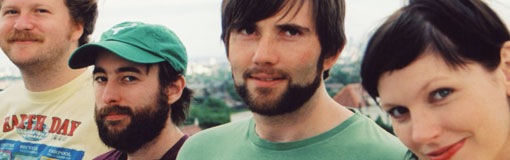
Free and legal MP3: dEUS (hard-driving, catchy, w/ speak-singing)

No-nonsense rock’n’roll, both hard-driving and melodic, and yet too with an almost gracious sense of purpose.

dEUS

“Ghosts” – dEUS

No-nonsense rock’n’roll, both hard-driving and catchy, and yet too with an almost gracious sense of purpose. The opening keyboard riff sounds like a regular old piano, and gives the song an old-school swing that brings to mind the kind of radio-friendly rock made in the ’60s that was not itself Motown but existed only because Motown existed, if that makes sense.

And yet “Ghosts” is hardly a nostalgia trip; the feeling is more timeless than retro, more hybrid than homage. Front man Tom Barman speak-sings the verse in a way that both grabs the ear and fully informs you that he is not a rapper. (I don’t mean that as a criticism, just as an observation that rock singers have a particular way of speak-singing lyrics that is its own kind of thing.) The speak-singing interrupts the flow created by the catchy keyboard riff, drawing the song in on itself, creating both tension and anticipation—it is only a matter of time before that piano line returns, and when it does it finds itself in the center of the chorus, as much a part of the hook as the actual melody. The song’s last two minutes—right after the line “So chase the ghosts away ’til they’re gone”—crank up the drama and the noise as the band tips its hat more directly to its roots as an experimental outfit influenced by the likes of Frank Zappa and Captain Beefheart. (I like the “hoo! hah!”—but sometimes also just “hoo!”—exclamations that now begin to interject into the proceedings.) And then everything just stops as if accidentally deleted.

Based in Antwerp, Belgium, dEUS was founded way back in 1991, but has recorded only seven studio albums to date, including two in the last two years. The only other remaining original member besides Barman is Klaas Janszoons, who plays keyboards and violin. The band, complete with its odd typography, remains relatively unknown in the U.S.; their records have only been sporadically released here. “Ghosts” is from the album Keep You Close, which came out a year ago in Europe. That album and 2012’s Following Sea were both released in the U.S. for the first time this fall, on the label [PIAS] America.

Free and legal MP3: Allo Darlin’

Brisk, jangly, and wistful

Allo Darlin'

“Northern Lights” – Allo Darlin’

Brisk and jangly, “Northern Lights” appears indeed to move too quickly for its own lyrics, as sweet-voiced Elizabeth Morris has repeatedly to squeeze extra syllables into tight aural spaces. The effect is somehow fetching. Listen, for example, to how she sings “suddenly came apart” (0:43), or how she handles the opening part of the lyric “And it makes me feel so alive” (1:09). The melodies, meanwhile, with their mid-stride minor-key modulations, have an undertow of wistfulness about them.

The song’s musical and lyrical fulcrum, to my ears, is the chorus lyric “This is the year we’ll make it right,” first heard at 1:12. The chorus presents us with a speedy gallop through a repeatedly descending, vaguely Christmasy melody line, its first two lines covering the same basic interval in such a way that the second line is subtly accentuated. The second time we get to the first two lines, in the second half of the chorus (is anyone still with me??), this moment feels extra-accentuated. And this is where we are when we get to “This is the year we’ll make it right.” And wouldn’t you know that everything else, moving forward, about the song—the “wait for me!” pace, the sweet-voiced singer expressing hopes and dreams, the lower-register guitar melody (consciously or not echoing the Blondie classic “Dreaming” starting at 1:23)—pretty much says hmm this also may not be the year you’re going to make it right. But, you can keep dreaming. (As luck would have it, Blondie will yet have the last word this week; see below.)

Allo Darlin’ is a London-based four-person band split between Brits and Aussies. “Northern Lights” is the third single from the band’s second album, Europe, which was released back in May on Slumberland Records, but the first I’ve found as a free and legal MP3. Thanks to Largehearted Boy for the lead. You can download the song via the title above, or at the record company’s SoundCloud page. The band was featured previously here in October 2010. The three gentlemen in the band are still wearing the same shirts.

Free and legal MP3: Chamberlin (smartly reimagined Paul Simon cover)

Brilliantly re-arranged to highlight the original’s strange and moody lyrics.

Chamberlin

“You Can Call Me Al” – Chamberlin

So it seems that Chamberlin guitarist Ethan West was driving down the New Jersey Turnpike one day, not exactly in the best mood, and heard Paul Simon’s “You Can Call Me Al” on the radio and was struck all of a sudden by how strange and brooding the lyrics are, despite the upbeat vibe of the music. He and the band, with a history of covering unexpected songs, decided to try to rearrange the things accordingly. And boy do they. These guys kill right away with their conversion of the original’s bouncy synthesizer riff into a wailing guitar (0:13), distilling Simon’s four full, cheerful iterations into a lead line that takes us through the motif just one and a half times, leaving us edgy and unresolved. Singer Mark Daly dives into the lyrics—previously sung so drolly by Simon—with a moody disquiet, sounding like an outtake from the first Counting Crows record.

Everything falls into place from there; this version has an instant, enviable inevitability about it. I love the effortless tension the band introduces in the chorus, as the familiar but still inscrutable line “If you’ll be my bodyguard/I can be your long-lost pal” is sung not with a wink and a skip as Simon did it but with a kind of harrowing plea (starting at 1:08), as a gathering drum beat sets up a stretching out of the word “long” that mirrors the original but in an utterly transformed context and culminates in the return of the central instrumental motif, now an unmitigated howl. Don’t miss as well how the band converts Simon’s cheerful “na-na-na-na” break into a slowed-down, cleared-out instrumental in which the percussive bass line in the original becomes a ghostly, intermittent clatter of drum sticks. If everyone affected cover songs with this much skill, no new songs might ever more have to be written.

Chamberlin is a five-man band from Vermont that was founded in 2010. They have released one album and two EPs to date, the most recent release being their Look What I’ve Become EP, which came out in September. “You Can Call Me Al” is a separate song, newly released. Thanks to the band for the MP3. You can download above the usual way, or visit the band’s SoundCloud page for streaming and/or downloading and/or commenting directly to the band. Be sure also to check out the band’s web page, where you can listen to the entire EP, download a song from it, and find tour dates for its fall tour, just underway.

Free and legal MP3: Blondie (spacey, w/ heavy guitar & potent melody)

A spacey, meditative thing with a heavy-guitar core, the song features Harry in dreamy mode, voice further altered by distortion–an effective sound for late-era Blondie.

Blondie

“Bride of Infinity” – Blondie

The legendary NYC rock band Blondie has been around long enough to have had by now not one but two different reunion incarnations. The first came in 1997, with the unexpected release (and success) of No Exit. The reformed band, featuring four of the original six members, took six years to record a follow-up, the smartly-titled but less successful The Curse of Blondie. Shortly thereafter, they lost original keyboardist Jimmy Destri to rehab. Another hiatus ensued, until the remaining threesome—Debbie Harry, Chris Stein, Clem Burke—were roused into action by the occasion of the 30th anniversary of the release of the group’s breakthrough album, Parallel Lines, in 2008. Word at the time was that the band, reformed with two new members, was working on a new album, which eventually became 2011’s Panic of Girls, another mixed bag at best.

So what’s a long-time fan to do? Blondie in their heyday were sensational, but their heyday was 30 years ago. It’s weird enough when our rock heroes grow old but it’s one thing when they’ve been making an effort to stay in the musical stream of things, so we can kind of (sort of) get used to their aging (Paul McCartney and Bob Dylan and Paul Simon are the models here). It’s another thing when they disappear for 20 years or so and then come back and say “Here we are!” when it’s not at all clear who “we” are, and where exactly “here” is. I found one song on The Curse of Blondie I’ve wanted to listen to more than once or twice (“Rules For Living”). Panic of Girls struck me as okay but unremarkable, but maybe I’ve haven’t given it enough of a chance. Thing is, I’m not sure I’m as happy, yet, listening to Debbie Harry’s 65-plus voice as I was her 30-something voice; the change is subtle but noticeable. But I’m going to stay with her still because, well, she’s Debbie Harry for crissake.

And so, finally, we arrive at “Bride of Infinity,” one of three songs the band abruptly released as free and legal MP3s this month. A spacey, meditative thing with a heavy-guitar core, the song features Harry in dreamy mode, voice further altered by distortion. This is an effective sound for late-era Blondie, especially when coupled with the kind of strong melody that made their best songs so deeply pleasurable. This one is an unusual six measures long, with an instant repetition; thoughtfully-paced, the melody glides fully up and down the scale, using all eight notes (where one and eight are the same note, an octave apart), which is both graceful and uncommon. There is no chorus, just two instrumental breaks in between the three run-throughs of the verse, and get a load of that second instrumental break (2:20), an understated world-music hoedown featuring what sounds like a sitar and some alternative percussion. Blondie was always at its best when flaunting a humor so deadpan you can’t always be sure it’s even there.

You can stream and/or download all three new tracks via the band; one of them is a cover of the David Essex nugget “Rock On.” Note that I’m offering the MP3 above as usual but I will encourage you to use the widget below for downloading because I’m not actually sure I should be hosting this but I felt compelled to. Having Blondie on Fingertips is an honor.

Fingertips Q&A: The Ampersands

The FIngertips Q&A returns with Aaron McQuade and Jim Pace, who make music together as The Ampersands.

The Ampersands are a duo that make zippy, perceptive, carefully constructed indie pop grounded in the aural universes of smart-pop progenitors Fountains of Wayne and They Might Be Giants. You may remember these two from the song “Try This,” which was featured here last month. If not, perhaps you are not paying close enough attention.

Multi-instrumentalist Aaron McQuade and guitarist Jim Pace have been making music together for more than half of their lives at this point. They both do the singing and the writing and they both were kind enough to sit down and take a crack at the the Fingertips Q&A questions. Actually I don’t know if they were sitting down. But here are their answers. Aaron’s come from New York City, Jim’s from Providence, where they are, respectfully, based.

Note that the duo’s new album, This Is Your Adventure Too, is coming out on October 30th. Check it out via its smartly-designed web site.

The Fingertips Q&A, for the uninitiated, is a recurring feature. More than three dozen artists to date have participated. The Q&A’s sole intent is to allow actual, workaday 21st-century musicians a forum for discussing the state of music in the digital age. I’m tired of hearing mostly from so-called experts who by and large have huge vested interests in their “future of music” pronouncements.

The Ampersands

Q: Let’s cut to the chase: how do you as a musician cope with the apparent fact that not everybody seems to want to pay for digital music? Do you think recorded music is destined to be free, as some of the pundits insist?

AARON: Depending on where you are on the issue, the operative word there could either be “destined” or “doomed.” Free digital content can certainly lead to increased awareness, greater buzz, and ultimately, a big spike in legitimate sales (Google “4Chan Steve Lieber” for an example). Unfortunately, that free digital content is usually not provided on a volunteer basis by the producers of said content. Honestly, I personally would probably feel differently about it if Jim and I were more than two dudes, or if we lived within a few hundred miles of each other. That way we could play regular shows, and I’d be a lot more willing to provide free content to build buzz and drive people to those shows.

From where I sit, the fact that anything that can be digitized is destined/doomed to be free is both good and bad. If someone pirates our record, and someone else downloads it for free, I wouldn’t really blame them, because nobody’s heard of us, and who’s going to drop money on a record completely sight-unseen? (or “sound-unheard?”) But if they get it and love it, I’d be pissed if they didn’t then go and legally buy a copy—or at least legally buy our last record. I would be lying if I said I’ve never obtained digital content that wasn’t completely on the up-and-up. But I’d also be lying if I said that those few downloads haven’t led to hundreds of dollars in legit sales that I’ve given to the things I’ve discovered. That doesn’t make it moral, and it certainly doesn’t make it legal, but I don’t think it should be left out of the conversation either.

JIM: Probably in the same way I cope with the fact that nobody wants to pay for anything. The issue isn’t that people are willing to get something for free (even if it isn’t 100 percent legal), but that it’s incredibly easy to download music and software illegally. And there are (almost) no repercussions. I don’t think someone who regularly downloads Microsoft Windows and Office torrents would ever steal that same software from a Best Buy, because there’s a ton more risk involved there and the reward (saving one or two hundred dollars) is not worth it.

Per Aaron’s response above, I’d be ecstatic if someone pirated our album, and then immediately disappointed if that didn’t lead to them buying the album legitimately. I’d counter the “recorded music is destined to be free” theory with this: Why should it be free? Because you want it to be? It’d be great if stuff was free, but people have to make money to eat and drink and live. Arts need to be supported, and the support of music is done partly through buying someone’s recordings.

Q: What do you think of the idea that music is destined for the “cloud”? How do you, as both a musician and a listener, feel about this lack of ownership, about handing a personal music collection over to a centralized location?

JIM: I’m not sure I equate putting music onto the cloud with losing ownership. I mean, I guess the cloud can be hacked, but so can my computer, right? I think the fact that it allows you to download a song you purchased onto multiple devices is great. At least I think this is how it works for Apple, Amazon, etc…

AARON: This is going to be corny as hell, but art—and music in particular—has ALWAYS existed in “the cloud.” It comes down to how you define “ownership.” Is music a tangible commodity that can be owned by an individual and and distributed at will? Is music an experience, thoroughly unique every time, owned by he or she who is doing the experiencing? Some of both? All of both?

Q: Technology has become so all-consuming in the 21st century that it seems in a way to be overwhelming the very idea of music itself. How do you guys stay in touch with music versus the technology that surrounds music? Do you even feel as if that’s important, or has everything truly changed?

AARON: Technology that’s used to create, distribute, or consume music is, I think, inseparable from the music itself. To me, finding the right technology (or figuring out how to best navigate the technology you have) is just as important as writing the right chord progression, or finding the right place for harmonies to overlap. And of course, “right” is subjective. To some, music sounds better when it sounds as though no “modern” technology was used. Others think it sounds better when technology smoothes over all the imperfections. To most, it’s probably somewhere in the middle. Now, did we go and use auto-tune on this record? HELL YES WE DID! But we didn’t go nuts with it.

JIM: I think, in regards to technology, that everything has changed, but for the better. I think it’s analogous to television. Forty years ago, there were three channels. Then the technology came along that allowed everyone to have 500-plus channels. Yes, there’s a higher percentage of shitty TV out there, but the overall number of brilliant shows is way, way higher than it was 40 years ago.

In regard to music, Pro Tools has allowed everybody to make an album (see Ampersands, The). Again, there’s a higher percentage of shitty music out there, when compared to 15 to 20 years ago. But I think there’s a lot more good-to-brilliant albums out now that could/would not have seen the light of day. I actually don’t think having 5,000 songs on an iPhone detracts from the enjoyment of said music. I think it’s wonderful that someone can have their entire music catalog in their pocket, and on a device that can also surf the web and make phone calls!

Q: One obvious thing the digital age has introduced is the ease of two-way communication between artist and fan. Does this feel like a benefit or a distraction, or a little of both?

JIM: Sometimes I don’t know what to think about Twitter/Facebook. At times, I thoroughly enjoy a comedian, musician, writer, or actor I like releasing his thoughts into the ether. And then there’s the millions and millions of inane why-on-earth-do-you-think-somebody-would-care posts/tweets. Overall, though, I’d say if you want to get a sense of who these celebrities are, it makes sense to bypass the middle men (the press). That allows you to more quickly find out what Snooki had for breakfast (spoiler alert: gin).

AARON: While it does make it significantly more difficult to separate the art from the artist, I will say that as a fan, the ability to interact easily with artists whose work I admire is truly an incredible experience. As an artist, I can only dream about the day when people will feel the same way about interacting with me. I will say that I’ve gotten a few new twitter followers since putting my name on the album’s website (@AaronABCP) and I can almost guarantee that they’ve been seriously disappointed to discover that I only talk about Pokemon, comic books, and the Oakland Athletics.

Q: There is clearly way more music available for people to listen to these days than there ever used to be. How do you as a musician cope with the reality of an over-saturated market, to put it both economically and bluntly?

AARON: To us, it’s not a matter of “coping” with it, it’s a matter of taking advantage of it. Jim and I have been making music together for nearly twenty years, and we’ve only put out two full-length albums, both within the last four. If you want to become famous, the barrier is still just as high as it’s ever been—if not higher. You still need to devote 100 percent of your life to this career for many many years (90 percent of which is self-promotion) AND be insanely lucky to be in the right place at the right time, playing for the right set of eyes and ears. Even if all you wanted to do was make good music and maybe hope to make back the money you spent producing them, in the past you still desperately needed the luck factor, because recording was so prohibitively expensive. Today, if that’s your only goal, you don’t have to worry about luck being part of the equation.

JIM: I really can’t worry about the fact that there are X million bands releasing albums. The only thing we can focus on is our album. Let’s make it as good as possible. If the stars align and it gets noticed—great. If not, let’s make another. Everything else is out of our control.

Free and legal MP3: Elim Bolt (droney guitars, indelible chorus)

There is something so cumulatively affecting about “Farm Kid” that it manages to seem a little short even while clocking in at over four and a half minutes. That’s usually the length at which songs begin to seem a little long.

Elim Bolt

“Farm Kid” – Elim Bolt

With something of the big ringing clamor of Arcade Fire, “Farm Kid” rocks to a swinging backbeat, adorned with delectably droney guitars. The verse is understated and blurry; we register the beat, bask in the guitar work, and don’t understand a word. And this is how we are led, perhaps against expectations, into a brilliant, indelible chorus. Too catchy for its own good, this chorus messes further with our heads by offering up the song’s only intelligible lyric, which is almost too straightforward for its own good, if it weren’t also so piteous:

And all I wanna do is truly love you
But all I seem to do is deeply hurt you

Otherwise buried in elusive aural mud, front man Johnnie Matthews emerges with these words as a full-fledged crooner, and everything about the song all of a sudden—the melody (half sing-along, half slippery), the lyrics, the delivery—grabs at the soul. The guitar that rejoins us next, first heard in the introduction, has acquired a majestic, pealing air, all the more effective for the nearly-audible distortion it seems to be keeping constantly at bay. (Some of it will break loose during the solo, at 2:49.) There is something so cumulatively affecting about “Farm Kid” that it manages to seem almost still a little short even while clocking in at over four and a half minutes. That’s usually the length at which songs begin to seem a little long.

You’ll find the song on the band’s debut album, entitled Nude South, which is scheduled for release next month on Hearts and Plugs Records.

Free and legal MP3: Themes

Chunky rocker w/ deconstructed vibe

Themes

“Play Along” – Themes

Hung upon a simple, mi-re-do keyboard vamp, “Play Along” quickly becomes a chunky rocker with a playful, vaguely deconstructed vibe. We’re in 4/4 time but things feel craggier than that, especially in the chorus, where the jagged, jiggered melody hints at crookeder time signatures than we are here given. Backing horns start as exclamation points but wander soon into squiggly eruptions that I find charming. Structurally, the song has three regular, repeating parts (verse, pre-chorus, chorus), but listen and you’ll see that beyond a desultory inner rhyme or two, the lyrics don’t rhyme at all, which adds to the cockeyed ambiance.

Themes is the male-female duo of Kelsey Crawford (she) and Jacy McIntosh (he). Crawford plays keyboards, McIntosh guitar—in the case of “Play Along,” he is on a baritone guitar, which offers up a lower register than a standard model. Don’t miss McIntosh’s backing vocals in the chorus: he sings the same notes as Crawford, but is mixed so far down he sounds almost more like rhythm than melody. An engaging effect.

For a duo, they have a kind of an elusive history. (Note: it doesn’t help that the band’s name makes it somewhat Google-resistant.) The two had met in Crawford’s hometown of Minneapolis, but began life as a band in Santa Rosa, CA, in 2005. They moved to Minneapolis in 2007. And then to Portland in 2008. Any number of musicians have floated through to work with Themes, but they remain, at core, a twosome. Although their Facebook page currently lists drummer Nick Dayka as a member too. Is this old news, waiting to be updated, or new news that hasn’t caught up with other press material? Not sure. What is for certain is that “Play Along” will be found on the band’s fifth album, Loveweapons, which is slated for release later this year. But—more elusiveness—no precise date has been set. Thanks to Largehearted Boy for the head’s up.

Free and legal MP3: Aidan Knight (unconventional & affecting)

The joy and the pleasure here come from Knight’s willingness to think beyond the stark restraints of the pop song, and willingness to trust that there may be some listeners willing to take that ride with him.

Aidan Knight

“A Mirror” – Aidan Knight

From its opening sounds—warm, mysterious, unresolved—“A Mirror” lets you know how good it is going to be, and how unusual. This is not a conventional pop song; not only is there no catchy chorus, there doesn’t even appear to be any recognizable verse. What we get instead is a series of motifs—some with lyrics, some instrumental—which do recur, if you’re paying attention, but which need to be listened to a number of times before they begin to coalesce into a meaningful whole.

I suggest giving this song that kind of time. A singer/songwriter from Victoria, BC, himself the son of a singer/songwriter, Knight has the natural touch of a born musician. In lieu of any one instantaneous moment of short-attention-span gratification, “A Mirror” employs its entire almost-five minutes to deliver its ineffable goods. The more I listen, the more individual pieces I grow to love (an early favorite: “I’m alive/I’m alive/I’m right here,” beginning at 0:51), while at the same time acquiring a gradual understanding of the song’s larger arc. I have no idea how a composition like this gets conceived and written, as it’s operating on a much different level than most songs I encounter. And yet also, thankfully, it comes without any avant-garde baggage or contemporary-classical pretenses. Its general musical language is familiar enough, but the joy and the pleasure here come from Knight’s willingness to think beyond the stark restraints of the pop song, and willingness to trust that there may be some listeners willing to take that ride with him.

“A Mirror” is the second of 10 songs on the album Small Reveal, Knight’s second full-length release, coming out later this month on Outside Music. Knight was previously featured on Fingertips at the time of his first album, in 2010. MP3 via Outside Music.

Free and legal MP3: TJ Kong and The Atomic Bomb (gypsy folk punk, or some such thing)

Affable, semi-apocalyptic stomper with gypsy spirit and a goofy heart.

TJ Kong and The Atomic Bomb

“Eye Witness on the Run” – TJ Kong and The Atomic Bomb

Affable, semi-apocalyptic stomper with gypsy spirit and a goofy heart. I know little about TJ Kong and the Atomic Bomb (except that they do happen to be from Philadelphia, yo), but I can hear in this ramshackle, fragmented narrative the unmistakable sound of a potent live band. And, even better, a potent live band that knows how to record well. These two things don’t always coincide. We’ve all been there, right? At a show with an unknown band that happened to be so good you bought the album on the spot only when you listened at home you’re like, okay, this is actually not very good at all? I don’t think that happens with these guys.

Because, first of all, the arrangement is splendid; the band keeps a careful eye on its sonic space, and often lets less do more, allowing individual instruments to make their mark. This doesn’t sound like a bar band just cutting loose for the sake of rocking out. (Never mind that the bass player plays an upright, which is many wonderful things but not a rock-out instrument. Never mind too that the percussion has the delightful air of pots and pans about it.) Second, “Eye Witness on the Run” offers up the delightful combination of melodic momentum and lyrical intrigue. In other words, this is a well-crafted song, however off-the-cuff the band’s vibe. Lastly, front man Dan Bruskewicz has both charisma and chops. Gifted with the rasp of a young Tom Waits, or a middle-aged Steve Earle, he doesn’t bog down in it, navigating the agile, syncopated melody with aplomb, not to mention the lyrics’ parade of evocative phrases (“entrails of steam,” “blue-flame eyes,” “the whispers of glass where the stones had been thrown”). The song is long because it leaves time for the four players to play, but the instrumental section, introduced by the upright bass solo at 3:07, is a gratifying journey itself, not just a meaningless jam. (And I mean jam in the actual sense of the word. Don’t get me started on its dispiriting use as a synonym for “song.”)

TJ Kong and the Atomic Bomb has just released its second full-length album, Manufacturing Joy, and that’s where you’ll find this one. You can check the whole thing out, and purchase it, via Bandcamp. The band’s previous album, Idiots, was released in 2010.

photo credit: Alexandra Marvar

Free and legal MP3: Astronauts, etc. (electronic pop, w/ warmth & texture)

An object lesson in how the delicate variations in computer-generated sound can be used for good instead of evil.

Astronauts etc

“Mystery Colors” – Astronauts, etc.

I enjoy my share of electronic-based music but I will admit I sometimes get weirded out by the immateriality of it all. Knowing that the sounds are all generated by the inscrutable insides of laptops and rectangular boxes with keyboards on them, if nothing else, makes my job here kind of hinky. It’s one thing to talk about the guitar and its aural character, and then maybe the bass, and the drums; it’s another thing to try to talk merely about sounds, the differences between which sometimes are so subtle that the line separating, even, beats and notes seems all but hallucinatory.

If the specific sounds in “Mystery Colors” are, therefore, difficult to identify and/or distinguish, the collective result is nevertheless an introspective pleasure. Anthony Ferraro, the solo mastermind behind Astronauts, etc., is uncommonly adept at creating warmth and texture from the delicate variations in computer-generated sound—and then, double the achievement, turning this warmth and texture into tuneful pop. In physical-instrument-based rock’n’roll, a rapid procession of notes and rhythms typically creates drive or tension; but listen here to how a tranquil vibe is maintained over and above the brisk arpeggios and fidgety beats. A lot of this has to do with Ferraro’s soothing tenor and the silky melody he’s singing. Note in particular the vocal effect during the chorus (first heard at 1:41), when he layers his vocals in two different registers, which creates a kind of whisper effect that feels cozy and personal. The choral break at 2:11 is another nice touch; human voices cut through artifice like nothing else.

Ferraro is a Berkeley-based musician who was on a classical piano performance track until beset by arthritis. Electronic music saved his career, pretty much. I look forward to seeing where he takes it all. “Mystery Colors” is from his first EP, entitled Supermelodic Pulp, which was released last month. You can listen to it as well as buy it via Bandcamp.