“True Religion” – Couch Prints

Fuzzy and buzzy

“True Religion” – Couch Prints

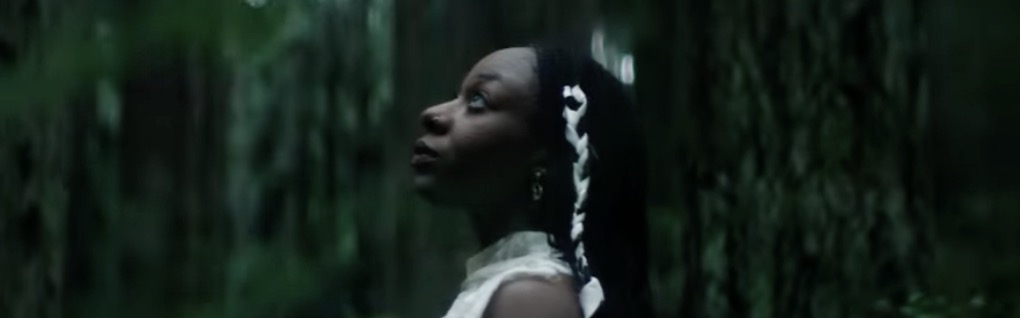
“True Religion” is a coherent tornado of fuzz and buzz, its swirling noise counterbalanced by unexpectedly sweet lead vocals and a concise structure. So, a question: are we starting to experience ’00s nostalgia? Between the terror attack and the economy bottoming out it wasn’t that much fun to live through but hell compared to watching democracy teetering on the edge of fascism, an ideology-crazed Supreme Court eager to treat more than half the population like second-class citizens, and social media continuing to fray our political and social fabric, the ’00s have an oddly innocent glow about them in retrospect. “True Religion” in any case gives me a 2000s feel, with its fizzing amalgam of droning electronics, bagpipe-y guitars, and disembodied vocal samples, guided from above by the feathery soprano of Jayanna Roberts.

I find it interesting to follow the percussion on this one. For the first half or so you might not think so–I’m no expert but the drumming sounds pretty programmed up to that point. All percussion clears out at 1:35 for the first iteration of the chorus, featuring just voice (Roberts in her lower register), guitar, and bass. At 1:49 we get the chorus repeated, an octave higher, with the drums kicking back in. And–again, I’m no expert–but I’ll be darned if the drumming doesn’t sound live now versus programmed. A big hint happens at 2:03, when the drum skitters through a few beats in an agreeably unexpected and (what sounds like a) three-dimensional sort of way. The drumming from this point onward hits the ear as somehow more grounded (listen in particular to the cymbal sounds), so either it’s a human drummer or the program was altered. In any case, all percussion exits abruptly at 2:36 in favor of a brief coda of noise and more of those disembodied speaking voices. Everything wraps up in just under three minutes, which is frequently a sign of a job well done.

Couch Prints is the NYC duo of Roberts and Brandon Tong. “True Religion” is the first single available from their forthcoming debut album Waterfall: Rebirth, which is due out this fall.

“Lover, Don’t Leave Me” – Bocce

Swoony early rock vibe

“Lover, Don’t Leave Me” – Bocce

Speaking of drumming: while you won’t, precisely, hear rock’n’roll’s seminal “Be My Baby” beat here on “Lover, Don’t Leave Me,” that bedrock rhythm is feinted at near the song’s beginning (0:18-0:26). (Listen for the first three signature bass-drum hits; while we never get the climactic fourth wallop you almost can’t help filling it in yourself in your head). The beat underlies the rest of the song even if it’s never spelled out, and goes a long way towards lending a swoony late-’50s/early-’60s vibe to the darkly charming “Lover, Don’t Leave Me.”

The song’s opening moments set the tone, with a whistly synthesizer (or maybe just a whistle?) describing a melody ever so slightly askew; if there’s something of a looney-bin vibe to it I don’t think that’s accidental. Nine seconds in, we go directly to the chorus, which sums matters up in one succinct, repeated couplet: “Lover, don’t leave me/Lovin’ ain’t easy”–the eternal push-pull of a passionate relationship. Singer Sarah Shotwell leans into the part with her honeyed, unhurried phrasing, which includes some muted melismas on the two contracted verbs (don’t/ain’t), adding a delicate achiness that reinforces the song’s echo of early rock’n’roll.

While the lyrics proceed to allude to physical torture, I’m reading them as metaphorical, mirroring the emotional torture baked into the experience of love in all its connective messiness. We even of all things get a quote, in Italian, from Niccolo Machiavelli (2:58) to wrap matters up, which, translated, means, “The insults must be done all at once”; Shotwell adds a bittersweet “caro” (“my dear”) to the sentiment.

And just when you think you’ve heard everything the song has to offer, along comes a background chorus of men’s voices singing, if I’m hearing this right, “Ba ba-ba-ba/Ba ba” (3:43). It’s a goofball touch at just the right moment, shepherding the proceedings to a gratifying conclusion.

Bocce is the trio of Shotwell, David Provenzano, and Christopher Keene. Shotwell and Provenzano worked together previously in the band Fialta. “Lover, Don’t Leave Me” is a track from Bocce’s debut album, Good For You, released earlier this month. MP3 via the band.

“Let Go” – Brooke Bentham

Bittersweet allure

“Let Go” – Brooke Bentham

Launched off a world-weary acoustic strum, “Let Go” turns almost magically beautiful, all resolute melody and intimate, affecting vocals. The song has the bittersweet allure of something that has come down through the decades, not just the months. And it has the feeling of a take recorded with what happened to be handy: “strum this guitar,” “sing in that mic,” “the lyric sheet’s over here if you need it.”

Even when things open up sonically near the one-minute mark, the song retains its tenacity, never filling the space up with more than is necessary, leaning in the chorus on twangy, unresolved chords for drama. And then–speaking of drama–there’s the unusual way the song comes nearly to a halt at around three minutes, finishing with a slow, reflective minute of voice and a guitar strummed even more sparingly than we heard in the intro. The uniting force from start to finish is Bentham’s appealing and penetrating soprano, which holds its silver tone at both ends of the volume spectrum.

Deemed “enigmatic” by her own press material, the Newcastle-based singer/songwriter Brooke Bentham started making and performing music as a teenager, and did her first recordings while still in college. After a flurry of singles and EPs in 2017, beginning with the moody, potent single “Oliver,” she hit a songwriting wall. Her much-anticipated full-length debut, Everyday Nothing, did not emerge until 2020. Three years later we have new music by way of the EP Caring, which is where you’ll find “Let Go,” and three other songs. The EP was released in March; check it out on Bandcamp.

“Showgirls” – Man on Man

Noisy and welcoming

“Showgirls” – Man on Man

For all its fuzzy noise and punk-ish simplicity, “Showgirls” moves with a light touch and a welcoming vibe. The vocals, although filtered, feel personable, while the parade of two-part, closely contained melodies gives the ear an easy hand-hold into the squawky soundscape’s controlled hubbub. A sense of things simultaneously coming together and falling apart is underscored by a set of lyrics that are concise but pretty much unintelligible, a series of sometimes suggestive phrases (“You gotta use spit/If you wanna get used to it”) without any sense of narrative or setting. Whatever is specifically going on, it appears to be a good time, and we seem to be invited along.

Guitars make their presence known quickly and noisily, providing a wash of background buzz from the start, but it’s the instrumental break starting at 1:51 where they really break out, with a squalling six-second opening moment that deserves an extra pat on the back.

Man on Man is the duo of Roddy Bottum, best known as keyboardist for the band Faith No More, and his partner Joey Holman. What started as a pandemic-based lark has solidified into an ongoing endeavor. “Showgirls” is a track from their second album, Provincetown, which comes out next month on Polyvinyl Records. It’s one of a number of songs from the album that were written in and/or inspired by its namesake locale, at the tip of Cape Cod, with its longstanding history of LGBTQ+ respect. As the band’s name implies, Man on Man is not only open about their sexual orientation but they appear ongoingly delighted to celebrate it. We would do well to be delighted on their behalf, as it takes an insecure and/or bigoted pinhead to believe that diversity of all kinds is anything but a planetary blessing.

MP3 via KEXP.

photo credit: A.F. Cortés

“To Supreme” – Will Ranier

The fine line between mysterious and ominous

“To Supreme” – Will Ranier

Any song that opens with the words “There were dark clouds” is unlikely to be super cheery. But however moody a scene “To Supreme” sets, the song retains an underlying spirit of curiosity and resolve, treading the fine line between mysterious and ominous in an agreeable way. Much is established simply via Will Ranier’s plainspoken voice; he sounds like a guy pondering his circumstances with a friend more than a guy undone by dark forces.

While not exactly peppy, the song does stride along with a midtempo pace, anchored by a steady acoustic rhythm guitar and some bass notes on the piano. Intermittent visits from a muted trumpet (played by Ranier) add to the reverberant atmosphere. But clearly the key to the song’s aura is the pedal steel providing fills between lyrical lines, each new echoey flourish different than the previous one. I especially like the discordant notes pedal steel guitarist Raymond Richards sprinkles in midway through (1:26-1:32)–another touch that lightens things away from the sinister.

In the end, perhaps the biggest mystery here is what the title is about. The lyrics do little to enlighten. “Supreme” is where “they” tell the narrator he “should go.” And he “followed their advice,” which led him “into the neon light show.” What the what? Then again, it doesn’t take much search-engine-ing to discover that Supreme is a pizzeria and bar in Seattle, which is where Ranier lives. I can see a songwriter building a mystery around a word laden with as much baggage as “supreme” (there’s the being, the Court, the leader, to start in the obvious places).

Ranier is a musician with a varied discography. “To Supreme” is a track from his forthcoming album, Wobble in the Moon, to be released June 30. While this is only his second solo album, he has one previous album with his band, Will Ranier and the Pines, and nine albums credited to Stuporhero, a duo comprised of Ranier and his wife, Jen Garrett.

“Flash of Light” – Tugboat Captain

Short and expansive, with bassoon

“Flash of Light” – Tugboat Captain

“Flash of Light” may be the most expansive, fully-developed two-minute song I’ve ever heard. It unfolds without any sense of hurry: fully 43 seconds of the two minutes operates as the introduction; there is, additionally, an instrumental break, an engaging structure, and a sophisticated sense of melody. At the same time, there is no chorus, which is one sly way to shorten a song. The imagistic lyrics are haiku-like in their brevity and allusiveness, hinting at unexplored depths with impressive conciseness–another way of creating an impression of something weightier than the time clock might seem to indicate.

Let’s get back to that drawn-out introduction. I’m not often a fan of long intros, and initially looked askance at the unusual intro/body-of-song ratio. But this one launches with a pleasing mixture of mystery and urgency: first, an in-the-distance keyboard pounding around some synth squiggles in a sort of pre-introduction; this swells at 0:21 into a more dramatic soundscape, a siren-like electric guitar now reinforcing the pounding motif; and everything now engaging the ear so thoroughly that the pull-the-plug ending at 0:42 feels momentarily disconcerting. But this drop is its own kind of wonderful, the song collapsing on the third beat of a measure idiosyncratically expanded to 6/4 as the singing starts. This might better be framed as a new, 2/4 measure, which adds emphasis to a melody otherwise being offered on the downbeat. In any case, what a melody it is, brought to melancholy life via the wistful tones of front man Alexander Sokolow, punctuated by some Beatlesque chord changes (cf. 0:46-0:48). Also, there’s a bassoon in here somewhere. The band has a bassoon player.

And hm–I risk explicating out of proportion to the song’s succinctness don’t I? It’ll only take two minutes of your time to investigate so go do. And maybe you’ll figure out on your own the location of “the first ever four-part bassoon drop in the indie-rock genre,” as noted by the band on their Bandcamp page. They take their bassooning seriously.

Tugboat Captain is a four-piece from London. “Flash of Light” is a single released in January. A second single, “Deep Sea Diving,” was released in mid-March. The band’s debut album, Rut, appeared in 2020. You can check everything out on Bandcamp.

“So Hard to Tell” – Debby Friday

Quasi-psychedelic electronic ballad

“So Hard to Tell” – Debby Friday

After hitting the Canadian music scene a few years ago with glitchy, club-oriented bangers (her first two EPs were entitled Death Drive and Bitchpunk, for what it’s worth), the Nigeria-born, Montreal-raised DJ-turned-musician Debby Friday unveils a gentler side with this single from her new album, Good Luck.

An electronic ballad with distorted backing vocals and washes of reverberant sound, “So Hard to Tell” centers on a soothing, circular melody that induced Friday to find a previously unutilized singing style; she usually hits the mic with a lower, speaking-voice-like register. This song finds her addressing and advising her younger self, which invited the vulnerable vocal–although she has said she was initially surprised by the sound coming out of her mouth here. There’s still some underlying glitch in the air, which to my ears is part of the appeal, as is the swirly, quasi-psychedelic atmosphere in general. It’s a hypnotic dream of a song, with a sturdy core but a tender spirit.

MP3 via KEXP. Good Luck came out March 24 on Sub Pop; the rest of the record is a good bit more forceful. You can check it out, and buy it (digital, vinyl, CD), via Bandcamp.

“Slow Passage” – Thomas Charlie Pedersen

Upbeat melancholia

“Slow Passage” – Thomas Charlie Pedersen

Here’s another song that packs a lot of presence into a relatively short package. Like many people alert to life’s bittersweet qualities, I’m partial to minor-key compositions, so I’m on board here from the song’s opening arpeggios; syncopated finger picking adds to the appealing vibe of upbeat melancholia. Thomas Charlie Pedersen’s forthright vocal style recalls something intangible about rock’n’roll records from the late ’60s or early ’70s, and this elusive nostalgia, too, feeds the song’s bittersweet complexion.

The song’s aural impact, in fact, is strong enough to do what many great rock songs do, which is render lyrical specifics unnecessary: the sound of the words is not only enough but in its own way more necessary than intelligible meaning. I’m never sure if this aligns with a musician’s intention or not but I enjoy songs like this in which you can easily enough discern individual words and short phrases but can’t decipher the bigger picture lyrically speaking. This forces the listener away from concrete analysis and into a looser state of attentiveness, in which the song might more easily induce an emotional rather than an intellectual response.

Thomas Charlie Pedersen is a Danish musician who showed up last year on Fingertips as half of the sibling duo Vinyl Floor. “Slow Passage” is the third of 15 tracks on the album Employees Must Wash Their Hands, set for release next week. This will be Pedersen’s third solo album; Vinyl Floor, meanwhile, have five full-length releases to date. You can check out Pedersen’s previous albums on Spotify; the new one will be up there on April 14.

MP3 via the artist.

“FOMO” – Small Million

Misty grandeur

“FOMO” – Small Million

Indie pop with a misty grandeur, “FOMO” manages to drift and insist at the same time. The trick here is the double-time melody: while the song ambles to a steady beat, rendered all the more deliberate by sustained bass notes, whether synthesized or otherwise, the verse melody comes at us in a twice-as-fast flow. The subtle ache in Malachi Graham’s voice echoes the emotion baked into the title, while a touch of reverb reinforces the sense of empowered solitude the song appears to be exploring. With the chorus (first heard at 0:44) the song spreads back out, luxuriating in the unhurried vibe of the foundational rhythm, with countermelodic backing vocals loosely layered underneath.

Graham’s voice is in a fact a highlight, its airy tone underpinned by something steely, which she keeps largely but not entirely under wraps. To hear what I’m talking about, check out the pent-up surge in her delivery of the line “So what’s it like at the end of the line” (0:41-0:43). That’s a voice to be reckoned with. And unlike the song reviewed previously, “FOMO” does appear to be more directly about something, even as the words, in Graham’s handling, do often dance just out of the reach of comprehension. (For those less comfortable in living with the mystery, the lyrics are available here.)

Note how the introduction’s stately synth riff retreats so delicately that you don’t really notice its presence below subsequent choruses, only to return at 2:10 for an emphatic 12-second recapitulation. With just a restrained bass line as accompaniment, this solo of sorts retroactively illuminates how mindfully arranged the entire song has been; however lush the overall feeling, there aren’t actually a lot of moving parts in play. Less, as the modernist architects used to assert, often is more.

Small Million is a Portland-based band that recently expanded from a duo to a foursome. They have released two EPs to date, in 2016 and 2018, and two singles in 2019. They have re-emerged this year with two singles so far, and an LP slated for release later this year. Check everything out on Bandcamp.

“Sunday” – Winter

You can’t resist

“Sunday” – Winter

About as dreamy as dream pop gets, “Sunday” begins all gossamer and twinkle, with desultory guitar chords and piano plinkings and, eventually, singer/songwriter Samira Winter singing languidly about something that’s in your head that you can’t resist. And then goes on to set the same lyrics to a brisk backbeat and yes it is hard to resist, that juxtaposition of happy rhythm and melancholy affect.

Because make no mistake: Winter, however airy the voice, isn’t singing about shiny happy people here. First there’s a reference to “years of trauma”; then we get the chorus: Where’s the truth?/It’s slipping loose/Getting abused/So confused. And yet, right after that comes a prominently articulated guitar melody, warm and low-registered. Then there’s that light-hearted instrumental after the second iteration of the chorus (3:17), a bubbling up of space-age synthesizers that augments the song’s shimmer even as Winter closes the tune out on the repeated lyric “So confused,” spun out via a series of layered harmonies marked by unresolved chords. A final touch: more of those lackadaisical piano tinkles that we heard in the introduction. Is the confusion referenced by the lyrics mirrored in the happy/sad mixed signals delivered by the songwriting? Or is this just dream pop being dream pop, in which the glistening soundscape is often contradicted by lyrics that may be disaffected, hallucinatory, or tenaciously indecipherable (cf. Twins, Cocteau)? Could be both. Me I’m chalking the whole thing up as an homage to Harriet Wheeler and her seminal semi-dream-poppy band the Sundays. I’m probably wrong about that but any time I get to write about the Sundays I’m happy.

Samira Winter was born and raised in Brazil and moved to the U.S. to go to college. Winter began as a duo in 2012, evolved into a band a few years later, and depopulated into a solo project for Winter herself by the time of the 2019 album Hazy. “Sunday” is a track from the album What Kind of Blue Are You?, the sixth full-length attributed to Winter. It’s a nice listen end to end.

MP3 via KEXP.