Bursting bubbles: the problem with playlists

As many of you may know, I regularly wax lyrical (or try to) about the benefits of musical diversity, especially when it comes to playlists. Hearing music from different decades and genres mixed intelligently together feels inspiring, entertaining, and rewarding to me, in some inscrutable and wonderful way.

The 21st century, however, doesn’t seem to agree. I mean, look around: we are in the Age of the Playlist, according to all accounts, but what kinds of playlists are we given? Sonically homogeneous ones, as far as I can see. Even Spotify’s lauded “Discover Weekly” playlists, ostensibly tailored to each listener’s individual tastes, while an improvement over mindless lists of predictable hits, are not terribly wide-ranging. And then there are the many and varied “mood” playlists around and about the internet, which seem to be populated almost exclusively with songs from the 21st century, and even then primarily from the last five or six years. There is no reason a playlist called “Rainy Day” should be built with songs only from the 2010s but on Spotify it is.

Rest assured: we have both the technical capacity and the intellectual curiosity to handle a much less reductive and more thoughtful musical landscape. And yet the powers that be at our mainstream music services seem not to care about being either less reductive or more thoughtful. It’s no doubt easier to offer formulaic playlists, and if people are clicking on and listening to such things, which they are, there becomes no financial motivation to fiddle with the model.

But like some out-of-sync Lorax, arriving not to speak for the trees but for the forest itself, I arrive to insist that this kind of musical segregation, as a default presentation, is not only unfortunate but maybe even harmful, culturally speaking. I mean, it’s okay (of course!) that EDM playlists and ’90s playlists and such exist—but I would like to help you see that it’s not okay that these playlists that separate songs into like-sounding silos are the default means by which people are encouraged to listen to music here in 2018.

Now then, I’ve long recognized this as an aesthetic/artistic problem: people should ideally be given more opportunity for diverse listening, I’ve insisted, if only because it’s fun and interesting and good for the spirit. Likewise, I’ve long since understood the problem to have sprung largely from technological and financial circumstances, in that segregated playlists featuring one genre or one decade are easier to automate than sensitively curated playlists that mix everything up. In this way, the segregated playlist is another side effect of our having handed control of music distribution over to the technologists.

But lately I’ve wondered whether there’s more going on here than a failure of taste, sensibility, or technology. In the face of wider cultural circumstances that have unfolded in recent years and have been coming to a noticeable, unhappy, and protracted climax since, oh, November 2016, I’ve begun to consider whether there isn’t some larger misfortune on display via the seemingly innocent problem of overly homogenized playlists.

Impenetrable filter bubbles

After all, thoughtful people have here in the 2010s come to identify the affliction of so-called “filter bubbles”—the damaging societal effects that can unspool from individuals being exposed only to a narrow range of information (and, often, misinformation), an idea introduced by the activist Eli Pariser in a widely-viewed 2011 Ted Talk. And yet in 2011 I’m not sure even Pariser anticipated the social poison that filter bubbles would release into our collective atmosphere, the harm that has come to us when large groups of people not only stay isolated among those others whose opinions validate theirs, but even worse, only read news stories they “agree with”—as if news stories, ideally reporting on facts, were something with which one can in fact “agree” or “disagree.” (Reminder: they are not.)

But in our filter-bubbled society facts have become confused with feelings, and as people with similar feelings communicate exclusively with one another, these feelings supplant facts as social currency.

This is not a helpful cultural trend. The current occupant of the Oval Office won the election because of feelings, not facts. Because there are no facts in the world that could justify the result. He is historically unqualified and temperamentally unsuited to the job in which he has, seemingly to his own befuddlement, found himself. Remember too that whatever Russia might or might not have done to sway our impressionable electorate, such folks were only swayable to begin with because they inhabit their impenetrable filter bubbles, and continue from there to insist that provable facts are “fake” merely because they don’t like them. If people could range farther and wider away from their known universes of interests and beliefs, it would be harder to convince them that all sorts of evidence-free ideas are somehow truer than actual truth, and/or to convince them that there is somehow no such thing as truth in the first place.

Okay: so you’ve noticed that I’ve strayed beyond the essay’s original intent. Let me attempt to gather things back together. A homogeneous playlist, drawing only from its own limited reference point, is its own kind of filter bubble. Just as in a healthy society, citizens have open minds and are ever curious to understand what is actually going on in the world around them, so, it seems to me, in a healthy musical landscape, listeners would be curious and open-minded enough to enjoy playlists that don’t go in one prescribed and predictable direction.

I understand that I’m not presenting a flawless analogy here. No doubt there are people who enjoy a range of music even as they are often just listening to one genre at a time. You might listen to a vintage hip-hop playlist now, and then switch over to a 21st-century indie rock playlist, or whatever. But I will still suggest that there may be something that shrinks rather than expands a world view when experiencing music as existing in discrete silos of sound rather than in a larger, interwoven universe.

The appropriately-named Pandora, a streaming-service pioneer, was in my mind a major culprit in the story of how the internet promoted compartmentalized listening environments. The way into Pandora as a listener is to identify an artist, song, or genre as a seed for a “station” that is then created for you on the spot. Suppose you enter “Juliana Hatfield.” You’ll get, first, a Juliana Hatfield song. Then you’ll get a song by a different artist—Liz Phair, say—along with an explanatory note, if you want it, that tells you that this next song was chosen because it shares a specific series of musical qualities with the previous song. Things proceed from there, with the operative idea that you are going to continue to want songs as much like each other as possible. You can go on to create as many different “stations” as you want, each micro-targeted towards the sound of the original seed. Along the way you can give a song a “thumbs up” or a “thumbs down,” to help “train” Pandora even further towards delivering music as much like what you are hoping to hear as possible—provided that what you are hoping to hear each time is a song very much like the previous one.

Pandora has always been so proud of their human-generated capacity to analyze music into component parts and make connections between artists and songs based on these analytics that they seem never to have contemplated the idea that people might actually be entertained by a stream of music that offers the unexpected as an ongoing rule. Nor, of course, have they contemplated the longer-term cultural effects of operating a popular service that encourages uncurious listening. It’s weird, because all the streaming music services, Pandora among them, make a big deal about introducing listeners to new music. But they have strong-armed the meaning of the word “new” into such a constrained box—“We’ll play you new music that sounds exactly like music you already know!”—that we maybe need a different word for it.

Homogenized playlists and their discontents

I should note that Pandora’s approach was partially born out of the licensing idiosyncrasies built into the world wide web that separate the idea of a fully on-demand streaming platform from what is considered to be “internet radio.” A fully on-demand system, where a listener can pick out what he or she wants to listen to on a song-by-song basis, is a more expensive and complicated proposition online than a radio model. In line with Silicon Valley’s tendency to present bugs as features, this was the main reason Pandora gives you the opportunity to create a Juliana Hatfield “station” rather than actually let you listen to a Juliana Hatfield album.

By now of course it’s not just the algorithms producing the homogenized playlist environment in which we are mired. There are plenty of human curators who at this point are doing little more than imitating the robots, with the addition, maybe, of finding lesser-known new songs to throw into mixes that fit right in with the established aural palette.

For casual listeners seeking amenable background music, the idea of a stream that aims above all to provide aural consistency may be just the thing. Likewise there of course are occasions and moods that seem well-suited to a single genre or musical ambiance. What I am questioning is the single-genre and/or single-mood playlist as more or less the internet’s default mode. And, circling in on the principle point, I am wondering whether this may slowly be having as deleterious an effect on musical culture as information-based filter bubbles are having on our culture more generally.

Think about this: rock’n’roll came of age as an artistic musical medium precisely when music was most freely presented: when FM disc jockeys in the early- to mid-’70s were unleashed to present their playlists (called radio shows back then) with no guiding principles other than their own taste and expertise. Many artists and styles of music were mixed together, and listeners willingly came along for the ride. Not every song was a winner, not everything from back then is worth revisiting now, but the free-ranging canvas on which the DJs painted was an environment that gave space and validation to everyone from Joni Mitchell to Yes to the Velvet Underground to Stevie Wonder to Roxy Music to Randy Newman and so much more. As a listener you may not have been in love with every song a DJ was playing. But there was no “skip” button, and not often a lot of other interesting listening options. You stayed with it. Your mind was not trained at that point to be quite so judgmental, so in need of immediate gratification that you couldn’t sit through one song that you didn’t know and maybe didn’t immediately like. And this too: you stayed with it because you trusted the human being who was putting the show together.

So three mutually reinforcing phenomena were fostered back then: artistic exploration by musicians, intuitive and idiosyncratic playlist creation by DJs, and open-minded listening by music fans. This sounds to me like the opposite of what single-genre playlists might be fostering, over time, in artists, curators, and listeners alike. Expecting little more than one type of music from your playlists seems like another minor but symbolic way we shut down the capacity to be reached by external reference points.

In fact, I’ll go as far as to hypothesize that had the constraints of today’s musical landscape been in place back then, little of what we now know of as classic music might even exist. You don’t get to “classic” via algorithms that focus on formula; you do not find artistic breakthroughs through the relentless application of RIYL. To funnel music ongoingly into pre-established sonic silos is not only to encourage listeners to seek and be satisfied with the overly familiar but to render jarring and/or foreign any music that does not glide soothingly into place from the previous song.

Return to eclecticism?

So, we have found out the hard way that people who are too dedicated to their own information bubbles tend towards an adversarial sort of “other-ing” when encountering people who have different opinions or orientations. In the worst cases, when his or her information bubble itself is dominated by evidence-free ranting, a person can lose track of reality altogether, all the while thinking he or she is the smart one. What, therefore, I have to wonder, will be the long-term effects of music listeners who grow accustomed to hearing music cordoned off by style and sound?

The answer is probably nothing as serious as what’s going on politically, if only because the stakes are not as high. Another mitigating factor is how readily available musical diversity remains, even for those who listen genre by genre. You don’t find a New York Times story on the Fox News web site, but you will find pop and country and hip-hop and rock and jazz playlists all available on your streaming service of choice.

This is certainly better than the complete isolation we’ve gotten with information filter bubbles. But I also think that expecting listeners to actively decide to go explore an unknown genre is expecting a lot. As such, the detrimental effects of genre segregation—whether they be artistic or social or some combination of the two—may not become clear for quite a while. I don’t anticipate that this would mean that one day people who like one kind of music will be unilaterally angry at people who like a different kind of music. But I do believe that brains that receive homogenized input, of any kind, are brains that do not over time develop the elasticity that characterizes our best and brightest citizens.

But I hold out hope, if cautiously. In the early days of digital music, I sensed a bracing spirit of curiosity in the air, as music from a wide variety of eras was abruptly available to one and all. There was a cultural moment or two when it seemed normal for high school kids in the mid-’00s to be listening to Led Zeppelin and The Who, for instance, because it was now so easy to hear anything from any time, anything you might be curious about.

If eclecticism didn’t take root for long at that point—if, instead, a literal Pandora’s box of genre- and decade-focused listening has become the norm—there remains much promise latent in the accumulated force of recorded music. The President and his partisan zealots can walk around pretending that facts don’t exist but the music industry really has no motivation to pretend that wide varieties of music don’t exist. As such, at some point, I’d like to believe the platforms will catch up to the reality that an amazing amount of recorded music is out there and available, in greater variety than ever, and that the best way to put it on display is, at least sometimes, to mix it all together. Not all music from all genres is great, by any means, but there is enough that is great to keep you listening for years and years. What creates cultural vitality is the widespread ability to appreciate an inclusive spectrum of artistic output. I mean, if the progressive-radio DJs of the ’70s created wonderful, idiosyncratic mixes with just 15 or 20 years of rock’n’roll at their disposal, think of the eclectic adventures to be had with 40 more years of music and so many new genres to choose from.

Look, people: the robots aren’t going to save us here. It’s going to take human beings, one by one, looking up from their screens long enough to picture a wider world than they can imagine, and realize that it’s up to them to find their way in it. And maybe, just maybe, the mundane act of expanding one’s world view just that little bit of enough to encompass an unpredictable playlist can for some be a small step in the larger process of remembering that we are all connected, and not just when we look alike or sound alike.

Everything wrong with the web, journalism, and music on the internet, in one convenient article

So much bamboozlement here.

The headline screamed, in capital letters:

METAL – THE MOST-LOVED GENRE OF MUSIC – IS GETTING ITS OWN STREAMING SERVICE

It was an article posted last month on a breezily designed online publication called Quartzy, which is a spinoff effort from a larger publication called Quartz. Quartzy calls itself “a guide to living well in the new global economy”; Quartz, meanwhile, was founded in 2012 by The Atlantic as “a digitally native news outlet” and self-proclaimed publisher of “bracingly creative and intelligent journalism with a broad worldview.”

But you know how it is online. Publications have to post copy relentlessly, and prefer not to pay writers very much, if at all. So bullshit pieces like this article about metal being the “most-loved genre of music” get published, even (indirectly) by The Atlantic. By now they’ve probably forgotten they even posted it.

I can see what Quartzy was trying to do. Someone saw an article in Billboard earlier in November about a new streaming service that wants to cater exclusively to heavy metal fans and figured they could make a story out of it by combining it with that article’s tangential mention of Spotify data that claimed that heavy metal is the music genre with the most loyal listeners. The Billboard piece was focused on the new streaming service, called Gimme Radio; Quartzy decided to lead with the “most loyal genre” factoid, probably surmising this was more generally interesting to their audience than the fact that someone was launching a heavy metal streaming service.

Quartzy overlooked two important things in the process. First, the Spotify data came from a post on Spotify’s “Insights” blog in April 2015. The Billboard article mentioned that the data came from 2015, because they were using the data as background. Quartzy made it the lead and how do you lead with two-year-old information on a constantly updating web site? By not mentioning that it’s two years old, obviously.

This is amateurish and disingenuous, but not at all the worst aspect of this story. To me, the worst part is the statistical sleight of hand perpetuated by Spotify and worsened by Quartzy when converted into that grabby headline about metal being music’s “most-loved genre.”

Spotify never said this, to begin with. What Spotify claimed was that heavy metal is the genre with the “most loyal listeners.” And this is, in fact, what Quartzy reports if you read the article. If you just read the headline, however, you would miss this distinction. Quartzy‘s faulty transfiguration of “most loyal listeners” into “most loved genre” is an all-too-common presentational sin in the age of online “journalism” (which I leave in quotes for good reason), but I’d say is no worse a bungle than Spotify’s muddling of its data in the first place and Quartzy accepting the Spotify spin without the slightest hint of journalistic inquiry.

What is loyal and why do we care?

What, after all, does it mean that a specific genre has the “most loyal listeners”? This is a two-part question. The first is logistical, as in: how would one go about measuring this rather slippery concept in the first place? Spotify assures us they have a workable methodology. (I beg to disagree, as you’ll see. Quartzy never appeared to wonder.) The second part is existential: what does it mean for a genre to have the most loyal listeners in the first place? Is this even a thing you can be? Does it make any epistemological sense? And if so, is being a loyal listener to a genre by any meaningful measure a good thing to be? And if so, good to or for whom? (Quartzy didn’t wonder about any of this either.)

Let’s start by looking at what Spotify did to ascertain listening loyalty. First, they identified what they called “core artists” in each genre; next, they divided the number of streams each core artist had by their number of listeners. Their findings placed metal at the top, with what their chart identified as a one-to-one correspondence between streams of these core artists and their number of listeners. Quoting from the Spotify post:

“We looked for repeated listens to the core artists from each genre—the ones sitting right at the ‘center’ of the genres, as it were. So one could also reasonably conclude that jazz, EDM, classical, and blues listeners play more fringe artists from those genres.”

(FYI: Jazz, EDM, classical, and blues are all genres that had less than a 0.6 correspondence in the “core artist streams divided by listeners” formulation.)

So much bamboozlement here! To begin with: core artist streams divided by listens equals loyalty? What the what? For starters: who or what determines a “core artist” in a genre? All Spotify tells us is they determined core artists via data from The Echo Nest regarding which artists “are most central to each genre.” (The Echo Nest is a “music intelligence” company, owned by Spotify.) Overlooking the unhelpful tautology—core artists are those that are most central—I question the basic premise that genres are best represented by core artists alone in the first place. This penalizes genres in which fans are by nature curious, who routinely explore all sorts of music within a given genre. Such fans could be very loyal to a genre but elude recognition by Spotify. One could also argue that a genre only truly solidifies as a genre when it expands robustly beyond some central group of artists representing a certain musical sound. To go back and ascertain helpful information about a genre by looking only at its so-called core seems like a random decision, made only for its statistical ease than for its connection to truth.

And then there’s the underlying formula itself. I for one can’t wrap my mind around what dividing streams by listeners even does—can you? There’s no coherent meaning here; it’s not like a batting average in baseball, where hits divided by at-bats creates a clear and meaningful statistic. Let’s say all the heavy metal “core” bands had one million streams, and one millions listeners, great—what does one stream per listener mean? Nothing that seems clear. Let’s go further and say the core jazz artists had 600,000 streams and one million listeners. This would create that 0.6 correspondence mentioned above. Given that we don’t know what the one-to-one correspondence means, we don’t, now, know what six-tenths of that circumstance means either, outside of the already clear realization that jazz listeners collectively listen to fewer songs from the genre’s most mainstream artists than do people listening to metal.

What, in turn, does that mean? Not necessarily what Spotify says at all. Listeners who focus on the most mainstream artists in a genre may not be “most loyal” as much as least informed—as in, they only are aware of the most popular bands. Or, perhaps, rather than “most loyal” these core-oriented folks are nearly the opposite: music’s most casual listeners, in that they don’t care to investigate beyond the usual suspects. Is a genre filled with uninformed and/or casual listeners a genre with the most loyal listeners? I instead argue that a genre where listeners listen to all sorts of so-called “fringe” artists (see above excerpt) would be the genre with the most loyal listeners—meaning, in this case, listeners who appreciate a genre’s musical landscape enough to branch out and listen to many different versions of it. This is precisely the opposite of Spotify’s conclusion, and Quartzy, in the queasy tradition of inexpert internet posts, swallowed the self-serving corporate line without chewing.

And then let’s back up and again ask ourselves what good is it to identify a genre with the most loyal listeners in the first place? Is being loyal to a genre of social significance? Whose purposes are being served by figuring this assignation?

A cautionary tale

Clearly the only thing going on here is a sales pitch. It was first a sales pitch by Spotify, which continues to present itself as a storehouse of quality by wrapping itself in heaps of quantity, and whose musical warehouse is, for better or worse (worse, mostly, I’d say), compartmentalized by a category concept that sounds more definitive than it mostly is (i.e., “genre”). Beyond that, it was indirectly a sales pitch for anyone (hello, advertisers!) seeking to identify target-able groups of consumers by economically meaningful new ways. This is obviously something in which Facebook has been specializing, often to the detriment of civil society, and it’s something that Spotify wants us to realize it can do too. Implicit in the misbegotten message that metal has the “most loyal listeners” is the idea that these listeners can be aggregated and sold to. That was the point of the original Billboard article, after all: here’s a new streaming service for metal fans, and here’s why it’s a brilliant idea.

As for Quartzy, they have no excuse at all for conflating loyalty with “most loved” except as blatant click bait. In this case, their sales pitch is for their own web site. Because we all know that web sites that fool you into clicking through to their articles are in fact the most loved sites on the web.

Look, I know this was just a throw-away article in the throw-away world of constantly updated web sites offering ongoing posts for an audience ever-ready to click away to something more interesting. And I know no active harm was intended here, unlike what’s out there from purveyors of misinformation and lunatic conspiracies. The stakes seem very low in an article misrepresenting music listenership.

But if this is the kind of piece it’s easy enough to click past, ignore, and move on from, it’s also exactly the kind of thing that illustrates the godawful limits of a digital world ruled by algorithm and monetized eyeballs. It’s death by a thousand poorly written and reported cuts. Maybe it helps to look down and say, “Hm. Maybe I’m bleeding a little.”

And then maybe it helps to begin to see each cut as its own little cautionary tale until the long-awaited day arrives when we may collectively break free of our digital trance and re-imagine our relationship with the world at large, and with each other. A new year approaches. One can always hope.

Music Delivery and the Empathy Vacuum

When the technology industry willfully pushes a certain way to listen to music, extolling its benefits with no recognition of its disadvantages, well, I have to speak up. Because there end up being unintended consequences…

Considering the aftermath of a two-week digital cleanse, gifted singer/composer Gabriel Kahane recently wrote a post that began as a heartfelt defense of non-violent resistance and expanded into a musing on what we human beings may lose when we hand too much of our existence over to our digital selves. These thoughts in particular struck me deeply:

Empathy requires time, contemplation, and ideally, the physical presence and energy of other human beings. Twitter allows for none of these. In fact, by disconnecting people from the ideas they espouse, and reducing those ideas to words on a screen, it further diminishes our ability to empathize with the ideas of others.

Kahane was writing about life and death matters, with our country’s existence abruptly and breathtakingly on the line. Entirely sympathetic to his views, I want to dial back the stakes a bit, not because they aren’t important (oh, but they are), but because they are beyond my bailiwick. I believe his thoughts to be very relevant to our current political crisis; I also believe them to be relevant to the artistic crisis we have been experiencing in the music industry since the onset of the digital age. And in a weird way, they may be connected.

Let me try to explain.buy records

The digital age, in music, began in earnest when the means to rip songs off CDs decoupled an artist’s output from their capacity to maintain ownership of their own work. I won’t yet again run through why the gleeful piracy instigated first by Napster and later by the torrent sites was so shameful; it’s old news here.

Then came the second half of the digital revolution, when the technology and marketing aligned to convince the world that MP3s were now, anyway, beside the point; what everyone really wants and needs is to stream music. It’s convenient, it’s cheap, and it’s all but limitless. You can listen to anything you want to, any time, anywhere. You’d have to be some weird kind of fetishist to still want to “own” music in the face of this digital cornucopia.

Now I have nothing against streaming at all. I stream music all the time, primarily as a way to listen to albums and/or songs that I might want to buy. But, yes: I still want to own my music. I have for years been trying to formulate the definitive argument on why owning is important and why it remains a necessary option even in the age of streaming, and I’ve been circling around a variety of positions without landing on exactly the right defense.

There’s the “streaming services don’t have everything” argument, which has its merits; there’s the “streaming services can go out of business” argument, which seems also important, given their ongoing unprofitability; there’s the “no music when the internet goes down” argument, which is compelling under certain circumstances. But I’ve always felt that deeper than logistical concerns like this, there remains a more profound reason to want to own music versus rent it. Sometimes I’ve posited the “you wouldn’t rent your clothes, why rent your music?” argument, which has its charms but never really caught on.

And then I read Kahane’s piece and the light bulb went off.

The disappearance of empathy

Kahane began with the thought that empathy requires “the time, contemplation, and ideally, the physical presence and energy of other human beings.” From the beginning of the digital age, when piracy ruled the musical oceans, as it were, I argued time and again against piracy based, ultimately, on the premise that it simply was not fair to the musicians. The idea of fairness always got pooh-poohed by the technology zealots who believed they were heralding a brave new world in which everything digital was somehow free because, well, the future.

But maybe the real reason the zealots, then as now, cared so little about fairness was because to be tuned into treating other human beings fairly requires a state of empathy. And if, as Kahane now asserts, empathy requires time and contemplation and the physical presence of others, well, aren’t these things that the digital realm erases? With its unstoppable flow of data, driven by clicks and swipes, digital content consumes our waking hours even as we spend very little time on any one specific item, so compelled we are to move from one thing to another and another. Not spending more than a few moments on any one piece of digitalia eliminates contemplation. And because it’s all happening on a screen, we are not dealing with any human being’s actual presence or interpersonal sense of felt energy.

And in this digital realm, vacuumed of humanist values such as contemplation and three-dimensional interaction, empathy far too easily disappears. Lack of empathy rather obviously fueled the piracy era; few people seemed willing even to consider the harm being done to actual individual human beings by illegally possessing and distributing music, never mind to consider refraining from piracy because of this harm. Even if the vast majority of people who pirated music during piracy’s heyday quite honestly “meant no harm,” had no evil intentions per se, neither did their actions ultimately reveal the positive intentionality that civilized society requires. Together, after all, we must do more than “mean no harm”; we must have the wherewithal to understand that active collective purpose to do good is also required.

This is why the MP3, to me, functions as a vehicle for empathy, even without a physical presence. The purchased download represents a conscious decision to be supportive, to reach out and connect with the artist, and your digital library, residing within your own personal computing space, becomes an articulated statement—not as public as records on a shelf, to be sure, but still, potentially, as intentional.

The age of streaming has introduced a subtler means by which empathy drains from the music delivery ecosystem. Streaming, even when paid for, falls woefully short of proper compensation to the artists. Maybe more to the point, streaming, removed from the engagement of owning, keeps listeners disinterested in the specifics of their streams. It has become more important simply to keep the stream flowing than to focus too purposefully on the songs that are flowing by. By making music ceaseless and ubiquitous (remember that widely-used ’00s metaphor about how music should be “like water”?), streaming subtly turns a connective, popular art form into a generic, dissociated sound delivery vehicle.

For casual music fans this may well be enough. And I am not disparaging anyone who does not feel a need to connect any more deeply with the music they are listening to. It’s a wide world and we all have different needs and feelings about what we listen to and how we listen. I get that.

But when the technology industry willfully pushes a certain way to listen to music, extolling its benefits with no recognition of its disadvantages, well, I have to speak up. Because there end up being unintended consequences.

Music minus any implied presence

Streaming is convenient, without question. But it is also now another digital activity that happens in an empathy vacuum. Because look: Kahane spoke above about how social media “disconnect[s] people from the ideas they espouse, and reduc[es] those ideas to words on a screen,” which “further diminishes our ability to empathize with the ideas of others.” I would say that streaming, relatedly, disconnects people from the music they are listening to by removing any depth of context from the act of listening—there’s not only no package to hold physically, there’s no linking of the sound of the music to any contextual anchor that would ground the sound in dimensional reality: no liner notes to consider, no organizational folder in which the song as an object, even a digital object, resides. Music is reduced to sound in a stream, which, echoing Kahane, I contend diminishes our ability to relate to it as the expression of a three-dimensional, living, breathing human.

What’s more, the stream we listen to now, as distinct from listening to terrestial radio, is generated without any apparent human intervention. What radio lacks in a physical product to buy and hold it makes up for with the aural presence of human beings—hosts to present the music, conversation in and around the songs. Best of all, radio offers community, baked into the understanding that what you are listening to on the radio other people are listening to also, at the same time. Radio is a communal experience. Streaming offers each listener his or her own hermetically sealed flow of music. There is no implied presence of anyone else.

I don’t think we, collectively as humans attempting to live peacefully together, can afford to engage in too many more activities that inherently sap us of empathy. While there is no way to correlate the rise of first piracy and now streaming with the rise of tribal intolerance online, and the election of a singularly unqualified and frighteningly autocratic man as President of the United States, I see a through-line here that troubles me.

The great music writer Alex Ross is the only person I’ve yet come across who has noted a correlation between piracy and autocracy in his December essay for The New Yorker entitled “The Frankfurt School Knew Trump Was Coming.” Speaking of the way an authoritarian leader can use mass distraction and misdirection to blind his supporters from the harm his policies are actually going to do to them, Ross pointed to the enabling mechanism of social media, which presents information without requiring it to be truthful—without, even, caring if it is socially poisonous. He writes:

From the start, Silicon Valley monopolies have taken a hands-off, ideologically vacant attitude toward the upwelling of ugliness on the Internet. A defining moment was the turn-of-the-century wave of music piracy, which did lasting damage to the idea of intellectual property. Fake news is an extension of the same phenomenon, and, as in the Napster era, no one is taking responsibility. Traffic trumps ethics.

And so the snake eats its own tail: traffic trumps ethics, increased online activity vanquishes empathy, leading to more traffic, leading to more deplorable (yes I’m using the word purposefully) online denizens who seem if anything eager to glory in the misfortunes of others. (Have you seen those mugs being sold to right-wingers that claim to be filled with “Liberal Tears”? Has there ever previously been a political movement whose only apparent purpose is to revel in the misery of their opponents?)

I have strayed from my original purpose. But everything post-11/9 seems to connect back to our dire circumstances. At the same time, one thing the new president has surely done is light a fire under those of us who still remember what American values actually are. We must continue to recognize each other, nourish each other, and be humane to one another. Any true path of resistance is grounded in empathy. Don’t let your digital life strip you of this consciousness-raising trait.

And if you don’t have the energy to be too overtly political right now (we’re all on overload at this point), do yourself and the musical world a favor and buy some music. Schroeder would understand, and approve.

Full of Schmidt

They’re at it again, those knucklehead Silicon Valley extremists.

Eric Schmidt

They’re at it again, those knucklehead Silicon Valley extremists. Here is former Google CEO and current Alphabet executive chairman Eric Schmidt, from a written op-ed published on September 12:

A decade ago, to launch a digital music service, you probably would have enlisted a handful of elite tastemakers to pick the hottest new music. Today, you’re much better off building a smart system that can learn from the real world—what actual listeners are most likely to like next—and help you predict who and where the next Adele might be.

Schmidt’s piece, published on the BBC web site, wasn’t about music per se, but was more broadly a glowing look at the progress being made by artificial intelligence; what’s more, one might read the music comment as little more than a pointed dig at Apple and just move along.

And yet, really? “You’re much better off building a smart system that can learn from the real world”? When it comes to music? Or any artistic human endeavor, for that matter?

I am doing my best to control my outrage that this man is someone anybody listens to. It would appear that Eric Schmidt wants to be the last human standing; while he’s allowed to pontificate and prognosticate he seems to have no need for any other individual point of view, and seems not to value in the slightest the very things that make us human in the first place: our individual hopes and dreams and inspirations and passions. Nope, just put all of us into a big blender and spew out data and we’ll be a-okay.

This view of the world is already reductive and demoralizing; that he further resorts to straw-man populism is despicable. Uh-oh: better watch out for those “elite tastemakers”! You don’t want them getting in the way of your mathematically predicted music!

First off I suggest that Mr. Schmidt has to put his money where his mouth is if he expects to be taken seriously. If “everyone” knows better than those damned elitists who want to tell us what to do all the time, then why doesn’t Google (and Alphabet) hand corporate decision-making over to the social media mob? It’s very elitist of him, after all, to think he knows better than all of us combined, right?

Ah but it turns out the demagogues of Silicon Valley are themselves inveterate elitists who slyly and consistently employ populist rhetoric for their own profit-hungry purposes. They elevate the quantitative formulations of Big Data into unalloyed truth, conveniently overlooking the helplessness of quantity alone to identify quality (nowhere in the history of humanity have we ever seen sheer numbers equate with human value), and also conveniently overlooking the subjectivity that will always embed itself into algorithmic selection, because (hey, how about that!) algorithms are at some point in the process created and overseen by human beings and will ever more reflect subjectivity even when posing as immutably objective.

Second, I can’t help wondering why anyone listens to any technology executive when it comes to sweeping cultural generalizations. All Schmidt is ever trying to do is increase his company’s revenue. There’s nothing necessarily wrong with that; that’s what capitalists do. The trouble begins when we confuse his professional motivations with anything resembling societal wisdom or personal insight. It’s all the more alarming when someone with so little apparent patience for the ineffable value of flesh-and-blood human beings becomes some kind of spokesperson for the future of humanity. Sounds like something from a Black Mirror episode if you ask me.

So: if we are going to continue to want to be blinkered and hornswoggled by digital ideologues into believing that humans have no qualitative place in the world, then fine: let us welcome the robots and algorithms of these mythical “smart systems” and let’s all be content to have music funneled automatically into our brains before we even know we want it there. Which also sounds like a Black Mirror episode.

But if anyone out there understands that beauty and inspiration cannot be manufactured out of data, that quantity does not have a one to one relationship with quality, that human beings are not now and never can be reducible to objective components, then join me in telling Mr. Eric Schmidt to go back to counting his money and leave the human endeavors to those of us with some humanity left in us.

In defense of quality

Quality is real, quality is not measurable by engineers, and quality will long outshine the petty strivings of page-view millionaires and their Silicon Valley acolytes.


Imagine for a moment that you could only ever listen to the most popular music—only the top 10 songs, say, or the top 10 albums. Imagine as well that you could only read the books that were most popular, and that the only available movies to see were, again, the super popular ones. Food, too, is limited in this scenario to only the most popular items. Even your activities: imagine for a moment you can choose in your spare time to do only one of, say, ten most popular leisure pursuits.

I am assuming this thought experiment is starting to sound a bit like a nightmare. Even a person with happily mainstream tastes veers regularly from liking and doing only very-popular things; everybody’s got a number of at least somewhat off-the-beaten-path favorites of some kind. This is why the accumulated preferences of a large population never coincide precisely with any one individual’s tastes. And they’re not supposed to: top 10 charts of various kinds are inherently interesting as information, but are not intended as strict behavioral control.

At least, not so far.

The web is working hard to change this—in particular, companies run by web entrepreneurs who so worship the God of Page Views as to drain life of qualitative meaning entirely. It’s all about quantity, all about getting the most people to click a link or like or follow. These are entrepreneurs such as Emerson Spartz, recently profiled in The New Yorker, who was there quoted as saying, “The ultimate barometer of quality is: if it gets shared, it’s quality.”

This is patently absurd. It doesn’t require that much history or independent thinking to realize that popularity and quality are not only not always aligned but often enough misaligned. Things that are popular are not always of high quality and things of high quality are not always popular. This is a truth as old as civilization, and it is not changed by a home-schooled 27-year-old who seeks page views for a living.

And then there is this truth, perhaps too subtle for Spartz and his fast-moving, screen-focused peers: that sometimes a thing of quality takes time to be seen, understood, and recognized. Schubert would not have ended up on any “most popular” list in his lifetime. Nor the Velvet Underground while they were still around. Or recall, if you would, the way The Shawshank Redemption was received upon release versus the way it is regarded today.

Despite the gaping hole in their understanding of human culture and human nature, this new generation of web entrepreneurs are the ones taken seriously in our benighted digital culture—the ones offered the microphones at TED conferences, followed on Twitter, and generally glorified as shining examples of 21st-century success. The lonely few of us who focus our attention on quality rather than quantity are not merely ignored, we may as well not exist when it comes to the so-called “real world” of commerce and (ooh, that word) innovation.

And while much of the squawking about Spartz after the article came out had to do with how his click-bait web sites purportedly spell the end of serious journalism online, that part of the hubbub seems to me somewhat overblown. Serious journalism has never been all that popular, and it’s unlikely that junk sites like Dose are specifically exacerbating the problem. To me the more serious concern is the Orwellian implication here—if publicly acclaimed web leaders can willfully present quantity as quality, what else are they dissembling and misrepresenting for their own ends?

In the New Yorker article and elsewhere, Spartz speaks without hesitation of his fascination with “virality.” His career to date as a web-site entrepreneur has seen him devoting endless energy and data-crunching power to refine again and again his understanding of what causes something to become rapidly and monstrously popular online. The endgame, not surprisingly, is the increasing employment of sub-rational enticements to promote an all but addict-like response from unwitting visitors: use this wording and not that wording, this photo and not that photo, place the headline here and not there, and so forth.

Users caught up in this kind of virality vortex have left the concept of quality just as far behind as have the web sites they visit. Quality by nature is a response of the thinking and feeling being, not a robotic reflex; even if arising in an instantaneous sensation, the recognition of quality springs from the depths of open-hearted intuition, not reptilian-brain instinct. At least those entrepreneurs baiting users into meaningless clicking have the gratification of profit tied up in this awful game; visitors, however, are left after the fact with little but the emotional equivalent of a junk-food coma. What did I just spent all this time doing? And why?

Thankfully, short-sighted hucksters share a common eventual fate: failure, and ridicule. And mark my word, history shall prove these virality chasers to be laughing-stocks, as much for their risible inability to mature beyond a toddler-like sense of greed and entitlement as for their blindness to their own human hearts. They hide behind currently acceptable jargon (innovation! disruption!), incapable of recognizing the painfully familiar and unimaginative nature of their actual endeavor. As Leon Wiseltier wrote recently in the New York Times, “there is nothing innovative about pandering for the sake of a profit.”

Quality is real, quality is not measurable by engineers, and quality will long outshine the petty strivings of page-view millionaires and their Silicon Valley acolytes. If you have a moral compass, you understand the existence and the importance of quality, so right away this gives you a hand-hold on what people who belittle the importance of quality are like—rudderless human beings, blinded by power of one kind or another, and just as likely to do harm as good in the world. Steer clear of these people and for god’s sake avoid their web sites.

Web Comments: Can We Cut the Crap Already?

How did we get to a place where we accept this level of vicious, assaultive ignorance staring at us, day after day?

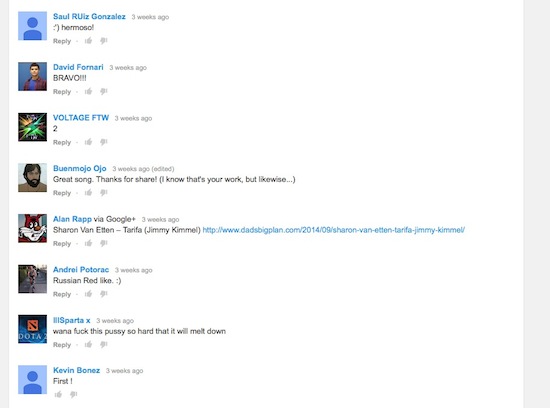
Because of how overstuffed my email inbox got while I was away for half of August, I spent the better part of September sorting through it all and therefore only recently noticed an email containing clips from Sharon Van Etten’s Labor Day weekend performance on the Jimmy Kimmel show. I have an unabashed soft spot for Ms. Van Etten, so on went the video. As the song, “Tarifa,” was playing, I began to scroll through the comments. There were only 14 of them, and as dedicated a comment-avoider as I try to be, it seems only human nature to be curious about what other people are saying about something or someone you like. Especially something as theoretically non-controversial as a late-night musical performance.

I should have known better. Down near the bottom I came across a comment that made me gasp, not out of surprise (alas, nothing really surprises me when it comes to barbaric comments on YouTube) but out of feeling viscerally attacked myself by these savage words. I am pasting the comment in here not to be sensational (I warn you it’s not pretty) but to stare it down with stouthearted determination. We have too easily learned to ignore this kind of thing, which is its own kind of awful. This is a brutish verbal attack on an unsuspecting human being, based largely, it seems, on her being a woman. And it just sits there like another part of a normal conversation:

SVE screen shot 9-24

On the one hand this is just a passing, all-too-common moment on YouTube. On the other hand, how on earth did we get here? How did we get to a place where we accept this level of vicious, assaultive ignorance staring at us, day after day, even on media outlets from large and respectable companies? The Jimmy Kimmel Live show posted the Sharon Van Etten clip on its official YouTube page, which is where this comment was posted and where, more than one month later, it remains.


It doesn’t have to be like this

I am well aware people have been complaining about comments on the web for as long as there have been comments on the web. By 2014, the more enlightened web denizens do their best not to read comments at all. But here’s the thing. It doesn’t have to be like this. There is no law of nature or country requiring web sites to allow people who cannot be civil to participate. With any will at all, any web site could be operated in such a way as to prevent first and foremost the lllSparta x’s of the world from sullying public discourse with words as hateful, violent, and insanely stupid as those he posted under the SVE video. But web comments could also be far more generally open-minded and supportive and interested in informed oppositional views than they commonly tend to be. That we have somehow accepted the guiding principle of belligerence and obnoxiousness is a failure of will on our part, not the way it has to be.

This is not a “freedom of speech” issue, but boy does this get confused pretty much all the time. No one is restraining lllSparta x from saying whatever pops in his head either to any friends he may have (?) or on a web site of his own construction. Neither is anyone preventing all the needlessly hostile other folks who clog up comment boards everywhere from being as hostile as they want, somewhere of their own making. That’s all free speech really means, you see—that our government can’t take action to prohibit people from expressing themselves. Collective entities of all kinds, whether corporations or sports teams or non-profits or what have you, remain empowered to decide that they don’t like what you’ve said and to create consequences for you—anything from removing what you’ve said from a web site to terminating any economic relationship they might have with you (see Schneider, Rob). The point being that neither YouTube nor Jimmy Kimmel is required by the Constitution to allow the likes of lllSparta x to speak his mind on their watch.

What it comes down is this: do we want to be civilized together or not? And if so, we might surely decide that repulsive, inappropriate, and/or disrespectful remarks need not be tolerated in a public forum.

So this is not a free speech issue but I am sorry to report that it is a free market issue, in that the reason that companies running web sites routinely do not police their comment sections has little to do with misguided application of the First Amendment and a whole lot to do with the fact that an unfettered comment section is a sure-fire way to drive page views up. First of all, goes the theory, people love to be able to leave comments, so allowing unhindered comments is a traffic booster. With web sites only ever concerned about quantity, anything that might reduce participation—such as requiring people to use their real names, or alerting people that all comments will require approval before being posted—is a negative thing. Because page views.

Second of all, continues the theory, rude or controversial or hostile comments, while not actively encouraged, are seen not merely as a necessary, traffic-boosting evil but maybe even as a valued if rowdy part of the web site’s operational center. It’s like a car wreck on the highway: people can’t help but stop and look. And perhaps engage in their own reaction to it. Because page views.

Further arguments are often made that excuse uncivilized web comments on the grounds that it would be too labor-intensive, and therefore too expensive, to expect huge companies with tons of online content to be able to effectively police all the comments being made minute to minute and hour to hour. To which I say: if it’s too expensive to police, then the only responsible answer is to remove the comment section entirely. Otherwise it’s like saying well, it’s too expensive to make sure our toys are safe, so we’ll just manufacture them without designing them or testing them properly. The fact that we collectively have allowed unmonitored comments to poison our online public spaces for the better part of the last 20 years is no excuse. This is all still early in the life of this new technology. We simply made a mistake in our first approach. We are entitled to correct it.


The limits of self-policing

I understand that we live in a world in which a certain benighted percentage of the human population is going to think thoughts like what lllSparta x posted on the Jimmy Kimmel YouTube page and will no doubt say things like this to their similarly debilitated buddies, and that’s the way the world has always been and alas may always be. But what far-fetched societal logic accepts sociopathic declarations as some kind of new public-behavior norm? How is it that lllSparta x could not only write what he wrote on a Google-owned, ABC-sanctioned web page but that the comment remains there, week after week after week?

And yes any YouTube user could “report” the comment as “spam or abuse” and maybe it would be taken down, at some point. Or maybe not. While repugnant, this comment might not, after all, be deemed literally “abusive.” But anyway: is being “spam” or being “abuse” the only two categories a comment can fall into to merit removal, or even consideration for removal?

And more to the point: why is it up to the people who visit YouTube to monitor such things? To assume a community of millions can self-police is disingenuous at best; the act of policing each other becomes just as liable to be abused as the original area being policed.

What the situation reveals is the lie at the heart of the democratization myth that has marred digital-based culture since the birth of the web itself. And the lie is this: that interactions involving millions of strangers can somehow mimic the interactions of small groups of known friends and acquaintances—that, in other words, the rules that govern the latter can in any effective way be employed to inform the former.

As it turns out, how people behave among friends cannot be scaled up to multiple thousands of strangers.

This is why, as one example, the personal act of letting a friend borrow and rip a CD is not in any way related to the impersonal act of uploading a CD so millions of strangers can download it. More to the point at hand, this is why three friends living together will easily enough make arrangements to keep their common living room acceptably clean but why three million people visiting a web site have no mutual understanding about keeping their common digital space acceptably clean, and should not be expected to.


Supervision and long-term self-interest

Yes, digital technology has widened the scope of our personal lives, giving us the capacity to interact with a wider and more far-ranging flock of contacts than was possible in our analog past. But there remains a relatively low threshold beyond which some (many? most?) individuals quite literally cannot extend their direct empathy, and therefore beyond which we collectively cannot be relied upon to be good to one another.

Once the number of people are gathered in a place, digital or otherwise, exceeds the possibility of personal relationships between all who are gathered, their interactions can no longer be left to operate without clear and present guidance. The loudest voices, expressing the most disheartening sentiments, are rarely if ever representative of the majority, but left to romp in digital space without supervision these are the voices that often appear to dominate and, over time, will ruin whatever the reasonable majority might otherwise be hoping to create together.

What may be most disheartening of all in this mess is that we have arrived at a stage of capitalism in which short-term self-interest has blinded the ability of all but the most enlightened of business leaders to understand that long-term consequences are by far more important. The fact that unsupervised public spaces online are destined to be destroyed from within seems both tragically irrelevant to managers who care only about quantitative metrics and sadly par for the course in our corporation-guided 21st-century culture. (In much the same way our human environment is being destroyed from within while corporations refuse to consider this long-term truth in pursuit of their short-term profits, but never mind.)

If the only people in a position to supervise refuse to do so, what then? Do we sit back and take it? Do we convince ourselves that this is an unavoidable by-product of our technology, which of course we can’t ever fiddle with because we might “break the internet”?

Or do we rouse ourselves out of our technophilia to begin to understand that if we can’t, after all, get civilized together, we may at some point find ourselves without much of a civilization?

U2 and the Irony of “Permission Rage”

So U2, a band that has operated throughout its long career in an irony-free zone, has gone ahead and pulled what may be the single most ironic publicity stunt of the Digital Age.

U2

So U2, a band that has operated throughout its long career in an irony-free zone, has gone ahead and pulled what may be the single most ironic publicity stunt of the Digital Age.

I would love to think that they planned it this way. That Bono is craftier than you may realize.

By now you know the basics: how Apple recently inserted the new U2 album into the music libraries, on the cloud, of all iTunes users, and how this prompted a powerful chorus of outrage from those who were unhappy with the liberty taken thereby. An atomic bomb’s worth of pent-up U2 hate seemed to be built into the reaction, I should note, since the band has taken the brunt of the hive-mind assault here (example), even as it is clearly Apple who was behind the whole thing.

Boil the negative reaction down to its core and it seems to be about permission. “How dare they put this album into my personal slice of the iCloud without my permission!” armchair critics across the internet have ranted and raved since Songs of Innocence appeared via Tim Cook’s magic wand on September 10th. The fact that the album seemed, at first, impossible to delete inflamed the naysayers all the more.

And I get this, I do. You don’t want trespassers sullying up your corner of the iCloud. No one likes having things done to their stuff, even their iStuff, without their permission. I mean, what was Apple thinking, right? And Bono too. Especially Bono.

Only, wait a minute. Let’s backtrack a bit. Say, 15 years or so. And let’s think about what has been happening since music has been widely available in digital form. An entire generation of young people has grown up with the understanding that music is simply out there, for the taking. Whatever you want, it’s there, it’s easy to find, and you can take it. I mean, right? If it’s there, why wouldn’t you just take it? Especially since, like, you don’t really have enough money to buy all the music you want. And who buys music anymore anyway?

Okay, now, class, let’s reintroduce the magic word and see what happens. The magic word is “permission.” All those folks busy downloading all that music for all those years that just seemed to be out there for the taking: do you think they were getting anyone’s permission? All the music sitting there on all the torrent sites, waiting to be taken, 24 hours a day—how much of that is up there with anyone’s permission?

But oh my goodness, dare to insert 11 U2 songs into my iCloud storage area and suddenly I am Lord High Minister of Permission?

Ironic, ain’t it?

But wait, there’s more. Mixed in with the “Get off of my iCloud!” criticism have been those who, apparently without irony, now accuse Apple and U2 of making music “worthless” because of this one particular album giveaway (example). But this is indeed a very ironic stance. So we have 15-plus years of pirated music on the historical record, but now, via an album the band was paid handsomely for, it’s Apple and U2 who have somehow, abruptly, made music “worthless”?

The ironies pile on. How about the concurrent gripe that the album could not at first be deleted—is this not its own kind of wry statement on the permanence of digital trespassing? A pirated album, after all, is pretty much impossible to cleanse from the internet, is it not? I never heard the pirates complaining too much about that little factoid. And, as ironic icing on the cake, think about how this whole thing was prompted by a gesture of goodwill, a band saying, here’s our new album, you can have it for free.

All that may really going on here is textbook projection. U2 seems to be resented, massively, by a vocal cluster of people in the generation that’s just behind them (for their status as the last arena-sized rock band? for the fact that they have stayed together, harmoniously, for so long? for their lack of irony??), and here the band has gone and done the very thing that so many in this generation have been doing, without apparent self-awareness, for the entire length of their young adult lives: moving digital property around without permission. And so sure: let’s get disproportionately enraged by U2, so we still don’t have to face down the wrong we ourselves have been doing.

I can’t wait till some of these folks begin to work it all out in a therapist’s office. In the meantime, get some popcorn and enjoy the show.

The Narcissism of Free

Rather than seeing pro-piracy arguments through the lens of copyright policy or economic theory or under the all-purpose banner of technological progress, let’s finally view them for what they are: the arguments of unrepentant narcissists.

Not long ago, the widespread establishment of legal streaming services online was seen as a possible or even probable antidote to piracy. If legal options were available for people to access the music they wanted to listen to, piracy would become both less necessary and less attractive, and the music industry could begin a slow and steady recovery. This ideally would involve actual musicians being able to earn money from the music they created, if or when listeners want to listen to it.1

Such was the theory. In practice, legal streaming has turned into piracy’s smaller, more attractive, but still kind of icky younger brother. While this may change in the future (although no one can yet say how2), so far, streaming services have struggled with the concept of compensating musicians with much more integrity than pirates do (and pirates, of course, don’t).

The problem at one level appears to be structural—endemic to the complicated landscape of licensing and rights and things most of us don’t want to think about but which directly affect both the ability and the desire of corporate entities to compensate artists fairly.

But beneath the legalistic difficulties is something at once simpler and more challenging—the fact that great numbers of music listeners in the year 2014 don’t seem to view music as something they either want or need to pay for.

Many consider this, at its heart, a generational problem, as it does seem to be the under-30 crowd who are most committed to a not-buying-music lifestyle. But generational generalizations are tiresome and pointless. First, a news flash: not everyone who is the same general age exhibits the same behavior.3 Second, has there ever been an upcoming generation in the U.S. that hasn’t been scorned for its various and profound inadequacies? Lastly, just who was it who raised these youngsters to be such reprehensible citizens in the first place?

And even if it is younger people who are most disinclined to buy music, I still say the problem isn’t generational. I see it as an issue that digs deep into the uncomfortable recesses of human nature, and the systems we create in an effort to live together.

Vigorously anti-social

I am talking in particular about capitalism and its tetchy relationship with compassion and fairness. Because, unless counteracted via law or custom or both, the basic capitalist desire to accrue wealth has at its heart a vigorously anti-social aspect. To accumulate MY money, I must as often as possible get it or take it, in one way or another, from YOU (“you” being anyone “not me”). The easiest way to effect this successfully is to think as little about YOU as possible, and as much about ME. If I in fact can convince myself that that YOUR concerns are either nonexistent or in any case meaningless, then it’s much easier for ME to do what it takes to keep accumulating money. For ME.

Another way of saying all this is that capitalism is an inherently narcissistic enterprise.

The urge to seek the lowest prices possible on anything and everything is part of this mindset, and so, obviously, is the widespread 21st-century belief that creative output such as music and films can and should be accessible without any cost to the end user. In a way, piracy as practiced on the internet is simply the inherent narcissism of capitalism taken to its logical extreme: I don’t have to spend MY money, and I still get YOUR stuff! How cool is that?

But it’s not just piracy. Now that legal streaming has been established to satisfy the same narcissistic urges as piracy previously has, it is simply reinforcing the self-centered belief in the necessity of free, while acquiring the veneer of respectability in the process. So on the one hand it’s legal, and some people are actually paying for it, which seems positive; on the other hand, free and/or super-low-cost, unlimited streaming leaves the people who actually create the music everyone still wants to listen to poorly compensated at best. Even engaged listeners are often not paying listeners.4

The harm in the situation extends far beyond injustice to the creators. We can’t have inequity at the heart of a cultural system and not harm ourselves in the long run. No good ever comes from bowing to the petulant demands of narcissism. Music as an endless, free, all-you-can-eat buffet? Does this really seem like a good idea? All I can bring to mind are those bloated, immobile humans from the movie WALL-E, who found themselves convenienced and pampered into uselessness. Our appetites are designed to be sated, not given over to without cessation. Nourishment turns noxious without a sense of limit.

The cumulative wisdom of human history

And yet those engaged in the cultural gorging appear to feel little but entitlement. It would seem that the unprecedented appearance of items of value in an effectual state of free—i.e., songs, in digital form—flipped a switch in our collective consciousness that activated the narcissistic tendency that lurks no doubt in all of us, but which most of us are civilized into de-emphasizing. Like looters during an urban blackout, we found the free stuff too tempting. Perhaps all it ever takes for narcissism to bust loose of its inner reigns is the assurance that we won’t get caught when we give in to it.

Among the many reasons I have always found the “music should be free” arguments so infuriating is the self-serving illogic of the basic premise. Freeloaders are saying on the one hand that they value music enough to want as much of it as they can cram onto their hard drives, or pile into streaming playlists, and yet on the other hand that it has no value at all, since they don’t want to pay for it.

And here exactly is where the underlying narcissism is most exposed. For a 21st-century music fan to say both “I value this so much that I am hoarding it” and “I refuse to pay for it” requires him (or her; usually him) to overlook the cumulative history and wisdom of humanity itself, all for the sake of his own personal gain.

Which is to say that since the beginning of human civilization, a basic, necessary rule has been in place when it comes to the exchange of goods and services. The underlying premise is: you want something from me, you pay for it. That payment may be in the form of bartering for goods and/or services of an equivalent value, or it may be in the form of agreed-upon currency. Yes, there have always been people who have decided to reject this system for their own benefit, and we have a name for these people. We call them criminals.

The fact that what a person may want in the 21st century exists as a digital file does not nullify the workings of civilization. A digital file is still a thing, it is still something that someone may desire to have, and, if the owner of the file is asking a price for it, then it is not up to the person who wants the file to decide that he gets it for free.

It is definitely not up to this same person to invent rationalizations to “prove” that he deserves it for free (“Piracy is not theft,” “The marginal costs of a digital file are zero,” et al.).5 But of course this is exactly what a narcissist, ever convinced simultaneously of his own entitlement and infallibility, would want and need to do. Narcissists do not tend to be shy and retiring.

A wave of narcissistic delusion

All of which is not to imply that the only people who have helped themselves to unauthorized MP3s online are full-on, clinically-defined narcissists. A sizable number of empathetic, socially-attuned people have slipped to the dark side of the issue all but unknowingly. I would bet that a lot of folks who have routinely downloaded illegally distributed MP3s not only don’t think of themselves as pirates, but barely recognize they are doing anything at all untoward.

As for those who are simply employing legal streaming services, they are quite literally doing nothing wrong at all in the eyes of the law.

But you don’t have to be a narcissist to have been addled by a collective wave of narcissistic delusion. For it is widespread narcissistic behavior that seems to have tilted the scale here. The extreme position of “everything for free” has been all but normalized—the loudest voices in the room willfully squelching the gentler voices of reason, a radical agenda hidden behind re-defined and incredibly self-serving concepts of “innovation” and “disruption.”6

What’s more, the aggressive force of collective narcissism has rushed in to fill the natural intellectual vacuum most of us would otherwise have on matters of artist rights and such in the first place. This is especially true of the generation of young people making the transition from child to adult here in the 21st century, who only know the environment in which they were born and raised.

So loud and insistent have been the narcissistic voices of “give me what I want for free” that any number of musicians themselves have been swept up in the fever. I encounter bands semi-regularly who seem proud of their determination to offer all their songs for free, because that’s how to get their music “out there.” And yet this is not the public service they seem to believe it is; it is, rather, its own sort of narcissistic misconception, grounded in the self-centered idea that everyone can and should love you, that they should gorge themselves on your music, that the only thing standing in the way of widespread adulation is the minor detail of payment.7

This is a fever that can and must break. Some of us have to have enough perspective to understand that the narcissist’s way is a cultural and societal dead end, much the way the extreme libertarianism that it often aligns with is a dead end. Civilization is impossible if driven by a philosophy fixated on the primacy and the freedom of the Self while consistently resisting any effort to extend compassion or sympathy (or payment!) to other Selves. There’s a good reason we don’t let toddlers run the day care center.

Piracy and/or free music for all is not innovation; it is a breach in the social contract. Narcissists innately do not understand the social contract. The rest of us know better. We need to start using louder voices.

1. Let us all please remember, briefly, that society does not owe all musicians a so-called living wage simply because they are musicians. What we do owe them is money for music that they make if we like it enough to want to have access to it on demand, and if they are seeking payment for it.

2. So it’s probably not going to change.

3. Surely there are plenty of younger people out there who are in fact buying music; we should be encouraging them, not insulting them with blanket assumptions.

4. In point of fact, the streaming system as currently constructed is entirely unsustainable, based on how little those who are paying are, in fact, paying. See a recent post by The Cynical Musician for a much more in-depth discussion of why low-priced, all-you-can-eat streaming is a house of cards waiting to be blown down.

5. By the way, can we put an end once and for all to the ridiculous, toddler-like argument of “Hey, I didn’t take anything, he still has his own copy!” The people who pull this one out hope you will be so dazzled by their legalistic dissection of what constitutes “theft” that you will ignore the clear fact that violation of the law and/or general wrongdoing does not depend exclusively upon “taking” something. (If you set a tent up in someone’s backyard without permission, you are still violating their rights, while taking nothing.) To take MP3s without permission is to gain unauthorized access to an artist’s work. This is a violation of the creator’s rights, plain and simple.

6. Digital ideologues routinely point to the concept of “stifling innovation” as just about the most awful crime imaginable. Never mind that the pro-piracy folks themselves continue to stifle any effort at innovation when it comes to properly compensating artists

7. I am not trying to be harsh here. I know that bands who offer their music for free are really just trying to do what they believe to be the right thing, out of the goodness of their hearts. I use this example precisely to show how mixed up the narcissistic underpinning of the “free music” movement has gotten everyone.

The Subtle Sorrow of Social Media

To experience our connections through impersonally-directed snippets on social media is to be denied the heart and soul of friendship.

We have so quickly grown accustomed to social-media-fueled communication that it seems almost quaint to remember that one-to-many communication was once both difficult and expensive to arrange. Only people who were either public figures or professional communicators were routinely put in the position of communicating at a distance to multiple people at the same time.

Today, anyone engaged with social media is typically doing so many different times a day, effectively for free. Sending the same message simultaneously to lots of different people we know is easy and fun and oh so efficient.

As a matter of fact, the internet not only allows us ready access to one-to-many communication, it seems to have flipped the equation in terms of what kind of communication is more readily employed. After all: how many of your friends and family members have sent you a personal email in the last week, or have actually called you on the phone, versus how many have sent you a social media message of one kind or another?

Easy and fun and efficient is winning out at this point, yes?

But where, I am beginning to wonder, does all this easy fun efficient communication leave the people on the receiving end?

Potentially overwhelmed by information, for one thing, but that’s not my immediate concern. I am concerned, instead, about the genuine and vital human need for specific attention, which is decidedly overlooked in the social media milieu.

Each of us is an individual, with the thoughts and feelings of an individual, the challenges and joys and desires and frustrations and dreams of an individual. And, in the course of our daily existence, one of our basic needs, as individuals, is for communication that substantiates and validates this individuality. Up until very recently, this was one of the wonderful things friendship was for.

Today, thanks to social media, even communication that happens in what is supposed to be our personal space is all too often replaced by the impersonal communication fostered by Facebook and other social media applications.

The rise of impersonal communication

Because that’s what one-to-many communication is, by necessity: impersonal communication. It may come from someone you know, it may have to do with circumstances you are familiar with, but such communication is not being specifically tailored to the individual that you are. This is a new mode of relating to one another—“I know you personally but I will address you impersonally”—and it’s sad, to me, in an elusive but powerful way.

On the sending side, the impersonality of personal broadcasting strikes me as an equal if not greater cause of subtle sorrow. Say you share a personally meaningful tidbit on Facebook with your social network only to be greeted with silence—no responses, no comments, not even any “likes.” Isn’t this kind of crummy? Or do most people not even notice, because it’s really more about the sending than the receiving? Which is also kind of crummy, if you think about it.

Of course non-responding recipients don’t mean to be making you feel badly. The nature of social media frees the recipients from the obligation to respond. This is hardly the same as letting a personal letter sent via the post office go unanswered.

But to me, this is exactly, and cumulatively, the problem. The central means of communication we have adopted in our 21st-century lives has freed us from not only the obligation but, one might suggest, the desire to respond to even our actual friends and family members.

And all this impersonal communication fostered by social media is actually so unnecessary. Here we have the most powerful and widely-utilized communication-oriented invention in the history of humankind—the internet—and it’s like we’ve pushed the one-to-many button and it’s gotten stuck.

The internet, after all, is still an unprecedented tool for genuinely personal communication. The asynchronous instantaneity of email remains a powerful way to dive into thoughtful conversations with close friends and relatives. Texting has its virtues, as long as you let it overwhelm neither your ability to be physically present nor your capacity for handling more involved or time-consuming dialogue. And, of course, picture-phone technology such as that offered by Skype or FaceTime allows us to turn a personal, one-to-one telephone conversation into a face-to-face(-like) encounter with ease.

But something about the social-media revolution of the ’10s seems to have cooled our collective enthusiasm for one-to-one communication, however beautifully enhanced the internet has rendered it.

Talking to everyone and no one

Perhaps the unabashed, on-display metrics of social media have hypnotized us into believing that even in matters of the heart and spirit, quantity counts more than quality. Social media applications love to display your number of friends and followers, while continually encouraging you to find more. And there these contacts sit day after day, all but begging us to address them—which of course is easily done with quick status updates and tweets via handheld devices we rarely let out of our grip. We are encouraged to send out personal details—new photos, new recipes, new jobs, new ideas, new links on the web—and forget we are wrapping them in an impersonal package. In talking to everyone collectively, we talk to no one individually.

Beyond the immediate realm of social media, there is no confusion about the difference between personal and impersonal communication. Even when Kevin Spacey’s character on House of Cards talks to you on the screen, you understand he is not talking to you personally, he is talking, collectively, to the audience who is watching. Talking at them, essentially. As theater, this is both reasonable and entertaining.

But in our lives, with our actual relationships, we seem willing to go along with the ruse. When your friends on Facebook send messages they are not talking to you personally but to the collected audience of people who happen to be “watching.” But because you know them, the illusion that they are in fact talking to you is easier to believe. But they are merely talking at you.

And don’t get me wrong—personal broadcasting surely has great utility in our interconnected world. Being able to say the same thing to lots of people at once is helpful in many contexts. Twitter, for instance, has almost single-handedly given those who aspire to the position of “thought leader” in any given industry an unprecedented platform. This is the power of personal broadcasting at its best.

I also understand the argument many might make that hearing from far-flung friends and family in any manner, impersonally or not, is better than not hearing from them at all. Facebook has surely put people in touch who would otherwise not be in one another’s lives in any fashion, and this seems only a positive thing.

Should friends be an audience?

But note the context. People you would “not hear from at all” if you were not receiving their impersonal, broadcast messages are, by definition, people with whom you are not close—people who don’t really know you in the here and now, nor you them. Distant friends, cousins many times removed, and random scattered acquaintances may in fact be the ideal audience for impersonal messaging: you sort of know them, so you believe they are addressing you more than Kevin Spacey is, but you also don’t really know them, so you are not unconsciously expecting any kind of direct connection.

There have recently been studies that have suggested that using Facebook is often a depressing experience for people. Articles discussing such studies typically focus on the potential for Facebook users to feel envious while watching a parade of pictures and status updates from friends having joyful and exciting experiences. This leads to stress and sadness, goes the theory.

I have yet to see anyone discuss what might be the bigger underlying problem, which is social media’s one-to-many communication mode. We seem so enamored of our newfound broadcasting powers we have thus far overlooked the discouraging effects both of being ongoingly talked at by our very own friends and family members and of being often deprived of personal responses when we ourselves are doing the broadcasting.

Simply put, one-to-many works best when the “many” and the “one” have no personal relationship. In this case, the inherent impersonality of this type of communication is no issue. When the broadcaster, on the other hand, is someone who does in fact have personal knowledge of who you are, of what your life is like, of what matters to you, and so forth, finding yourself now merely a member of his or her “audience” may not feel especially gratifying or connective.

Meanwhile, broadcasting via social media puts a person continually in the position of seeking an audience, not seeking a personal connection. This is why people are routinely discouraged if they post a status update on Facebook and only one person comments. If they were seeking a personal connection, they might be delighted with one comment. But they are actually seeking an audience, and an audience of one feels like failure.

To me, the actual failure is the over-use of personal broadcasting. To experience our connections through impersonally-directed snippets on social media is to be denied the heart and soul of friendship.

It all gets back to the idea of being specifically tended to. This is what social media works to take away from us. We have no reason to assume a friend is ever expressly thinking of us when he or she sends thoughts or news out into the social-media world, and we are never guaranteed the reassuring attention of a friend when we, in turn, send our own thoughts and news into that relentless stream.

Obviously this is not a black-and-white situation. There are still good reasons to employ social media for personal broadcasting. And there obviously remain many other ways to reach out to our closer connections, beyond sending out social-media salvos. I am just not convinced we are doing this as often as honest-to-goodness friendship might seemingly both require and desire now that we have this new communication tool so centrally placed in our arsenal.

Recently it has occurred to me to wonder if our online social reality is some weird kind of karmic retribution for life in the Citizens United era here in the United States. The Supreme Court, after all, would have us treat collections of human beings (i.e., corporations) as we would individual human beings. Substituting broadcast communication too broadly for personal communication seems to me to be part of the same category error.

Personal broadcasting has yet to make quite so many people quite as angry as the Citizens United decision, of course. But time may yet tell.

New essay: “Is There Any Hope for Eclectic Listening Online?” (off site)

For those who haven’t stumbled upon this one yet, I wanted to let you know that I have a new essay online at the Linn music blog.

Linn is a high-end audio equipment company, based in the UK. The new essay is entitled “Is There Any Hope for Eclectic Listening Online?,” and it addresses another one of my digital music pet peeves, this one being the relentless way that digital music tends to be divided by genre, especially when it comes to streaming and/or playlist services. I believe this genre fixation rather badly under-serves us as listeners. Read the piece and see if you agree.