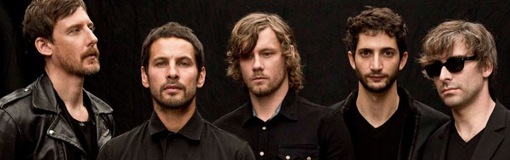
Free and legal MP3: La Sera (unrestrained, guitar-driven rock’n’roll)

With the succinct, thunderous drive of mid-career Blondie, “Losing to the Dark” is catchy, unrestrained, guitar-driven rock’n’roll the likes of which are not often heard here in 2014.

La Sera

<a href="https://s3.amazonaws.com/fingertips-free-legal-mp3s/2014/La_Sera-Losing_to_the_Dark.mp3&quot; – La Sera

With the succinct, thunderous drive of mid-career Blondie, “Losing to the Dark” is catchy, unrestrained, guitar-driven rock’n’roll the likes of which are not often heard here in 2014. From the feedback-friendly, multi-part introduction through the ear-catching major-minor shift in the pre-chorus and on into the fiery guitar solo, this one is three-plus minutes of adrenaline and purpose.

La Sera is the performing name of Katy Goodman, the bass player for the recently disbanded Vivian Girls, and while in the past looking to the ’50s and early ’60s for melodic inspiration, Goodman leaves the dreaminess behind for a shot of unblinking, contemporary reality. The title scans precisely to the Adele hit “Rolling in the Deep,” and as such (it’s a stretch but bear with me) I can’t help viewing this as a punked-up bookend to that song. Both singers mourn a failed relationship. While Adele is defiant to the point of vengeful, focused on the potential that has been cast aside, Goodman sees the loss as a morality play. Her erstwhile lover consumed by bad behavior, she starts sarcastic (“How ’bout you have another drink/So you can pass out in the back seat of my car?”), offers the faux sympathy of “What a pain it must be/To have to only be with me” at the song’s emotional and melodic fulcrum (first heard at 0:48), and then just lashes out at the real enemy, which isn’t the guy at all but human frailty itself. Adele is done with her lover because she’s better than him; in this song, the narrator is just as pissed off but also, in a weird way, more understanding. There’s a feeling of “There but for the grace of God go I” in here, which makes me think that maybe it’s Katy Goodman who is actually rolling in the deep.

“Losing to the Dark” is the lead track from the third La Sera album, entitled Hour of the Dawn, which comes out next week on Hardly Art. La Sera was featured previously on Fingertips in November 2010.

Free and legal MP3: Papercuts (rich, delicate, orchestral)

The richly delicate “Life Among the Savages” hints at what Brian Wilson might sound like if he were a 21st-century indie rocker.

Papercuts

“Life Among the Savages” – Papercuts

The richly delicate “Life Among the Savages” hints at what Brian Wilson might sound like if he were a 21st-century indie rocker. Not that Papercuts front man and general mastermind Jason Robert Quever has quite as many idiosyncratic tools at his disposal as Wilson, but surely there is something Pet Sounds-y in the orchestral-minded, melodic yearning on display.

The opening verse melody, to begin with, is a concise gem of descending sweetness (0:06-0:09), and is itself part of a beautifully constructed eight-measure melody that seems simultaneously to resolve and retain suspense two or three different times. The melody is so well-developed that the song does without full-fledged instrumentation until the first iteration of the chorus at 1:08, and while the pulsing string arrangement distracts us from missing the band, when the sound does kick in, something in the ear relaxes. Combine that with a subtle uptick in vocal urgency here (listen to all the hard “c” sounds Quever hits between 1:16 and 1:22), and “Life Among the Savages” is pretty much all delight from this point onward—the verse the second time through now fully accompanied, the chorus getting an unexpected instrumental lead-in and an extra repetition, and the whole thing capped off by a tidy, dramatic coda.

The San Francisco-based Quever has been recording as Papercuts since 2004. “Life Among the Savages” is the title track to his fifth album, released earlier this month on the new L.A. label Easy Sound in the U.S., and via the London-based Memphis Industries label in the U.K. Papercuts was previously featured on Fingertips in 2011. Thanks again to Lauren Laverne at BBC 6 for the head’s up.

Playlist: Power Pop, Vol. 2

A second Spotify playlist of power pop gems.

connells-ring

Close readers here may remember my initial journey into PowerPopLand, via my Power Pop, Vol. 1 playlist. The very name, of course, implied that there would have to be a sequel, and at long last the thing takes flight.

Check out the previous post for some of the underlying philosophical musings, which this unique not-exactly-a-genre genre seems effortlessly to prompt, at least in me. This time around, the list veers even further from the generally acknowledged power pop standards, in part because I mixed in a good number of 21st-century examples, and in part because I sought to include a larger spectrum of power pop’s musical coverage, which ranges from the impeccable melodic gloss of songs like “Slackjawed” to the Byrds-ian jangle of “When Things Go Wrong” to the peppy pseudo-reggae of “Second Choice” to the blink-and-you’ll-miss-it crunch of “All-Nighter.” While I may take some extra liberties here and there—some people might consider the Ramones beyond the genre’s boundaries, even as quite a few of their songs are spot-on power pop, if you really just listen; and Sarah Harmer has probably never before shown up on anyone’s power pop playlist, but from the itchy, new-wave-y bass line to the subtly glorious chorus, I’m on board here, and encourage you to join me. I do manage to bring things home with “Shake Some Action,” which is on just about everyone’s top 10 list. And if you listen to only one song, make it the one right at the top, as Translator’s “Un-Alone” is surely one of the great lost power pop gems of the 20th century. Everything that band ever did was overshadowed by its first-album college-rock classic “Everywhere That I’m Not,” a fine tune itself but nothing like power pop. And as at least some of us are convinced, there is nothing like power pop.

direct Spotify link:

Free and legal MP Nap Eyes (guitar-driven groove, w/ simple charm)

It takes a special kind of song to manage to be so charming while stuck so pointedly in one groove, one melody, and, all too often, one repeated phrase.

Nap Eyes

“No Man Needs to Care” – Nap Eyes

Like a wayward Smiths song dismissed from the catalogue for being too good-natured, “No Man Needs to Care” has a determined jangly jauntiness to it and more going on with the guitars then its seemingly two-chord framework might suggest. And if “No man needs to care/About another man’s hair” is not a Smiths lyric it’s only because Morrissey never thought of it.

It takes a special kind of song to manage to be so charming while stuck so pointedly in one groove, one melody, and, all too often, one repeated phrase. I’m not sure even why I like this so much, except that I completely do. On the one hand it shows you what a strong beginning and a strong closing in a three-minute, fifty-second song can do for you: the opening lyric is an unexpected delight (“Well I was reading my book/Just so that everyone would come take a look”), the closing guitar freakout 24 seconds of noisy joy. In between, well, we get that personable, recycling guitar line, and front man Nigel Chapman’s insistent yet somehow still soft-spoken presence. He’s in our face but his face is reading his book. And if you pay attention you may see that he is hiding a much more involved story in his simple, repetitive lyrics. And can I say what a good strong so-retro-it’s-up-to-date rocker name that is, Nigel Chapman? Buy his records just because his name is Nigel Chapman.

Nap Eyes is a foursome from Halifax. They’ve been around a couple of years, and have two previous EPs to their name. “No Man Needs to Care” is a track from the waggishly titled Whine of the Mystics, their debut full-length, released on Plastic Factory Records in March. You can listen to the whole record on Bandcamp, and buy it there too, at a price of your choosing.

Free and legal MP3: Kim Harris (emotional ballad sung with soul and spirit)

A rare and wonderful instance of an audio recording and a video aiding and abetting each other in elucidating the power of both the song and the singer.

Kim Harris

“The Weight of it All” – Kim Harris

I am not inherently attracted to earnest piano-based ballads, let me make that clear. Neither am I inherently oriented to videos, as any number of you already know by now, by the sheer tiresomeness of my haughty disclaimers over the years. And yet here we are: an earnest, piano-based ballad that sold itself to me to a large extent on the strength of its video. (See? I do watch them intermittently. And post them; see below.) With the wisdom of (many) years, I have come to embrace these kinds of contradictions. Who the hell wants to be that consistent, anyway?

Now then, the video of “The Weight of it All” is actually a guitar version, the song stripped to its essence and performed, almost as if an afterthought, live and uncut on a residential Halifax street. (Yes it appears to be Halifax week here. Don’t knock it; the music up there is ever vibrant and worthy.) Taken together, the video and the sound recording highlight different aspects of Harris’s soul and spirit: the video places her in three-dimensional space, and gives us an immediate, visceral affinity with her rich, athletic voice; the audio, meanwhile, in slowing the song down, allows us to savor the depth and nuance of her presence and delivery in a more contemplative way. The song itself likewise benefits from this dual presentation. The sound recording scores via its sensitive, dramatic (but not over-dramatic) production, with percussion, pedal steel, and backing vocals used with precision, giving the slower tempo a vividness unmarred by the histrionics we are all too often subjected to when mainstream music aims for emotion. The video, on the other hand, finds its power in the guiding pulse of Harris’s resolute right hand and of course the appeal of her unassisted voice, rendered all the more touching as she stands in the street and we watch and hear cars go by, with unseen birds likewise adding to the soundtrack. When she is joined later and unexpectedly by a chorus of five singers, linked arm and arm just beyond the original frame of the video, the song’s cumulative force feels instant and fresh. (Don’t miss Harris’s not-quite-masked smile—around 2:33 in the video—as she anticipates the entrance of the chorus just before the rest of us either hear or see them, a moment of unpremeditated humanity that underscores the beauty and authenticity of the performance.)

Based in Halifax, Harris is originally from Newfoundland. “The Weight of it All” is a song from Only the Mighty, her debut full-length, released at the end of February. You can listen to the whole album, and purchase it, via Bandcamp. Only the Mighty was produced by Dale Murray, who, among other things, is a member of the band Cuff the Duke (featured here way back in 2005, the year Murray joined the band).

Free and legal MP3: Minor Alps (minor-key indie-rock drive)

Not only do are the musical instincts of Juliana Hatfield and Matthew Caws thoroughly interconnected, but their voices are so oddly similar that Hatfield has been quoted as saying that even she sometimes can’t distinguish between them on record.

Minor Alps

“I Don’t Know What To Do With My Hands” – Minor Alps

Minor Alps is the duo of Juliana Hatfield and Matthew Caws—Caws the front man from the band Nada Surf, Hatfield the long-time indie-rock/alt-rock goddess—and this is a duo in the most intertwined sense of the word. Not only do their melodic, ’90s-based musical instincts seem thoroughly interconnected, but their voices are so oddly similar that Hatfield has been quoted as saying that even she sometimes can’t distinguish between them on record. On this song, the vocals are shared throughout, and the verses are sung without harmony, accentuating the indistinguishability. This becomes especially interesting given the subject matter, which is the awkwardness between two people spending the evening together, getting to know each other, but wondering how to instigate physical contact. Having both the male and female voice speaking the same thoughts underlines the poignancy of the insecurity. It is a small-subject song enlarged greatly by lyrical discipline and musical straightforwardness. The subtle but definitive opening is the shift in the last verse, which moves the problem from the local to the global, a songwriting technique that never fails to move me:

I can’t decide on the channel
I’m just flipping around, maybe you can choose
Maybe some kind of monster
Maybe I just don’t know how to reach out

I love the graceful blurring of meaning in the third line, as the narrator seems to slip from talking about what’s on television to what may be the state of his/her heart and mind and being. This is further insinuated by the last iteration of the chorus, as the song ends, when the lyrics finally leave out the words “with my hands,” and the relentless minor-key drive of the music arrives at both apotheosis and long-delayed resolution.

The debut Minor Alps album, Get There, came out on Barsuk Records back in October without causing as much fuss as it might have; critics liked it but it never rose to buzz level here in the only place that matters, the internet. (Please add dripping sarcasm to that last sentence, if you haven’t already.) Thanks to the ever-discerning Lauren Laverne at BBC 6 for the head’s up on the more recent availability of this song as a free and legal MP3. You can download it above, in the usual way; but note that this one plus six others are currently available as free and legal downloads via NoiseTrade, where leaving a “tip” for the artists is also encouraged. Note that four of the songs on NoiseTrade are not on the album. Alternatively, the fine song “Buried Plans” (on the album) is available as a free and legal download via Barsuk Records.

Someone will come to help you

Eclectic Playlist Series, Vol. 5 – April 2014

Eclectic Vol 5

One of my ongoing beefs with the futurist contention that music is destined to move entirely into the cloud, that access will obliterate ownership, is the inevitability of gaps in the libraries of music streaming services. I love that streaming is available but I will mourn the day it becomes the only thing available, because no streaming service will ever offer everything. The vagaries of music licensing are just too, well, vague. Do we want high-quality, deep-value songs to disappear simply because the Acme Streaming Service can’t license them for streaming?

This is a roundabout way of introducing you to the fact that two songs I have included in the original version of Volume 5 in the Fingertips Eclectic Playlist Series are not available on Spotify. I did my best to replace the absent songs with reasonable fits, but anyone who has ever spent time aiming for a tightly conceived mix will know that there is no precise replacement. And, so, here: “Afternoon in Kanda,” from Jesse Harris, should actually be Oscar Isaac’s affecting cover of “The Death of Queen Jane,” from the soundtrack to the film Inside Llewyn Davis; and where the true version of the playlist has the song “Stoned Out of My Mind,” by the Chi-Lites, I have substituted “Drowning in the Sea of Love,” by Joe Simon. Spotify only carries three songs from the Inside Llewyn Davis soundtrack, for unknown reasons, and, as many times that “Stoned Out of My Mind” by the Chi-Lites is available on Spotify, it appears always to be a re-recorded version, not the original 1973 studio version, which I prefer without hesitation.

The good news is the playlist will eventually appear as originally intended when I get around to making a Mixcloud version. [Ed. note: Mixcloud version now available.] The less good news is I still haven’t gotten a Mixcloud version of Vol. 4 online yet, so Vol. 5 is no doubt a good few weeks from being Mixclouded. The bastardized Spotify iteration will have to do in the meantime. And there are of course plenty of fine tunes on board, as always. I am happy to include the overlooked Elvis Costello treasure “No Hiding Place,” from his rapidly created 2008 album Momofuku; the whole album isn’t operating at quite the same level, but that would be difficult, as this song stands up with the best of anything he’s written, in my mind. The Boz Scaggs song that follows is from his landmark Silk Degrees album, but it is a song I had entirely forgotten about until I heard Bruce Warren play it recently on one of his casually masterful weekend radio shows on WXPN here in Philadelphia. The St. Vincent song, from her new-ish self-titled album, is a formidable keeper, a song which I feel will emerge in future decades as powerfully evocative of whatever it is we are going through right now. The Grays’ song “Both Belong,” meanwhile, from the first half of the’90s, strikes me as powerfully evocative of a time period that until recently seemed not very long ago but now seems nearly as remote as the one other rock’n’roll decade that rivals it for its breadth and quality of music (which to me would be the ’70s). By the time we get to “Dime a Dozen Guy,” an overlooked Marshall Crenshaw treasure from 1999, things seem back in the realm of the more recent past, somehow. What went on from 1994 to 1999 that makes those five years seem like almost 15 in retrospect I will leave to historians to fathom.

And for those who are interested but are not Spotify members, here is the Mixcloud widget:

And for one and all, here are the songs featured, along with year of release and album of origin, if any:

“Här Är Det (Here It Is)” – Ebba Forsberg (Ta Min Vals/Sjunger Leonard Cohen, 2009)
“The Rainy Season” – Howard Devoto (Jerky Versions of the Dream, 1983)
“A Shot in the Arm” – Wilco (Summerteeth, 1999)
“One in a Million” – Maxine Brown (single, 1966)
“No Hiding Place” – Elvis Costello and the Imposters (Momofuku, 2008)
“Love Me Tomorrow” – Boz Scaggs (Silk Degrees, 1976)
“Love and Anger” – Kate Bush (The Sensual World, 1989)
“Digital Witness” – St. Vincent (St. Vincent, 2014)
“Sick of Myself” – Matthew Sweet (100% Fun, 1995)
“Lost” – Dusty Springfield (A Brand New Me, 1970)
“Talking” – Annuals (Such Fun, 2008)
“Myself to Myself” – Romeo Void (It’s a Condition, 1981)
“Both Belong” – The Grays (Ro Sham Bo, 1994)
“Down to Zero” – Joan Armatrading (Joan Armatrading, 1976)
“The Death of Queen Anne” – Oscar Isaac (Inside Llewyn Davis: Original Soundtrack Recording, 2013) *
“The Execution of All Things” – Rilo Kiley (The Execution of All Things, 2002)
“Stoned Out of My Mind” – The Chi-Lites (Chi-Lites, 1973) **
“Dime a Dozen Guy” – Marshall Crenshaw (#447, 1999)
“The Fox” – Niki & The Dove (The Fox, 2011)
“We Belong Together” – Rickie Lee Jones (Pirates, 1981)

* replaced on Spotify by “Afternoon in Kanda” – Jesse Harris (Sub Rosa, 2012)
** replaced on Spotify by “Drowning in the Sea of Love” – Joe Simon (Drowning in the Sea of Love, 1971)

If you are just tuning in to the Eclectic Playlist Series, I suggest likewise going back and seeing what you missed in the first four installments, as follows:

Volume 1 (featuring Brian Eno, Ben Folds Five, Laura Veirs, New Order, et al.)
Volume 2 (featuring The Stone Roses, Arcade Fire, Björk, Randy Newman, et al.)
Volume 3 (featuring Liz Phair, Vampire Weekend, Connie Francis, Stevie Wonder, et al.)
Volume 4 (featuring Courtney Barnett, the Grateful Dead, the Cars, Portishead, et al.)

Free and legal MP3: Ages and Ages (anthemic group-sung indie rock)

An ambling, deftly-building piece of homespun wisdom that centers around a swaying, repeating, group-sung chorus. Slightly goofy yet genuinely inspiring.

Ages and Ages

“Divisionary (Do the Right Thing)” – Ages and Ages

The fine line between good-catchy and bad-catchy remains indistinct. And, of course, one person’s good-catchy may be another’s bad-catchy. But I do have two basic guidelines. First, there has to be an actual melody. Mindless repetition, or silly chanting, for me, is bad-catchy, not good-catchy. Secondly, there should be a sense of softness to counteract the unavoidable bluntness of aiming to be catchy in the first place. Neither ears nor minds generally speaking like to be bludgeoned without respite. And by softness I am not talking about volume; I simply mean I want to sense the humanity in the music. Lord knows the songwriting factories behind most of today’s Top 40 (arguably a more homogeneous-sounding Top 40 than at most other points in pop music history) have taken formulaic bad-catchiness to new heights (or depths), with robotic sheen and mercenary techniques obliterating any whiff of palpable human-being-ness.

“Divisionary (Do the Right Thing)” is an antidote to that kind of musical conception and delivery. An ambling, deftly-building piece of homespun wisdom, the song centers around a swaying, repeating, group-sung chorus that manages the neat trick of sounding both goofy and inspiring. While the song employs one recurring melody for both verse and chorus, it adds depth and interest via heedful instrumentation and a variety of counter-melodies that rise in conjunction with the chorus as the band forges onward with redoubtable exuberance.

The title track to the band’s new album, “Divisionary” has been floating around the internet for a few months, but only recently, to my knowledge, became available as a free and legal MP3, via NPR Music’s excellent SXSW-related cache of downloads. The album was released on Partisan Records at the end of March. Ages and Ages is a seven-member band from Portland, and were featured previously on Fingertips in August 2011.

Free and legal MP3: Rae Morris (moody, w/ simmering momentum)

Morris—21 and British—emerges here as a young Kate Bush for the Lorde generation, with an elastic tone that ranges from sweet to muscular.

Rae Morris

“Skin” – Rae Morris

“Skin” launches off an ear-grabbing tick-tock rhythm, glides into a precisely calibrated duskiness, and builds unerring drama and interest from the knowing interplay between an itchy drumbeat and melancholy, softly-voiced piano chords. Morris—21 and British—emerges here as a young Kate Bush for the Lorde generation, with an elastic tone that ranges from sweet to muscular, and an elusive speech idiosyncrasy (listen to her “r”s) that seems only to add character to her already formidable presence.

I am not sure whether to thank Morris or her producer (Ariel Reichtshaid, who has worked with everyone from Cass McCombs and Vampire Weekend to Skye Ferreira and Kylie Minogue), but I love how adeptly “Skin” transcends “girl-at-piano”-type rock music. Part of this has to do with how obliquely the piano is employed; it never goes away, but it is very much an ensemble player here, creating the sense that every chord that does come forward is there for a purpose, not just because the singer plays piano. And then there is the song itself, and its subtly indelible chorus, which would not be as effective as it is without its unusual setting. First, there’s a pre-chorus (first heard at 0:51), followed by a chorus involving two asymmetrical iterations of its central motif. The second time (1:12), the “We break the rules” melody is repeated, after which new lyrics blossom without warning into the song’s pivotal moment: “We break our hearts and pretty much everything.”

From the seaside city of Blackpool, in North West England, Morris was signed to Atlantic Records when just 19. “Skin” was released in January, available as a free download via SoundCloud, and will apparently end up on her debut album, scheduled for release this summer. Morris has been releasing a series of EPs since late 2013; the latest is due out next month. A new single from the forthcoming EP, “Do You Even Know,” is available to stream via via SoundCloud.

Free and legal MP3: Heyrocco (catnip for ’90s fans)

Tricky of a power trio to wrap its sensitive side into a thunderous song that appears to be about premature ejaculation.

Heyrocco

“Melt” – Heyrocco

Here’s a shot of adrenaline for you ’90s rock fans, full of loud crunchy guitars, gratifying melodies, slightly affected-while-trying-not-to-sound-affected vocals, sexually forward lyrics (“When you undo/My belt/I melt”), and some of that loud/soft oscillation that worked so well before smartphones took over (not that there’s a connection…necessarily…). In the bigger picture of things, “Melt” is timeless rock’n’roll—young men making their desire desirable via backbeat, melody, and loud crunchy guitars.

But notice the tempo here. It’s got a backbeat, yes, but a deliberate one. For all the mighty, bottom-heavy sound on display, “Melt” is nearly a ballad, albeit a loud and R-rated one. (Tricky of a power trio to wrap its sensitive side into a thunderous song that appears to be at least partially about premature ejaculation.) And yet this is not to be confused with those treacly so-called “power ballads” arena rock bands used to churn out back in the day. This is maybe just a slowed-down rock song, but with such brawny vitality that the crowd’s going to dance anyway. From start to finish, the sound is stout and bracing; the simple, declarative chorus is the definition of killer; and the guitar solo you have waited patiently for (2:46) is a concise, off-kilter triumph. For three minutes and forty-nine seconds you can pretend Bill Clinton is still president.

Heyrocco is a young trio from Charleston, South Carolina with one digital-only full-length release to date, 2012’s Comfort, which you can listen to and/or buy via Bandcamp. A full-fledged debut album is expected later this year.