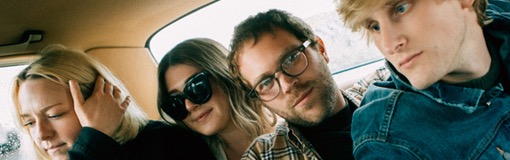
Maybe what we all really need right now is some guitars. In which case, the Minneapolis band Sass is at your service. And we’re not talking mindless, mathematical thrashing. What Sass delivers, guitar-wise, runs the gamut from amiably ringing riffs and sparkly plucking to full-on crunches and delightfully distorted squonks. For the guitar-starved who also likes a good pop song, this is a veritable buffet of aural delight.
And this is indeed a terrific if thoroughly grunged-out pop song, full of melodic spunk, lyrical thrusts, and self-possessed forward movement. And did I mention guitars? Given the fitful ruckus, “11:11” requires a special someone to pull it all together, vocally, and Sass has you covered here too, in the person of front woman Stephanie Jo Murck. Often we speak of a singer’s vocal range in terms of dynamic register, as in how low to how high a voice can go. Murck’s range, alternatively, is tonal, encompassing everything from blasé yearning to full-throated howling, a range that aptly complements the variegated guitar work. There’s nothing show-off-y going on here, which is one of the song’s special powers—the dynamic performances here all hit the ear as matter-of-fact. Murck’s narrator seems to have made a misstep in a fledgling relationship after previously assuring herself she didn’t need anyone to be okay. Now she’s not so sure. It’s a complex circumstance to cover in less than three and a half minutes, and a good part of the complexity is portrayed as much by sound as by words; there’s an “I can’t go on; I’ll go on” vibe in the air. Sporadic moments of chaos convey it; sustained histrionics would ruin it.
You will hear without effort the obvious moments of ramshackle guitar splendor the song has in store for you; let me here draw your attention to a few subtler things this deft band makes happen along the way. There’s the smeary line drawn by one of the guitars from 0:28 to 0:32; the odd group of slightly off notes woven in from 1:17 to 1:20; and the squeal at 1:35, which leads into this lyrical highlight:
I am unreasonable Let me push and Never be pulled But that’s impossible
Murck lets loose on this last line, the guitars screech a while, and then we’re back to a more restrained tone, revisiting the line “I thought I’d be fine alone,” and it somehow hits the ear as especially poignant, perhaps because this time it’s followed by the lines “I’d watch a new TV show/Learn to dance and paint and sew.”
Sass was founded in 2016. After a couple of early singles, they released an EP in 2017 and their first full-length, Chew Toy, last year. You can listen to and buy all their music via Bandcamp. “11:11” was released this month, and is a track from their upcoming album, Heart to Heart. Thanks to the band for the MP3.
I didn’t plan it this way but I see now that this month’s playlist, reacting to the anxiety and insecurity of the current moment, has been populated by many familiar names. Good, solid ones they are: The Smiths, Emmylou Harris, U2; Björk, Depeche Mode, Fiona Apple. The Monkees, for crying out loud. The Zombies, the Cars. Led Zeppelin! The gang’s all here. Not that there aren’t a couple of curveballs too. And in any case, as always, few songs you’re likely to hear on any kind of radio station or playlist at this point, certainly not gathered in one place like this. Do the restrictive policies of mainstream radio stations make any sense at all? Or today’s playlist norms, for that matter? Life may actually end up being literally too short for mindless capitalist repetition, not to mention algorithmic blunders. Which is all to say: join the humans while you still can. Tell another human while you’re at it. Such great, accessible music out there, decades and decades of it, and at best it’s been consigned to playlist silos, and winnowed down to the usual suspects via the web’s mindless, click-based leveling impulse.
All that aside: just as I was finishing this mix, the awful news about Adam Schlesinger sprang onto the internet, further attacking our already beleaguered psyches with a gut-punch of targeted sadness. While I cannot claim expertise in all things Schlesinger—the guy was super-prolific, and worked in a wonderful variety of settings, with a wonderful array of collaborators —I have long since counted Fountains of Wayne among my all-time favorite bands. The lilting, literate dirge that closed the band’s final album provides an apt coda to this month’s playlist. I wish strength and fortitude to Adam’s family and friends following this inconceivable turn of events. Alas, I guess we are all going to need such attributes with us as we move slowly through the grim days that yet lie ahead. Lean on music as you can; it seems unusually able to provide solace. Stay safe and keep the faith….
Full playlist below the widget, and the widget is below the following random bits of explication:
* In among the name brands this month, don’t miss the 21st-century power pop gem that is “The Devil and the Jinn,” from the redoubtable Joe Pernice, and his most recent go-round as The Pernice Brothers, 2019’s Spread the Feeling. All I can say here is wow. And warn you that the song is likely to stick semi-permanently in your head.
* I feel that Portishead’s uncanny take on the old ABBA standard “SOS” went oddly unnoticed, at least here in the U.S. It was recorded for the British film High-Rise, directed by Ben Wheatley and starring Elisabeth Moss and Tom Hiddleston. The film, based on a J.G. Ballard novel, is billed as “dystopian,” which maybe you can ascertain from this version of what had previously been pop fluff. To date this is the last thing this mighty band has released.
* Björk’s Vespertine was released not long before 9/11, and, for me, its gentle, isolated soundscape seemed icily soothing in the uncertain weeks and months that followed. I go back to it here intentionally, given this new crisis, and the ongoing need to find solace and resilience where one can.
* “Cloudburst”: a bit of joy in the middle of it all. I love it when it’s not words but the music and performance itself that brings a smile to the face. We can still allow this to happen, and must.
* Oh and let me once again extol here the awesome talents of the Australian band Middle Kids, who make songs so well-built they all but bring happy tears to my eyes. After a brilliant debut album in 2018 they came back last year with an EP that was just as good. Please check them out if you haven’t yet.
* More tears prickle in the corner of the eyes, for me, at the sheer beauty of Emmylou Harris’s “Michelangelo,” which never fails to move me deeply, that combination of glorious melody and indelible voice. The iconic singer/songwriter turned 73 this month.
* And then just the sadness, as Fountains of Wayne close us out for the month. This piece in the Guardian is one of the best tributes I’ve seen so far.
“This Charming Man” – The Smiths (single, 1983) “He Gets Me High” – Dum Dum Girls (He Gets Me High EP,2011) “Friends of Mine” – The Zombies (Odessey and Oracle, 1967) “It’s Not Up To You” – Björk (Vespertine, 2001) “Enjoy the Silence” – Depeche Mode (Violator, 1990) “The Devil and the Jinn” – Pernice Brothers (Spread the Feeling, 2019) “As The Wind Blows” – Christina Rosenvinge (Frozen Pool, 2000) “Out of the Blue” – Roxy Music (Country Life, 1974) “Cloudburst” – Lambert Hendricks & Ross (The Hottest New Group in Jazz, 1960) “SOS” – Portishead (single, 2015) “Gimme Just Another Try” – Betty Wright (Wright Back At You, 1983) “Love Is Only Sleeping” – The Monkees (Pisces, Aquarius, Capricorn & Jones, Ltd., 1967) “Acrobat” – U2 (Achtung Baby, 1991) “One Fine Summer Morning” – Evie Sands (Any Way That You Want Me, 1970) “Needle” – Middle Kids (New Songs For Old Problems, 2019) “Hots On For Nowhere” – Led Zeppelin (Presence, 1976) “Michelangelo” – Emmylou Harris (Red Dirt Girl, 2000) “Be My Baby” – The Cars (Panorama [outtake], 1980) “Fast As You Can” – Fiona Apple (When The Pawn…, 1999) “Cemetery Guns” – Fountains of Wayne (Sky Full of Holes, 2011)
As we collectively ponder just how to put one foot in front of the other without falling into a pit of grief, recalling a disregarded sense of normal wrenched away from us, let’s take a deep breath. Music remains accessible. It helps. As the hackneyed but undeniable truism reminds us: Don’t look back. You’re not going that way.
So. We’ll take it one song at a time, and “Lesser” is a worthy place to start—a smart 21st-century rocker paved with subtle hooks and accumulated majesty. The throbbing beat set against an unresolved chord in the introduction grabbed me quickly, while the song’s unfolding changes and idiosyncratic twists—most notably the spoken-word pre-chorus (first heard at 0:52; listen to how the melody is implied without being sung)—keep the ear and heart engaged through to the end.
Other impressive moments and touches: the anthemic guitar line appearing at 1:08, and again only at 2:51 (what great restraint to use this only after one particular lyric); the telegraph-signal synth that emerges from the background around 1:38, and gets something of its own solo around 2:27; the unexpected percussive effect at 2:39; the wonderful squiggle of a synth solo in the coda (beginning at 3:26).
Thrillhouse is a trio based in Brighton. “Lesser” is their second single, released earlier this month. Thanks to the band for the MP3.
A long-standing Fingertips favorite, the duo Wye Oak continues to produce music that feels effortless and compelling. Despite my general familiarity with their history, each new recording of theirs manages to hit my ears in unexpected ways. “Oh,” I end up saying to myself, “that’s what they sound like this time.”
The ongoing constant is Jenn Wasner’s voice—smoky, yearning, articulate, unyielding. We begin in a sparse setting, devoid of time signature, just Wasner and a few piano chords. This is striking as an opening salvo—not a standard introduction, it is in fact the song’s first verse, waded rather than plunged into. We end up in the middle of the first verse without quite realizing how we got there—perhaps an apt mirror of how someone afraid of heights has to trick herself into making the upward journey.
As the song develops lyrically, the ostensible subject transforms into a metaphor about the difficulties and rewards of a long-term relationship. The idea of being afraid of heights is, I think, easier to grasp and/or acknowledge as a physical concept than as an emotional one; as such, linking the two informs both sides of the challenge.
A potentially weighty concept? Maybe. And yet handily presented at a pop-perfection length of 3:34, gliding forth with a gratifying momentum that feels at once circular and syncopated. Building off its piano-based opening, the song juxtaposes verses with musical space between lyrics against a declarative chorus, offering one thought: “You say it’s worth it for the view.” Wasner’s self-harmonies add gorgeous texture. A bridge section intervenes with a cascade of phrases pivoting around the recurring sentence “I am a woman.” It is mysterious and powerful. To top it off we get a Bowie-like saxophone (or sax sound, in any case) playing the song out from 3:00 onward.
Wye Oak has lately been releasing singles in lieu of albums. “Fear of Heights” came out in January, more recently available, via KEXP, as a free and legal MP3. Their latest single is “Walk Soft,” available via Bandcamp. This is the band’s fifth feature on Fingertips, dating back to 2008.
If you happen to know that Hamilton Leithauser is the lead singer for the perpetually underrated New York City band The Walkmen, you may also happen to know that he doesn’t usually sound like what you hear when “Here They Come” starts. Typically Leithauser presses against the upper range of his vocal register, with a scuffed-up sort of zeal that does battle with the band’s bashy atmospherics.
This starts as another thing entirely: we hear a growly baritone, accompanying a finger-picked guitar. This goes on for 35-some-odd seconds, at which point, if you listen carefully, something in the background lightens up—you can kind of hear a higher vocal harmony in the distance, and the elusive sound of maybe a melodica? Then, just after his voice turns growliest, on the lines “all my candy’s gone” (1:02), bang: Leithauser converts to his familiar upper register, the music acquires a ramshackle beat, and off we go into the epitome of a sing-along chorus. This is, I feel, impossible not to like, but maybe that’s just me.
The verse returns at 1:26, now swinging along in the song’s revised setting. Leithauser’s transformed voice, just this side of hoarse, is for me the source of the song’s deepest charms—despite the tale of woe recorded here, something about a friend who can’t cope with the messy realities of life, the music’s effervescence coaxes a smile. Maybe that’s the point.
From the album The Loves of Your Life, released last month. MP3 again via KEXP. Note that the Walkmen have been on hiatus since 2014 but have not officially broken up. Old-timers may remember that that the band have been featured twice on Fingertips, in 2004 and 2008.
Music however remains something we can all access, and something that may be more necessary than ever. Music is about human connection (sorry, robots!), and operates across space and time–surely helpful treatment in the face of the disconcerting and unprecedented current circumstances. This month’s playlist wasn’t constructed with our abrupt new collective lifestyle in mind but it’s somewhat suggestible, from stalwart attempts to remain hopeful–cf. Lindsey Buckingham’s soaringly catchy “In My World” and Ian Dury’s evergreen, smile-inducing classic “Reasons to Be Cheerful, Part 3”–on through Pet Shop Boys timeless lament (complete with a star turn from Dusty Springfield) and Norah Jones’ plainspoken, open-ended final word this month.
If you enjoy this sort of mixed-genre playlist, don’t forget there are dozens of similar (but different!) mixes available via my Mixcloud page.
Full playlist below the widget; widget below the following bonus explanatory notes:
* As ubiquitous as Dionne Farris was for a while there back in the ’90s, between her featured vocal on Arrested Development’s “Tennessee,” her big solo hit “I Know” in 1994, and a variety of high-profile soundtrack placements, she has had a very low 21st-century profile. It’s kind of great to hear the big hit again.
* Speaking of someone else with a history of laying low musically, Canadian singer/songwriter/activist Sarah Harmer released an album last month that was her first since 2010’s Oh Little Fire. I’m still absorbing the new one; here in the meantime is the terrific single that emerged from the last one.
* I am not often a fan of Baby Boomer musicians putting out new music after a long absence, and this album featuring Lindsey Buckingham and Christine McVie, from 2017, wasn’t stellar from top to bottom, but the song “In My World” is a wondrous thing that just didn’t really capture a lot of attention at the time. But any song is new that you haven’t heard before.
* Sam Phillips has long been among my uppermost favorite singer/songwriters, as much for her literate, borderline spiritual lyrics as for her musical inventiveness. On the Beatleseque Martinis & Bikinis album, produced by then-husband T Bone Burnett, “I Need Love” stands out to me as one of the best-ever Beatlesque songs because in my mind it’s one of the best-ever songs of any kind. Gorgeous, concise, mysterious, memorable.
* If you’re of a certain age and/or a fan of Americana music, I heartily recommend the new Robbie Robertson documentary, Once Were Brothers. Yes it is a history of the Band seen pretty much only through Robertson’s eyes, but what a compelling story, and what historic and evocative music. After enjoying the movie, I couldn’t resist throwing a Band song into the mix this month, and went with one of the deeper tracks, from their near-mythic debut album, Music From Big Pink.
“Genesis” – Jorma Kaukonen (Quah, 1974) “Romance” – Great Aunt Ida (Nuclearize Me, 2011) “Revenge” – Ministry (With Sympathy, 1983) “One of These Days” – Jill Sobule (Pink Pearl, 2000) “Mi Chiquita Quiere Bembé” – Tito Puente (Lo Mejor De Lo Mejor, 1958) “I Found Out” – John Lennon (John Lennon/Plastic Ono Band, 1970) “I Know” – Dionne Farris (Wild Seed – Wild Flower, 1994) “In My World” – Buckingham/McVie (Lindsey Buckingham Christine McVie, 2017) “Why” – Gina Villalobos (Rock ‘n’ Roll Pony, 2005) “Reasons to Be Cheerful, Part 3” – Ian Dury & The Blockheads (single, 1979) “Ferry Cross the Mersey” – Gerry & The Pacemakers (single, 1964) “I Need Love” – Sam Phillips (Martinis & Bikinis, 1994) “Take My Heart” – Kool & The Gang (Something Special, 1981) “Captive” – Sarah Harmer (Oh Little Fire, 2010) “We Can Talk” – The Band (Music From Big Pink, 1968) “Never You Mind” – Semisonic (Feeling Strangely Fine, 1998) “What Have I Done to Deserve This?” – Pet Shop Boys feat. Dusty Springfield (Actually, 1987) “Good Girl” – Astrid Swan (Poverina, 2005) “If They Left Us Alone Now” – Wool (Wool, 1969) “Uh Oh” – Norah Jones (Begin Again, 2019)
Researchers from Georgia Tech have created a robot called Shimon that can write songs, play music, and sing. The marimba-playing robot is going on tour to support a new album that he has composed and sings.
Slashgear.com, Feb. 26, 2020
Among the many and varied innovations that digital technology has brought into our lives is an increasing capacity to produce various types of content in a variety of automated ways. Some of this is as (seemingly) innocuous as Gmail’s “Smart Reply,” which generates responses to emails; others are provocative, such as the “Bot or Not” web site, which challenges you to figure out whether a poem was written by a human or a computer. Visual imagery is another area in which computers have been turned loose to create what some may call “art.”
And then there’s the land of sound, where the computer’s increasing ability to generate music, versus merely assist in its composition and production, presents a deep and murky Pandora’s box of issues, from the artistic and the financial all the way to the ontological. Shimon, the singer/songwriter robot, was inevitable.
As we have collectively become at least a little warier of techno-utopianism than we used to be (thanks, Facebook!), discussions of how computers can create things that previously only humans could write, draw, paint, compose, or otherwise design and produce seem now to take a stance somewhere between the gee-whizzy and the maybe-slightly-concerned—as in, “Wow, look at what computers can donow, or very soon!; I guess we better get used to it?”
Regardless of any given commentator’s assessment of computer-generated writing and artwork and what the future may hold, the one thing everyone holding forth on this topic has in common is a relentless focus on surface output. Discussions are framed around whether an image looks like something a person might have created, whether a poem might be mistaken for something a person might have written. Mimicry is posited as the goal.
What is ignored when considering computer-generated content, of all kinds, is that human-generated art is never simply about the surface of what has been created. The point of a poem isn’t the manifest reality of one word placed after another on a page, it’s that the words were put there, consciously, by a human being with a life history, with connections to and relationships with other human beings, and with an awareness, both instinctive and unique to each person, of the excitement and the fragility of organic existence. Human beings inherently, inescapably bring depth to artistic output; one could argue that that is in fact the whole point of artistic output: the reaching of one individual consciousness towards another, or an audience of others.
Machines programmed to generate output that looks like something a human might have written (or painted, etc.) achieve their task based on massive computational capacity—typically, artificial neural networks designed to mimic, in a limited way, the neural networks at work in the brain, as far as science understands them (which is an incomplete understanding at best). There is nothing resembling “thought” and even less here resembling “feeling” in what the computers are doing to generate these poems or images or songs. Which means that, inherently, there is no depth to it; it’s all surface.
Georgia Tech can happily post a video of Shimon the robot’s “song”—here, if you must: https://www.youtube.com/watch?v=sHl-Cg2KDbg—and, sure, it (kind of) sounds like a normal song. But is that all that music is: sound? Is all we’re hearing when we hear a song simply a sequence of notes, and a series of words?
The same, but different
Let’s try a thought experiment, which at this point doesn’t sound far-fetched. Let’s say that a computer programmed to produce poetry ends up generating a poem that is, word for word, what a human poet somewhere on earth has in fact written. (Maybe this has already happened!) On the surface, the identical words. Underneath: very different. To pretend that the computer’s poem, regardless of its word-for-word match, is the “same” as the human’s is to conflate surface with depth. The human poet dives into their inner world, choosing words to communicate thoughts and feelings—thoughts and feelings that are rooted in the reality of being a thinking, feeling human being who lives and breathes and eventually dies, a human with a family of origin, with a network of friends and loved ones, with a sexual drive and egoic demands, a human who daily struggles with the reality of the aforementioned fragility of human existence. (I re-emphasize this last part because it seems overlooked when considering whether computers can produce human-like art. )
The “gee-whizzy but also worried” folks who confuse the surface of computer-generated content with the depth of art produced by human beings are misdirecting you from the actual trick being performed here. Because the trick isn’t that a computer can write poetry, the trick is the sleight of hand employed to assure us that the surface of the end product is all that matters. Once you buy that, sure: a computer is writing poetry.
But we shouldn’t buy that. Depth is everything here, and nothing that a computer can offer. And note that while the depth inherent to a work of art begins within the consciousness of the artist, it by necessity ends within the consciousness of the observer sensing this depth-to-depth connection. Whether you are aware of it or not, what most engages you, when you look at a painting, or read a short story, or hear a piece of music, is the bridge that any work of art creates between the consciousness of the artist and the consciousness of the viewer/reader/listener. The communication is implicit, even if the art work often prompts more questions than answers. But as the viewer/reader/listener, the reality that another human has reached inside their being to create something that they want you to experience is, in the end, as noted, the purpose of art. And it’s what computer-generated content cannot, by definition, provide.
This missing element of one human seeking contact with another is, perhaps, what underlies that “uncanny valley” sensation that people talk about when encountering an object that seems nearly human but also off in some disconcerting way. Or, for you Philip Pullman fans, think of how the humans in His Dark Materials are instinctively repulsed by the reality of a person walking the earth without their daemon. Computer-generated art or writing creates the appearance of soulful enterprise minus the soul. It should repulse us.
And let me make it clear that I’m not talking about the use of computers to assist in art-making. At that level, the computer is another tool, and a powerful one at that. I’m talking about the concept of the computer creating the art on its own, via programming that removes all direct human input from the end result.
Now then, in a world in which people interact with content in a rapid-fire, look-share-and-forget kind of way, the essential difference between computer-generated and human-generated content may end up unnoticed or disregarded. If so this will be a symptom of a culture that is losing ts capacity for any sort of interior reflection, and with it the desire to seek genuine contact with one another.
The point at which human writing and computer writing become indistinguishable on the surface may mark an inevitable moment in technological development. The question is whether we will have the resolve required to stay informed—to demand transparency in our content sourcing much as we have been learning to know where our meat and produce come from. I contend this will always matter, but am not all that optimistic that the average American, ever intoxicated by convenience, will agree with me.
The ineffable connection
Music actually presents a bit of a special case, because, in a way, we’ve been confronting a related surface-versus-depth issue in the music world for quite a while, long before Shimon came along. Because whether or not we are dealing with computers writing music themselves, we’ve had a corresponding circumstance in the context of sound generated via digital programming versus human hands on physical instruments.
Another thought experiment: program a computer to generate the exact sound of Kenneth Pattengale, of the Milk Carton Kids, playing lead guitar, and then record Pattengale actually playing. These two recordings may be impossible to tell apart. But they are different. The pleasure of Pattengale’s guitar-playing is intimately tied to the knowledge that a human being is producing these amazing sounds in real time and real space. (This is why watching him play versus simply listening to the sound intensifies the joy of the experience.) You don’t have to know Pattengale personally to sense the ineffable connection between performer and audience when you are witnessing his physical effort (which by the way he makes look effortless). Note, however, that you don’t have to see him playing; as long as you know an actual person was playing an actual guitar, the effect on the listener is real.
This is why the “Look: a computer can do the same thing!” framework is dishonest. In an age of consummate computer-generated mimicry (“deepfakes” represent the malicious end of this spectrum), being able to tell, merely by looking or listening, whether a computer produced something or not becomes a false benchmark of validity.
And yes, there certainly exists a lot content in our information-saturated world that requires, for its creation, nothing beyond surface input, content that can therefore if necessary be produced without concerns about lack of depth. I’ll be sorry to know that this may cause human beings to lose their jobs in various arenas, but, sure, send the robots in there and let them do their thing if they must. Just stop writing poetry please. And, dear god, no singer/songwriter tunes. I mean, a human creating art via the filter of his or her own psyche and history, versus a computer “studying” thousands of songs to learn to produce human-sounding lyrics: which would you rather spend your human life listening to?
Truth be told, this is one of the main reasons why I resist the urge to use Siri or Alexa, above and beyond the privacy issues. When I talk to someone, I want to hear, in return, a voice attached to the baked-in reality of conscious human life, with all its history and emotions and frailties. To hear words spoken based on algorithms and machine learning leaves me feeling not spooked but profoundly sad. When Forster said “Only connect,” he didn’t have a USB cord in mind.
And what of the day when computers themselves are in some meaningful way sentient? Oh, don’t get me started. I don’t personally believe that a construction of metal and plastic that ultimately bases its experience on an on-off switch of 0s and 1s, a machine lacking the innate awareness of its tissues’ organic fate—because it has no tissues and no organic fate—can ever be sentient in a way that equates to human consciousness. When computer “consciousness” arrives—if it arrives—it will be its own territory (located, no doubt, somewhere in the uncanny valley). How much you might or might not be interested in learning about and hearing from this new kind of consciousness will be yours to determine.
Me, I’m sticking with the humans. They still have so much to say and I so much to learn about this existence of ours, fated to decay and disappear, and yet requiring neither a plugged-in power source nor ever any operating system updates. Our eventual deaths, to borrow Silicon Valley promo-talk, turn out to be not a bug but a feature. A defining component of our consciousness, this knowledge of our own mortality is what undergirds our artistic inclinations, and, paradoxically, fills our lives with the capacity for profound meaning and connection. The smartest computer in the world will never know what this is like. I don’t need it to write me a poem or sing me a song.
“New Year, New Me,” already pithily arranged, strips down even further, shortly after the halfway point, allowing front woman Haley Shea to draw attention to the following lyrics:
I keep playing my own therapist
And I’m convinced I’m good at it
Packed into these lines is the layered theme of this appealing midtempo rocker. With a blasé crispness suited to the matter at hand, Shea initially sings of the inevitable disappointments of unfulfilled new year’s resolutions. But this isn’t a cynical pity party. If, yes, we annually set ourselves up for failure by making new year’s resolutions in the first place, then maybe this inevitability is itself worth pondering. Most of us want to be better people but at some point have to confront the reality that you don’t get there via new year’s resolutions. Being convinced that one can be one’s own therapist is a poignant part of the wistful predicament, but recognizing that this is what one keeps trying to do is, maybe, a first step towards actual change. And maybe approaching the self with compassion rather than reproof offers a new hope, having nothing to do with making fated-to-fail “resolutions” (a word Shea does not in fact employ here).
So yes I guess every now and then I am engaged by a song’s lyrics, however much that is not normally the case for me here. As for the music, the first thing I like a lot is the laid-back lead guitar line, which comprises the introduction: it’s concise, melodic, and self-assured. The verse unfolds so casually as to seem spontaneous, with a couple of nicely-placed chord changes (e.g., 0:25), then launches into the chorus on a riff itself so understated as to be nearly nonexistent (0:37)—a musical reinforcement, perhaps, of the self’s predicament here: does stasis make change impossible, or is there some oh-so-gentle way to accept the self that can lead to transformation?
Sløtface is a band based in Stavanger, Norway. Although consistently identified as a punk pop (or a pop punk; is there a difference?) band, Sløtface (original name Slutface, and that’s still how you pronounce it), presents more accurately as a band that knows how to write and perform crafty, accessible rock songs, their guitar-laced volume consistently tempered by musical know-how and Shea’s approachable vocal style. Note that Shea has American parents, but grew up in Norway; the band’s other three members are Norwegian. “New Year, New Me” can be found on Sløtface’s new album, Sorry For The Late Reply, released late last month via Nettwerk/Propeller Recordings.
The oddly inviting instrumental “Home Shore Highlights” intermingles the organic and the electronic with idiosyncratic aplomb. Listen, for instance, to how the synthesizer takes the lead at some moments, a homely glockenspiel at others. The overall effect is a singular type of unsophisticated sophistication—it feels both homespun and skillfully assembled. On the one hand, the song is little more than a variety of recurring, related melodies on top of an unhurried tropical beat; on the other hand, things feel ongoingly off-kilter and endearing. As different sounds take turns in the spotlight, one consistent underlying element is the hands-on percussion, mixed with a bashy spaciousness that adds three-dimensionality to the aural landscape.
What might be the song’s signature moment, if not an actual hook, is that repeating place in the unfolding melody in which we get an even-tempoed march up the scale: a full, eight-note ascent that, in fact, occurs in pairs—when it happens once, it happens again a few seconds later (first at 0:43/0:51). Once this progression gets in your head, you tend to anticipate it in a variety of spots in which it doesn’t show itself. This makes its final appearance, at 3:04/3:12, seem particularly gratifying
“Home Shore Highlights” is the first single available from Rain Patch, the second Rewilding album, which is due out in April. Rewilding is masterminded by the Philadelphia-based musician Jake McFee, who wrote and recorded the bulk of the album in Glacier Bay, Alaska, where he decamped for a few summers starting in 2017.
You can pre-order the album (digital, vinyl, cassette) via Bandcamp.
A balm to the jangled-nerve world of 2020, “The Only Ones” is two guitars and two voices, all four elements interlacing with masterful ease. The end result is a song at once gentle and sturdy, with a lullaby-like loveliness that helps nudge the lyrics over the edge from despair into something closer to hope. Weirdly enough, I’m hearing an almost Springsteen-esque conviction at the center of this un-Springsteen-like composition, something maybe in the mettle of the chorus’s descending melody, and its ambiguous but stirring lyrics.
The Milk Carton Kids are the duo of Joey Ryan (the tall one) and Kenneth Pattengale (the shorter one). Known for their impressive guitar skills, consummate harmonizing, and amusing stage banter, the Kids have, since 2011, been almost single-handedly in charge of keeping the time-honored “singing duo” concept alive in our 21st-century musical awareness. Written accounts of the Kids turn inevitably to talk of Simon & Garfunkel and the Everly Brothers, both of which have no doubt influenced these guys. But to me, the back-in-the-day musicians the Milk Carton Kids evoke far more directly is the duo Aztec Two-Step, who featured not only the gorgeous harmonizing but, crucially, the interplay of twin acoustic guitars, including some virtuosic finger-picking.
If you by the way have some time on your hands you could do much worse than to watch the Milk Carton Kids concert DVD, “Live from Lincoln Theatre,” which is streaming on YouTube. Pattengale’s facility as a lead guitarist is all but miraculous, and is almost as much of a visual treat as an aural one.
“The Only Ones” is the title track to the most recent Milk Carton Kids recording, an EP released this past October. MP3 via The Current.
(MP3s from the Minneapolis public radio station The Current are available in files that are 128kbps, which is below the established 192kbps standard, not to mention the higher-def standard of 320kbps. I personally don’t hear much difference on ordinary equipment but if you are into high-end sound you’ll probably notice something. In any case I always encourage you to download the MP3 for the purposes of getting to know a song via a few listens; if you like it I as always urge you to buy the music. It’s still, and always, the right thing to do.)